


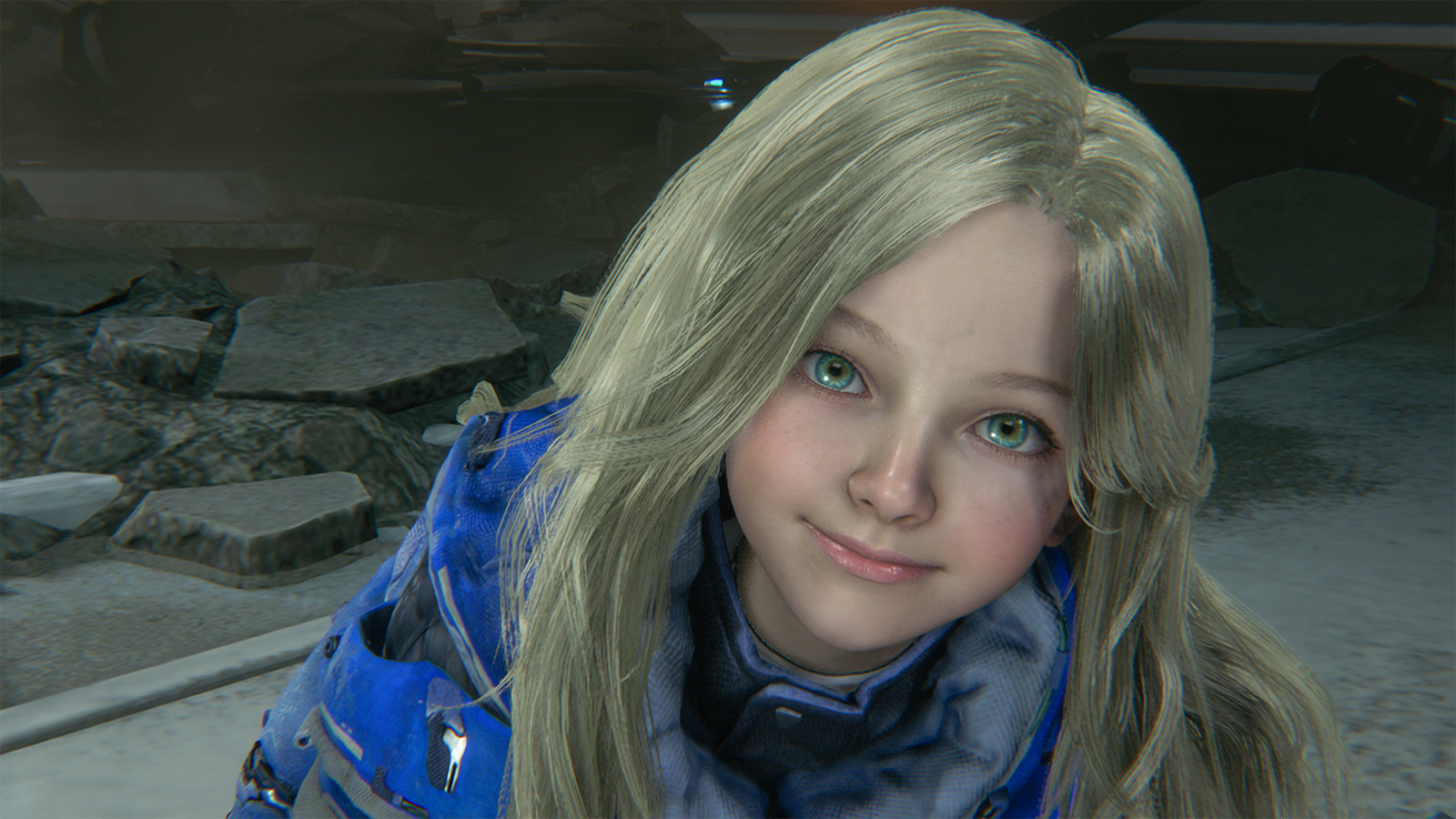
The premise of Pragmata may seem utterly unfathomable right now so I’ll try and break it down for you: an evil AI takes over a lunar research station, and being evil, it tries to eradicate our human protagonist Hugh and his android companion Diana. Ok, that’s actually pretty fathomable right now.
Funnily enough, the hardest part of bringing an evil AI to life was mimicking what the world it inhabited would actually look like. “It mirrors reality, but its unique appeal comes from the setting errors and how they feel out of place, such as taxis sinking into floors, or buses sprouting from walls,” producer Naoto Oyama says in an interview with 4Gamer (via Automaton). “Although the premise is that it generated by AI, actually, our human developers painstakingly worked to incorporate mechanisms that express this AI-like uncanny feel.”
(Image credit: Capcom)
The infected lunar base has all of the above. With glitching billboards showcasing generic advertisements for burger joints or cars, it all just looks a bit off, as it should. “For Pragmata, we set the premise as ‘a fake New York generated by AI,'” director Cho Yonghee adds. “When familiar locations appear, players can relate more easily. On top of that, to make it clear that this isn’t the real New York, we wanted something slightly distorted.”
Article continues below
You may like
Cho continues that the focus was on recreating “AI errors” which you’d usually see in AI generated art. You know, the classic six fingers, inconsistency, and general slop that we’re used to seeing in whatever an AI tool vomits out.
It seems like an easy enough task, but the reality is vastly different. Weirdly, recreating these errors can be difficult, not only because human artists simply know better but because too many mistakes or errors could potentially be misinterpreted by players.
“Distortion is when something takes a shape that people have never seen before, and things unseen before are considered unique,” Cho says. “But if the shapes are too unusual, players might think they’re related to puzzles or that the terrain has some hidden meaning. Balancing distortion to be both unique and merely background was difficult.”
So there you have it, recreating the slop that AI shits out is, in fact, quite difficult. Not for lack of any skill, mind you, but because mimicking stupid when you’re not is harder than it looks.
