


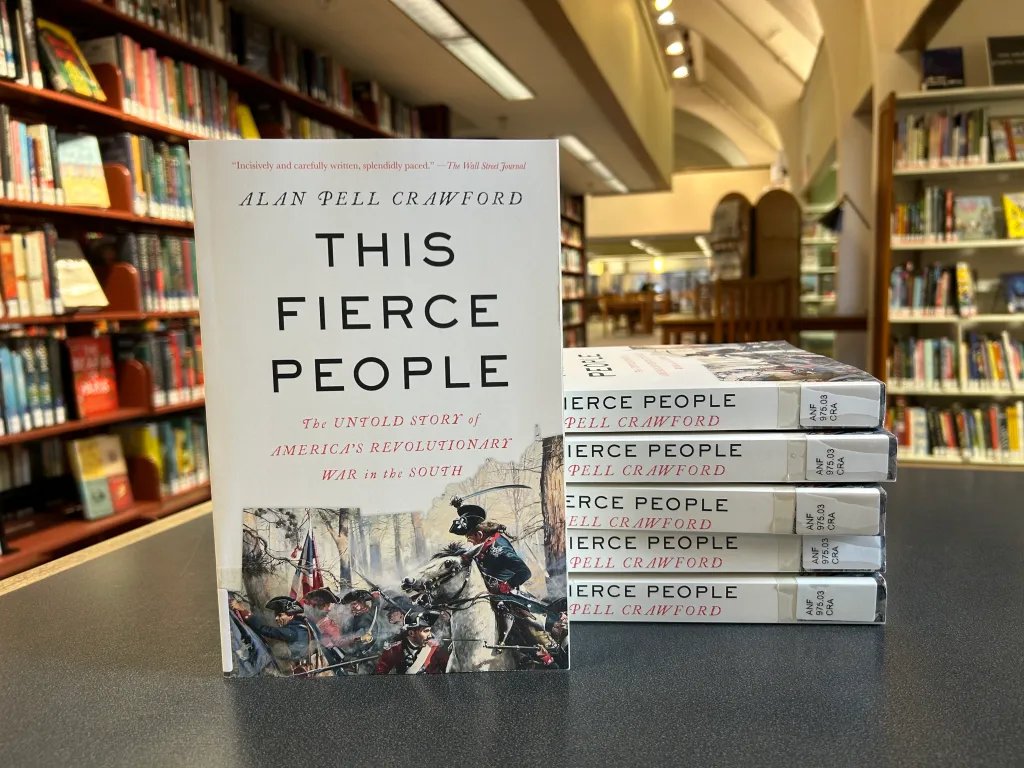
WILLIAMSBURG — Historian and author Alan Pell Crawford will present a lecture on his most recent book at the culmination of a monthlong reading program in Williamsburg.
One Book One Community is an annual event that encourages the community to read a socially relevant book and discuss it. Throughout March, the Williamsburg Regional Library, in conjunction with the William & Mary Libraries and the Friends of WRL Foundation, has been encouraging the community to share reading experiences through a series of talks and discussions.
Crawford’s book, “This Fierce People: The Untold Story of the American Revolution in the South,” is this year’s featured book. He is scheduled to speak at 7 p.m. on March 24 in the Williamsburg Library Theatre on Scotland Street.
Author Alan Pell Crawford is scheduled to speak at 7 p.m. on March 24 in the Williamsburg Library Theatre. (Williamsburg Regional Library)
The journalist and author has written four books, including “Twilight at Monticello: The Final Years of Thomas Jefferson,” a Washington Post bestseller, and a host of articles and essays for The New York Times, The Wall Street Journal, The Washington Post and National Review. “This Fierce People” won the American Battlefield Trust’s 2025 book award.
“We’re excited to invite our community to read ‘This Fierce People’ and discover a side of the Revolutionary War that many of us haven’t heard before,” said WRL director Sandy Towers in a news release. “As we commemorate the nation’s 250th anniversary, this year’s One Book One Community program gives us a meaningful opportunity to welcome new perspectives into the story of our founding.”
Next week features five programs in the One Book series. All are free and open to the public.
• Today, a book discussion at 11 a.m. at the James City County Library on Croaker Road.
• On Monday, Mike Steen of the Watermen’s Museum in Yorktown will give a talk titled “The War on the Chesapeake” in the Williamsburg Library Theatre at 7 p.m.
• On Tuesday, a discussion will take place at 6:45 p.m. in the Williamsburg Library during the Turning Pages Book Group.
• On Thursday, another discussion of the book will take place at 2 p.m. with the Real People, Real Places Book Group at the Stryker Center.
• Also Thursday, Harvey Bakari of the Jamestown-Yorktown Foundation will present a talk on African American life during the Revolution at 7 p.m. at the Williamsburg Library Theatre.
Crawford’s “This Fierce People” puts the war into perspective and demonstrates that without fierce battles and fierce people, there might not have been a Yorktown battle at all.
“Mr. Crawford’s account is incisively and carefully written, splendidly paced, and supported by mine of primary and secondary sources,” Barton Swaim said in a Wall Street Journal review. “’This Fierce People’ is military history in an older tradition, in which the outcomes of great conflicts depend on the foresight, character and courage of individual men.”
Crawford, who lives in Richmond, said he became interested in pursuing the Southern campaign of the war when he realized the “much of the focus on the war involves Lexington and Concord and Valley Forge. Suddenly, the war seems to jump from Valley Forge to Yorktown and three years are completely forgotten.”
“I’m a better author than historian,” Crawford said during a phone conversation earlier this week. Many historians have looked at the Revolutionary War “through the eyes of George Washington and he was in the North. He didn’t come south until Yorktown. That’s why the Southern fighting was largely overlooked.”
Maj. Gen. Nathanael Greene, Washington’s commander-in-chief in the South, “was given full charge,” Crawford said. “Washington indicated to him that he did not know the available troop strength, nor the disposition of the troops but that he had confidence in Greene and his ability.”
In examining the Southern battles that focus on British Gen. Charles, Lord Cornwallis’ strategy in South Carolina and North Carolina, Crawford found “wonderful stuff,” such as the Battle of Cowpens in northwestern South Carolina, which is compelling reading.
Morgan — “a totally self-made man” — was the colonial rebels’ leader at Cowpens, where Lt. Col. Banastre Tarleton and his British Legion suffered a major defeat. Morgan’s troops of militia and area volunteers were enhanced by some of the “Overmountain Men,” who contributed to several earlier battles.
Another often overlooked leader was Marion, a backcountry farmer whose desire for adventure outweighed his agriculture needs. He and his recruits became best known as guerrilla fighters, whose tactics outflanked British military actions, Crawford’s account explained.
“Crawford’s narrative makes it easy to see how this American adventure, full of hardship and glory, was the start of something big,” according to Robert W. Merry in his Modern Age account of little known “campaigns (that) made victory possible.”
Wilford Kale, kalehouse@aol.com
