


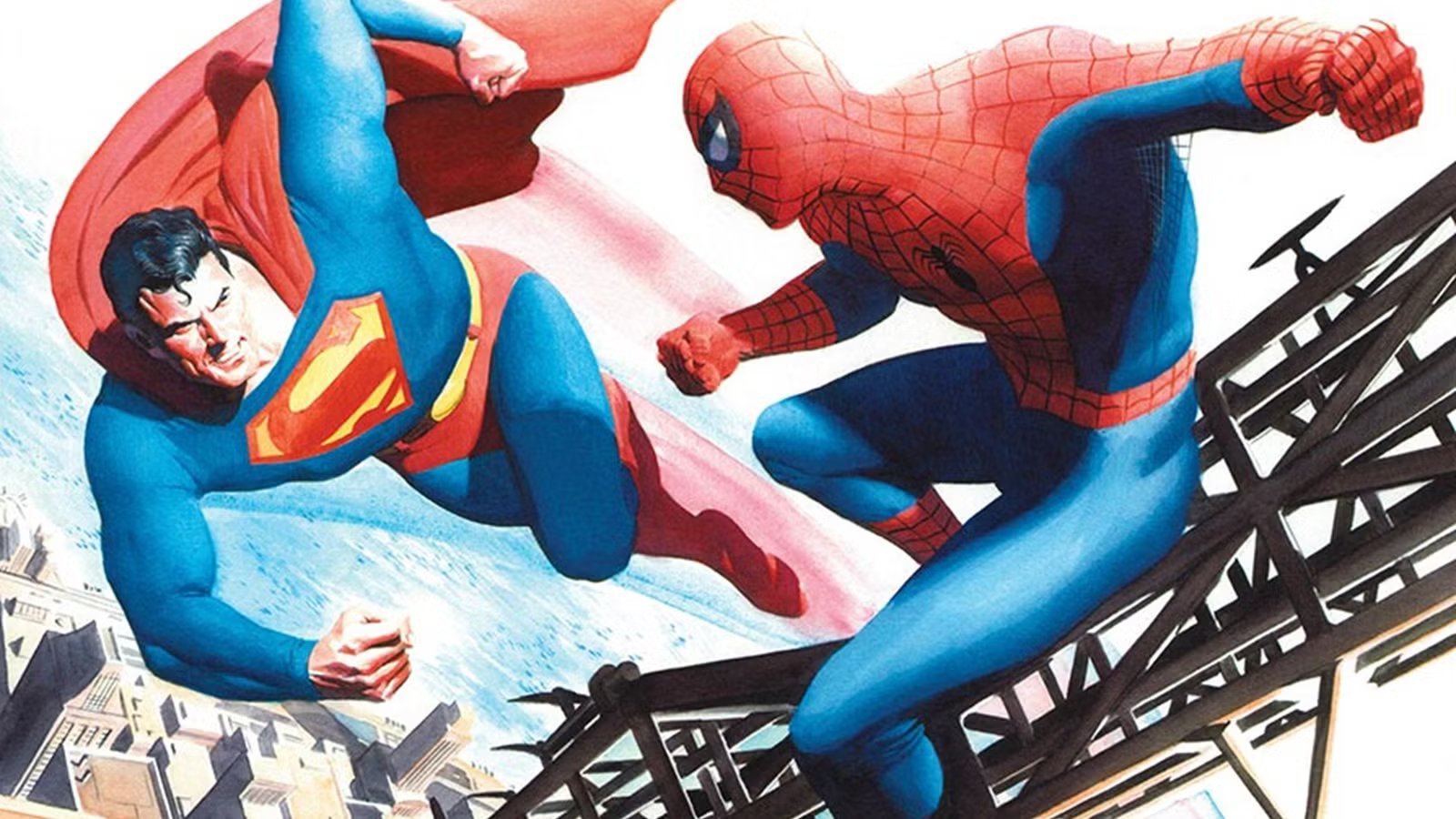
In every Look Back, we examine a comic book issue from 10/25/50 years ago (plus a wild card every month with a fifth week in it). This time around, I head to January 1976 for the first meeting between DC and Marvel’s superheroes.
Last year, I noted that DC and Marvel acutally had their first crossover in 1975, as the two companies came together under unusual circumstances to jointly publish a comic book adaptation of The Wizard of Oz. Both companies had the rights to one aspect of The Wizard of Oz (DC had the rights to the movie, while Marvel had the rights to the original book), so they figured that it made no sense to compete with each other with competing one-shots, and instead decided to simply do one one-shot together.
Now, you would think that that would suggest that working on that comic book began them on the road to working on ANOTHER joint project, but in reality, the discussions for what became Superman vs. The Amazing Spider-Man began years before that, in 1974, when the agent, David Obst, pitched the idea to Marvel and DC, and more specifically, to Stan Lee and Carmine Infantino.
Due to the fact that he had been a working artist for decades before he got the top job at DC in the late 1960s, Infantino had a slightly different relationship with Stan Lee than other heads of DC, as he had actually worked with Lee on some comics over the years (Lee had actually tried to recruit Infantino to Marvel in the late 1960s due to his skills as an artist, which is likely what led DC to keep him by giving him a promotion to their head editor). So they were very close friends, which made the project happening a lot more realistic than at any previous point in comic book history.
At that point in history, there really was only one writer and one artist who had worked on both Spider-Man and Superman’s comic books, and that was Gerry Conway and Ross Andru, so those two became the creative team on the book, with Dick Giordano doing the inking, Jerry Serpe doing the colors, and the legendary Gaspar Saladino doing the lettering. The result was published as an oversized comic book magazine in January 1976.
What was the unusual aspect of Ross Andru’s art on the issue?
You see, since Dick Giordano was inking the book, that meant that the pages would be sent to his offices as Continuity Studios, the commercial art studio that Giordano ran with Neal Adams. When Adams saw the pages before Giordano inked them, Adams actually began to re-draw Superman on the pages.
Giordano explained it to my buddy, Daniel Best, years ago:
No one asked Neal to re-draw the Superman figures but the pages were sent to me at Continuity and were mostly left on my desk or thereabouts when I went home at night or on weekends and Neal took it upon himself to re-draw the Superman figures without telling me that he was going to do it. I didn’t complain but I also never mentioned it to anyone at the time and really never spoke of it until now…mostly out of respect for Ross and his work. Ross was one of the very best storytellers in the business as well as great at composition, layouts and design. But his drawing was a bit quirky and somewhat distorted as a result of an eye problem that affected his perception. He often drew on one side of the paper, then, on a lightbox, turned it over and re-drew it on the other side, correcting the distortion, then reversed the page again and traced the corrected version from the back side of the art board onto the copy side. This took a great deal of time and slowed him down greatly toward the end of his career. But…
I loved the distortions! It gave his work a charm and distinction that I always believed was appealing. I learned how to ink his work to minimize the distortion without losing the charm! That became moot, as Neal changed/corrected all the Superman figures to his own frame of reference. I tried in the inking not to lose too much of the Ross Andru look ( and to his credit, Neal tried, as well, to retain the “look” mostly correcting anatomy errors in his re-drawing ) . You really couldn’t lose his storytelling or compositions, so in my mind, the result was still Ross Andru at his best!!
Image via DC and Marvel
I doubt many fans even really noticed much of a difference at the time. John Romita did more straightforward re-drawings of Spider-Man (Romita’s were more plainly done, as Romita would frequently make corrections to pencils when he felt them necessary on Marvel Comics of the era).
What was the plot of the crossover?
The issue opened with Superman foiling a Lex Luthor plot…
Image via DC and Marvel
and then Spider-Man foiling a Doctor Octopus plot (these stories were oddly intensive, as Spider-Man gets knocked out by Doctor Octopus earlier in the story, only to come back and defeat him later after using a Spider-Tracker on him)…
Image via DC and Marvel
So, yes, we did, indeed, just get THIRTY PAGES into a crossover comic before the heroes actually crossed over. It was sa long Superman introduction, and then a long Spider-Man introduction, and after they were introduced, we even got one-page “explainers” for each of the heroes to explain their backgrounds! Who was picking up this comic book who didn’t know who Superman or Spider-Man were?
Luthor and Doctor Octopus then team-up. Note that even the comic is calling all of this PROLOGUE! It’s 35 pages of PROLOGUE!
Image via DC and Marvel
Okay, so Clark Kent and Lois Lane and Mary Jane Watson and Peter Parker are both at a news conference announcing a special satellite that can affect weather patterns on Earth. Luthor pretends to be Superman, and kidnaps Lois Lane and Mary Jane Watson (he was just trying for Lois Lane, Mary Jane was taken just because she was nearby). This makes Spider-Man think Superman just kidnapped his girlfriend, and Superman, being biased by Spidey’s negative press, each think the other is responsible, and we get this amazing double-page spread…
Image via DC and Marvel
Luthor and Doctor Octopus then use a red sun generator to make Superman weaker, and Spider-Man stronger, allowing Spider-Man to hang with the Man of Steel for a bit…
Image via DC and Marvel
However, when it wears off, Superman almost kills Spider-Man, pulling his punch at the last minute, and STILL sending Spider-Man flying…
Image via DC and Marvel
Spider-Man then almost breaks his hands punching Superman (this recently led to a joke that perhaps JIm Lee was homaging this moment in his recent Superman/Spider-Man variant cover), and the two heroes decide to just work together to stop Luthor and Doctor Octopus (who have hijacked the weather-controlling satellite)…
Image via DC and Marvel
After various shenanigans (including Doctor Octopus turning on Luthor when he learns that Luthor plans on destroying large chunks of the world with the weather machine), the heroes save the day together…
Image via DC and Marvel
Clark Kent and Lois Lane then double-date with Peter Parker and Mary Jane Watson.
And a long hisstory of DC/Marvel crossovers had begun!
If you folks have any suggestions for February (or any other later months) 2016, 2001, 1976 and 1951 comic books for me to spotlight, drop me a line at brianc@cbr.com! Here is the guide, though, for the cover dates of books so that you can make suggestions for books that actually came out in the correct month. Generally speaking, the traditional amount of time between the cover date and the release date of a comic book throughout most of comic history has been two months (it was three months at times, but not during the times we’re discussing here). So the comic books will have a cover date that is two months ahead of the actual release date (so October for a book that came out in August). Obviously, it is easier to tell when a book from 10 years ago was released, since there was internet coverage of books back then.
