


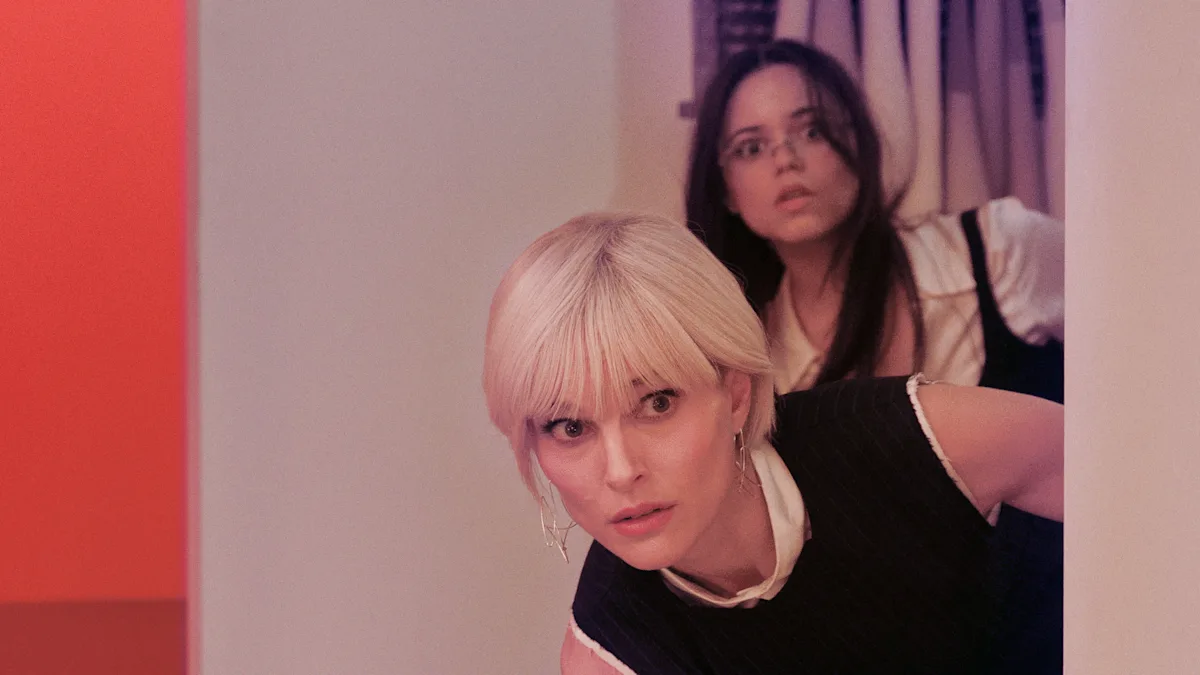
Cathy Yan returns to Sundance with an obscene cast and a dark, absurd satire that proves sometimes the best art is a total accident.
Cathy Yan made her return to Sundance, and she hasn’t lost her bite.
Advertisement
Eight years after her debut, Dead Pigs, shook up the festival, she returned to the Eccles Theater stage with The Gallerist, a film she described in the post-premiere Q&A as “smart, wicked fun for the clever.” She wasn’t lying. This is a high-wire act of dark satire that takes the art vs. commerce debate and impales it on a sharp, metallic sculpture. I loved it. It’s absurd, it’s stylish, and it manages to get a little personal while remaining a total riot.
While early critical reception has been polarized, those who appreciate the film’s frequency will find much to appreciate here. It’s a film that thrives in the awkward, lingering silences and the frantic energy of a Miami Art Basel exhibit gone horribly wrong. It’s a bold, women-driven heist of the soul that asks: how much of yourself are you willing to sell to be seen?
The Canvas: Art, Bodies, and Base Instincts
The premise is pure, high-concept chaos. Polina Polinski (Natalie Portman) is an ambitious gallery owner on the verge of a breakdown or a breakthrough—whichever comes first. She’s betting everything on Art Basel Miami and her newest discovery, Stella Burgess (Da’Vine Joy Randolph), an artist whose work is as instinctive as it is demanding.
Advertisement
The engine of the plot kicks into gear when an art influencer is accidentally killed, and his body becomes entangled with Stella’s latest sculpture, a jagged, intimidating piece nicknamed “The Emasculator.” Rather than call the police and watch her career evaporate, Polina makes the sociopathic, business-savvy decision to pass the corpse off as part of the installation.
What follows is a frantic, 90-minute descent into the absurdity of the modern art market. Yan and co-writer James Pedersen use this “body-as-art” hook to skewer the way we assign value to things. If a dead man on a spike can be sold for seven figures because the context is right, does the art even matter? The film leans hard into this tension. It explores the logical brain of money laundering and commerce clashing with the nebulous, subjective world of creativity. As Yan noted in her post-premiere talk, the Emasculator itself is a tool of commerce (a slaughterhouse instrument) used to create art, literally impaling the characters on the commercial elements they’re trying to navigate.
Visually, the film is stunning. Yan’s evolution as a director is evident in every frame. The camera movements are deliberate and energetic, pivoting between the claustrophobic tension of the gallery backrooms and the neon, wide-lens spectacle of Miami. The way the camera lingers on awkward moments — just a few beats longer than comfortable — elevates the comedy from standard slapstick to something more psychological and biting.
The production design by Francesca Di Matola deserves a shout-out. She managed to create an entire world within the confines of a single gallery. It feels sterile yet dangerous, a perfect playground for the “smart, wicked fun” Yan intended. The music, edited by Zach Norman and featuring a score by Andrew Orkin and Joe Shirley, adds another dimension, upping the thriller elements until the final, inevitable climax.
Advertisement
Performance Check
The ensemble cast is, frankly, obscene. Portman is a revelation here. We’ve seen her do prestige intense and starlet sweet, but The Gallerist allows her to lean into a sharp, frantic comedic timing that feels fresh. She captures that specific brand of high-functioning insecurity—the “I’ve got this” ambition masking the “I’m a total piece of shit” inner monologue that Yan mentioned was personal to her own experience as a filmmaker.
The real surprise, however, was the pairing of Portman and Sterling K. Brown. I didn’t know I needed this onscreen romantic match, but their chemistry is, for lack of a better word, hot. Brown provides a charismatic, grounding presence that balances Polina’s spiraling energy. Their scenes together offer a necessary breather from the satirical onslaught.
The rest of the women-led cast is equally formidable. Jenna Ortega perfectly nails the nervous artsy persona as Kiki. Her character serves as the moral (or at least semi-sane) anchor, and Ortega plays the escalating panic with a subtle, twitchy brilliance. As Stella, Randolph is the calm of the film. She brings a depth and heart to the role that makes you care about the artistic integrity being sacrificed. My only complaint? I wanted more of her. Every time she’s off-screen, you’re waiting for her to come back. Catherine Zeta-Jones simply eats every scene she is in. She understands the assignment perfectly, delivering a performance that is as commanding as it is camp.
Advertisement
Zach Galifianakis is perfectly cast as Dalton Hardberry, the self-important art influencer whose accidental death sets the film’s gruesome events in motion. Even as a literal prop for the majority of the runtime, Galifianakis’s likeness captures the exact brand of pretentious, main character energy that makes his transformation into a static art installation so ironically satisfying.
Charli xcx makes the most of her limited screen time as the concerned girlfriend, leaning into a delightfully silly energy that provides some of the film’s best levity. Even in a brief role, she fits the movie’s heightened reality, once again showing how she has a knack for this kind of deadpan, satirical comedy. While her vibe here is a bit different, she leans into the same snobbish girlfriend energy she brought to one of her other Sundance premieres, I Want Your Sex.
The way these personalities mesh is one of the film’s greatest strengths. It feels like a genuine ecosystem of ego, talent, and desperation.
Final Credits
The Gallerist is not for everyone, and I think that’s OK.
Advertisement
Its humor is dry, its premise is grotesque, and its satire of the elite art world is unforgiving. Some critics have called it “uneven,” but I’d argue that the unevenness is the point. It reflects the very tension Yan spoke about: the gap between intention and compromise, between the art we want to make and the product we have to sell.
It succeeds because it commits. It takes an absurd situation — a literal silicone body double impaled on a metal spike — and treats it with the same life-and-death seriousness that gallerists treat their profit margins. It’s a provocative, visually playful ride that stands out as one of the most memorable entries in this year’s Sundance slate.
Yan has made a movie that is both a communion with the audience and a middle finger to the industry that demands art be easily categorized. It’s a world-class dream cast working at the top of their game in a world that values numbers over emotions.
If you like your comedy dark and your satire sharp, then this is a film for you.
Advertisement
Read More:
Sports February 13, 2026
The Long Game: How the Super Bowl Halftime Show Signals NFL’s Global Future
Entertainment February 13, 2026
Why I Can’t Stop Thinking About Doctors on ‘The Pitt’ and Generational Heartthrobs
Sports February 13, 2026
Kevin Durant and Hakeem Olajuwon Talk SGA, Jokić, Embiid, and the Evolution of Basketball
Film & TV February 12, 2026
Beyond the Upside Down: Caleb McLaughlin on Broadway Roots and His New Animated Era
Sneakers February 12, 2026
A Strategic First: JuJu Watkins Co-Creates Within LeBron’s NXXT Gen Line
Media February 12, 2026
