


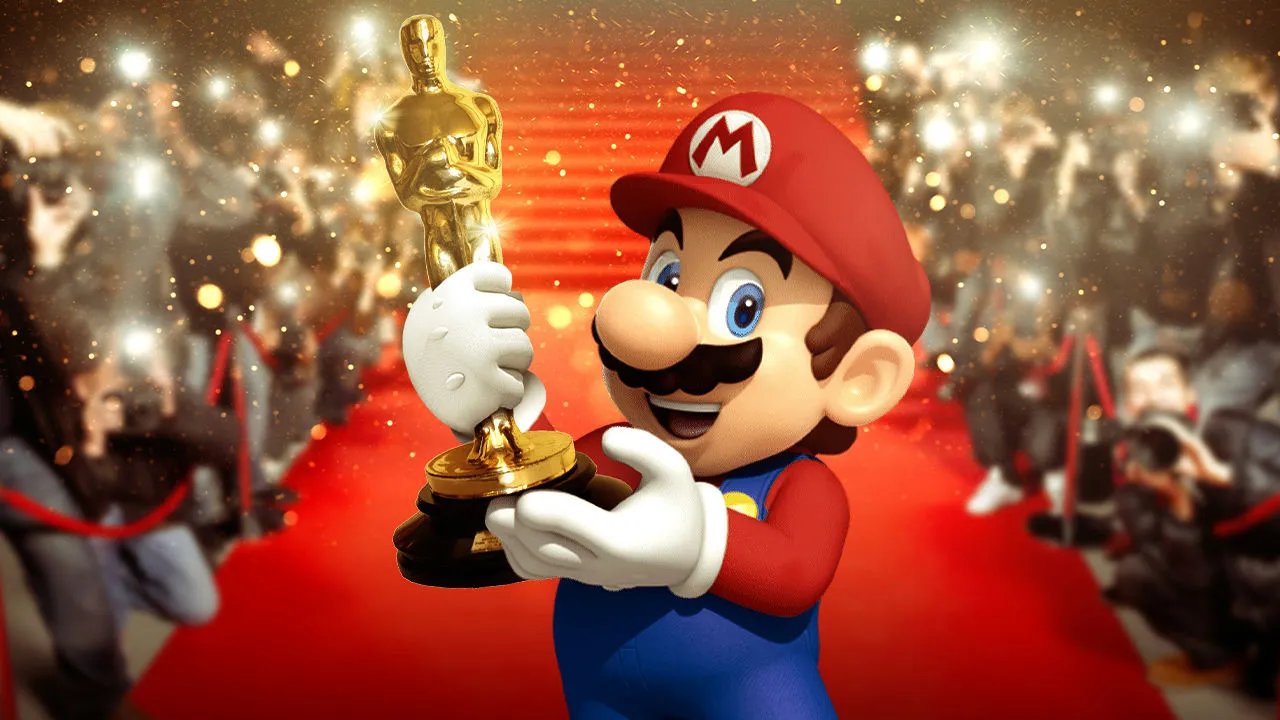
There was never not going to be a Super Mario Bros. Movie, even if it took Nintendo nearly 40 years to fully commit. The company had never really made a film itself before 2023, but three years and $1.3 billion later it’s already on its second, with several more in the pipeline. The blockbuster triumph of the modern Super Mario Bros. movies goes beyond beloved characters, highly-paid voice actors, and on-the-nose needle drops. They’re the products of a massive shift in Nintendo’s philosophy brought about by some of its greatest failures, a change of heart that has graced the world with Nintendo theme parks, Nintendo LEGO sets, Nintendo chicken salads, and Nintendo movies.
After three decades of keeping characters under lock and key, Nintendo has finally embraced brand synergy, and not a moment too soon. Today we’ll explore Nintendo’s early stumbles exploiting its intellectual property, the disaster that slammed the door on Hollywood for 30 years, and the decision to open it up again.
This is the story of how Nintendo finally made Mario a movie star.
Jump Man for Hire
Nintendo learned the value of a huge licensed property early on, which for a company founded in 1889 meant roughly 70 years into doing business. After decades of making hanafuda playing cards in Kyoto, Nintendo president Hiroshi Yamauchi visited the United States and discovered that kids loved card games. In Japan, cards were seen as sleazy, associated with gambling and unsavory elements of society, but Yamauchi wagered that his small family business might have some success marketing to children. He struck a deal with Disney in 1959, and Nintendo’s new Disney-branded cards tripled the company’s profits and landed it on the Japanese stock exchanges. Yamauchi had two big takeaways: Families make better customers than criminals, and beloved characters are worth far more than the cardboard they’re printed on.
Nintendo didn’t become an IP factory overnight. Its next era was largely defined by extremely clever original products, many designed by Gunpei Yokoi, the eccentric genius who later created the massively successful Game Boy, and its disastrous successor the Virtual Boy. The card company had become a toy company, and by the late ‘70s, the greatest toys were video games. Nintendo was eager to enter the American market and had some success with Yokoi’s Game and Watch, but its new arcade game, the bland space shooter Radar Scope, was a flop. Stuck with tons of unused cabinets, Nintendo went back to the well of IP and decided to convert them into a licensed game featuring the well-known, cyclopean visage of Popeye the Sailor. The company gave this unenviable task to rookie designer Shigeru Miyamoto.
Miyamoto’s project to create a Popeye game resulted in the original Donkey Kong, and the start of Mario’s rise to stardom. | Image credit: Nintendo
The repurposed hardware couldn’t render sprites at the size demanded by Popeye’s characters, so Miyamoto made his own instead. Brutus became an ape, Olive Oyl became “Lady,” and the Sailor Man became a moustachioed carpenter called Jump Man. Donkey Kong was a huge hit in 1981, so Nintendo had a plan to capitalize on its new IP: sell as much of it as possible, and don’t sweat about consistency.
Is Mario a squat ‘30s cartoon, a pizza mascot, or a buff, ape-slaying avenger? Is his girlfriend named “Lady” or Pauline? Has he done the work to take accountability for his gig as a cruel zookeeper? Nobody really complained at the time, and Nintendo wasn’t policing much of it– the company was busy fighting lawsuits against bootlegs and ripoffs, and Miyamoto himself has always had a laissez-faire attitude toward defining Mario.
He had originally conceived of the character as “Mr. Video,” an every man placeholder who could be dropped into any game. He could referee a boxing match, race a go-kart, or fight dragons with a sword. Miyamoto wanted the player’s imagination to carve out the essence of the character for themselves. Even today, he seems reluctant to reveal too much about his greatest creation. To Miyamoto, Mario is whatever we need him to be.
This made him extremely easy to license, with little creative involvement demanded by or offered from Nintendo, giving licensors a lot of freedom to embellish Mario into the world’s most endearing Italian stereotype, although the first time he spoke on American television, voiced by future Optimus Prime, Peter Cullen, he bore neither a New York nor Italian accent. Mario is little more than an Elmer Fudd-style animated antagonist in the 1983 Donkey Kong cartoons, and his personality was still anyone’s guess.
Nintendo was quietly filling in some blanks on its own terms. The Mario Bros. arcade game gave our hero a sibling and vocation as a plumber unclogging pipes obstructed by crabs and shellcreepers. Super Mario Bros. provided a world, an archenemy, and a princess to rescue, but it still didn’t give him much character. That kind of fleshing out would require syndicated television and a lot of carbohydrates.
Mario was colonizing every surface available to him, from cereal boxes to shampoo bottles. “
DIC Entertainment latched onto Mario’s given name, took the cannoli, and ran with it. In 1989’s The Super Mario Bros. Super Show, Mario and Luigi set up shop, literally, in a live-action low budget pastiche of contemporary Brooklyn, packed with so many Italian stereotypes they might as well be bottling limoncello in their basement. These live-action segments, carried by the considerable charisma of Captain Lou Albano, bookended cartoons in which our heroes battled “King Koopa” alongside “Princess Toadstool” in a fever-dream mash-up of the first two games and various kids’ cartoon cliches.
The gesticulating paisan became the definitive vision of Mario for years, at least in the West. Some of the new mythology came from Nintendo of America’s own localization, but a lot of now-traditional Mario tenets actually came from TV producers who marvelled at how little input Nintendo offered about their flagship character. But, lest you think America was sullying Mario’s good name in a slanderous slough of spaghetti, Japan was still figuring it out too.
A 1986 anime film called The Great Mission to Rescue Princess Peach– the first piece of Mario media to credit Miyamoto by his real name– also played fast and loose with the primordial Mario canon. It imagined the brothers as grocery store clerks who get sucked into the Mushroom Kingdom through a Famicom cartridge to save Peach with the help of a dog monster who is also her fiancee. Luigi is yellow. Nintendo apparently had no notes.
The hands-off approach seemed to be working. Mario was colonizing every surface available to him, from cereal boxes to shampoo bottles. He appeared in edutainment software and graced the pages of comics and surprisingly gruesome Choose Your Own Adventure books. All the while, Nintendo cashed the checks and focused on creating incredible games that more-or-less ignored everything going on in the outside world.
Mario was everywhere by the early ’90s, from your library to your bathroom. | Image credit: Nintendo / Revlon
By 1993, Mario was the most recognized fictional character on earth and answerable to nobody. The only arena he had yet to conquer was the silver screen. It would be the last time that Nintendo didn’t care.
Devolve Your Expectations
Hollywood had been hounding Nintendo for the film rights from the moment Mario first manifested in World 1-1. Acclaimed producer Roland Joffe won the fierce bidding war by flying to Kyoto and pitching Yamauchi personally. He walked out with the rights for a mere $2 million, which was a steal considering the star power that came sniffing around.
Dustin Hoffman, fresh off his Rain Man Oscar win, practically begged for the role of Mario, but was denied. Danny DeVito was offered the lead and the director’s chair, and Tom Hanks nearly signed on before the producers balked at his salary. It sounds like a Wizard Magazine Casting Call, but this was genuine A-list heat that was thirsty for the opportunity to slap on some overalls and kick some shell. It was the same caliber of stardom whose headshots would eventually adorn Nintendo Directs decades later, but the studio decided to skimp and hired the more affordable Bob Hoskins and John Leguizamo, both of whom would come to regret it.
To categorize the production as “chaos” would be an insult to deterministic laws of dynamic systems. A whopping eight drafts of the script survive today, fascinating fossils of the painful evolution that first brought Mario to the big screen.
The film was first envisioned as a clever fairy tale fantasy reminiscent of The Princess Bride or, probably more realistically, Shrek– there’s some great concept art from this period that looks like it would be more at home on the back of an envelope in the Nintendo Power letters section.
As the project took shape, Super Mario Bros. developed into a grounded brotherhood drama, then a sardonic Ghostbusters-style comedy. Things somewhat solidified when Joffe finally found his directors: Rocky Morton and Annabel Jankel, the husband-and-wife team behind the O.G. AI brainrot icon Max Headroom.
Today, their inscrutable decision to steer the movie in the direction of Mad Max cyberpunk dystopia wouldn’t last beyond the first slide of a pitch deck, but there’s something undeniably refreshing about going this off-model on Nintendo IP. It’s the kind of ambitious, swing-for-the-fences misfire that Nintendo itself often pulls off, gambling on crazy new hardware that could either bomb spectacularly or change the whole industry.
Miyamoto offers the characteristically quixotic criticism that the wildly unfaithful Mario ‘93 stuck too close to the games.“
Nintendo’s involvement in the 1993 movie was extremely minimal, borderline uninterested. Miyamoto had one polite half-hour meeting with the directors and never saw them again. The movie itself explicitly acknowledges that its existence is little more than a licensing transaction. Nintendo cautiously trusted the fungus, aloof but curious about how their burgeoning brand would fare in the Hollywood arena. The only thing the company really cared about was the deadline, holding the production to a strict time frame that only exacerbated the disastrous shoot.
Much ink has been spilled on the misery of the Super Mario Bros. cast and their animosity with the inexperienced directors, even while the film was being shot. Scripts were torn up daily, especially once distribution rights were picked up by none other than the Walt Disney Company– the same studio whose characters had helped launch Nintendo’s empire thirty years earlier. Both companies had come a long way since the ‘60s, and by 1993 it was Disney who wanted a piece of Nintendo’s IP so badly they were willing to wade into this mess and throw their weight around to demand rewrites.
Super Mario Bros. is a fun movie and a terrible ambassador for the brand. There’s not much there for fans beyond skin-deep references on neon signs buried in the background of the admittedly impressive Dinohattan set. Looking back, Miyamoto offers the characteristically quixotic criticism that the wildly unfaithful Mario ‘93 stuck too close to the games, if anything, and there is wisdom in that seemingly incorrect sentiment. If you approach the movie with an open mind it’s easy to appreciate the creativity that can bloom when Nintendo isn’t in the room. It would be the last time Nintendo wasn’t.
The 1993 live action movie gave us a very different version of the beloved Mario brothers. | Image credit: Buena Vista Pictures
Super Mario Bros. ‘93 opened the door, got on the floor, but ultimately couldn’t walk the dinosaur. It was a commercial failure, grossing $20 million domestically against a budget of at least $42 million, dino-mogged by Jurassic Park in a summer stacked with brutal competition. Mario took a critical thwomping as well, and in the intervening decades the film has become the cornerstone of an entire industry of “bad movie” podcasts, the tragic, cautionary example of How Not to Adapt a Video Game.
That being said: Mario and Luigi are down-on-their-luck Italian-American pasta-loving plumbers who are bullied by their fellow small business owners. They race to fix a flood beneath the streets of Brooklyn and stumble across a mysterious portal to another universe, meeting a princess who is a child of both worlds. In the end, the two dimensions merge painfully as our heroes save the day and are awkwardly proclaimed as “the Super Mario Bros.”
For such a poor example of adaptation, the extremely successful 2023 film sure takes a lot from 1993, and the DIC cartoon for that matter. The difference is that today, Nintendo is fully onboard.
The Walled Garden
Nintendo doesn’t like to be embarrassed. The rare flops are hidden under the rug and rarely discussed until their nostalgic rehabilitation decades later, and the 1993 film is no exception– you won’t see the Boom-Boom Bar as a Smash Bros. arena any time soon. The highly public box office bob-ombing of Super Mario Bros. was a big blow to Nintendo’s image at the peak of hostilities in its console war with Sega. The Hollywood experiment was a failure, and the company could only count on itself.
The forbidden door was quietly slammed shut, and for the next three decades Nintendo’s beloved characters were kept in protective custody, only seeing sunshine under the company’s watchful eye. Licensed art stuck to a house style, a coherent visual language based on Yoichi Kotabe’s extremely pleasant character models, and the days of devil-may-care merchandising and sloppy adaptation were a distant memory, for the most part.
Mario iconography in pop culture tended toward the nostalgic, establishing the early days of the “retro game” aesthetic through ubiquitous green 1-Up t-shirts and NES-controller belt buckles sold at Hot Topic. Mario was back to being just a video game character. It took 16 years for him to appear in a Happy Meal again. Nintendo had learned, belatedly, what its characters were worth.
This all worked out extremely well, allowing the company to reinvent itself in the mid-2000s on the back of some truly revolutionary hardware. The wild success of the Wii and DS was enabled by their widely accessible and intuitive inputs, inviting everyone from grandmas to toddlers to throw gutterballs on their TV. The company’s hard-earned squeaky-clean image enabled the brilliant “Wii would like to play” campaign, replacing the hirsute hysterics of Captain Lou in the public consciousness with two well-dressed Japanese men in a Smart Car.
Nintendo kept its characters and IP firmly locked up and focused on hardware instead.“
Nintendo had become a force beyond gaming, a shiny white walled garden with a carefully cultivated premium persona that appealed to anyone with an appetite for fun. The Wii outsold the PS3 and Xbox 360 combined. Nintendo was on top of the world. It would have been the perfect moment to lean into IP and open the gates, but the company never pounced on the opportunity.
Why risk it? Nintendo was already reaping the benefits of the largest media franchise in history without having to do much about it at all. Pokemon was and still remains a massive money maker for the company, but only as part of a joint venture with the independent-ish Creatures Inc. and Game Freak, meaning Nintendo doesn’t have the same control over the franchise as it does with Mario, Zelda, and the rest of its first-party properties. It kept the crown jewels firmly locked up and focused on hardware instead.
Said hardware was the Wii U. Nintendo’s clever but confusing followup to the household name that was the Wii went absolutely nowhere, selling a paltry 13.5 million units and racking up operating losses unheard of for the company. Nintendo was crashing out of the console market without the safety net of a film franchise or theme park to catch it. President Satoru Iwata had seen enough.
Nintendo implemented a three-pillar strategy for the future, focusing on mobile, hardware, and maximizing its intellectual property, the biggest strategic shift in the century-old company’s history since Yamauchi’s deal with Disney in 1959. Iwata died before he could see it through, but his strategy survived him.
In 2015, the same year Iwata left us, Nintendo inked a major deal with Universal to build massive theme parks all across the planet. Super Nintendo World is a massive success, and a new park has opened every two years since the original began in Osaka. It’s a charmingly gamified immersive Mario experience, that holds its own against the imagineers of Disney, Nintendo’s now-direct competitor, whose own Star Wars LARP experiences have quietly closed their blast doors.
Super Nintendo World brings the Mario Brothers into our world. | Image credit: Nintendo
The two companies were entangled once again, with Nintendo reaching for a strategy Disney had been running since 1957, the year Walt Disney himself sketched the entire blueprint that drives the company today: a complex web of diverse assets radiating from a core creative center. Disney’s parks and experiences generated $34 billion in revenue in 2024, more than a third of its total revenue and nearly 60% of its operating income. Its flagship content barely ekes out a profit, but every bloated-budget blockbuster and every “where’d all that money go?” streaming series serves as marketing for a much more profitable segment.
Nintendo had resurrected its brand by sticking to video games but it was leaving astronomical amounts of money on the table. Parks were the first step towards diversification and toys were another– Nintendo first began talks with LEGO in 2015, the year of the Universal deal. Games remained Nintendo’s core, and the new hybrid console it was cooking up in Kyoto would become the second highest-selling console ever. But back then, there was no way of knowing that the Switch would be a success, and Nintendo was thirsty for the kind of revenue Disney was pulling with blockbuster after banger blockbuster, putting its vast library of iconic IP to use with connected film universes like Marvel and Star Wars. A Mario movie was inevitable.
Going Galactic
Nintendo wasn’t going to hand the keys to just anybody after the massive fumble that was 1993. But why did the most protective company in the history of entertainment, stewards of characters recognized and adored by virtually all humankind, entrust this awesome responsibility to the people who made Minions?
The alternatives are interesting. Sony courted Nintendo for years, as revealed in leaked e-mails in which Spider-Man producer Avi Arad flexes about his meetings with Miyamoto. At one point Primal and Samurai Jack auteur Genndy Tartakovsky was floated to make an animated Mario adventure, but nobody told Nintendo. The deal never materialized, possibly because the hyper-confident hypeman Arad gave Miyamoto the ick.
Instead, the rights were secured by Illumination Pictures, whose founder vibed with Miyamoto by volunteering the story of his biggest failure, the 2000 film Titan A.E. that single-handedly destroyed Fox Animation. The Super Mario Bros. movie spun into production, with Nintendo as a full co-financier. With money on the line and real skin in the game, the company wasn’t going to take any chances. Miyamoto was made co-producer, and Nintendo played a major role throughout the production and promotion of the film at every stage of its development.
We knew what kind of movie Mario would be the second the voice cast was announced, a murderer’s row of unsurprising celebrity voice actors whose names would look great on a poster. The film was to be everything we imagined and not a figment more. DIC’s influence is apparent throughout, but Illumination isn’t afraid to add its own wrinkles to the Mario mythos, like the inclusion of the brothers’ extended family, which has never been meaningfully addressed in the games beyond the canon-confounding Yoshi’s Island. The animation is gorgeous, with character designs just different enough from Kotabe’s benchmark to justify the purchase of some brand new action figures.
The movie is safe and polished but genuinely a great time, with a distinct sense of “Mario-ness” infused in every layer of production by a studio getting the absolute most out of Nintendo’s close involvement. Deep-cut references and rearranged Koji Kondo tunes are catnip for the faithful, but real Nintendo magic is baked into The Super Mario Bros. Movie’s bones.
Super Mario Bros. was the second-biggest movie of 2023 and is the highest-grossing video game adaptation ever.“
Instead of dull action scenes, our heroes leap and run through intricate obstacle courses– can you think of any other movie that could reasonably be called a “platformer?” Everything Mario does in the film is something you yourself can do with your own Nintendo console: drive go-karts, 1-stock smash with Donkey Kong, or have a realistic panic attack. More than any reference or callback, this fidelity to the actual Mario experience is what gets a guy like Miyamoto up in the morning and The Super Mario Bros. Movie is full of it. It worked.
The film grossed $1.36 billion worldwide. Released mere weeks after the Hollywood opening of the U.S. branch of Super Nintendo World, the two unprecedented Nintendo events amplified each other and led to record profits. Super Mario Bros. was the second-biggest movie of 2023 and the highest-grossing video game adaptation ever by a factor of three. The theme park drove Universal to its best fourth-quarter EBITDA in history. Nintendo was Disney now, the wheel Walt sketched in 1957 was spinning, and the company didn’t waste any time adding more spokes.
Donkey Kong is already set for his own Seth Rogan-led spinoff based on his appearance in the first film, boasting a fresh new design, a massive theme park expansion, and an awesome triple-A game to prepare the audience for his arrival– and there are several characters introduced in Galaxy who could also easily carry their own franchise. To facilitate these Hollywood ambitions, Nintendo bought an animation studio of its own in 2022, and partnered with Sony to produce the Legend of Zelda, a project for which Nintendo had firmly rebuffed suitors for years.
Will the live-action Link cross over with his animated brethren? It seems unlikely, but the fact that a Zelda movie is actually happening, with an actual dude in a green tunic traipsing through the woods, is proof that anything is possible. The company has no shortage of incredible source material to stock a cinematic universe, and it’s not inconceivable that we could find ourselves in a Subspace Emissary situation if the stars align, as long as Nintendo doesn’t change its mind.
It’s happened before and could happen again, but something is different now. The video game industry isn’t quite what it used to be, with studios shuttering left and right, consolidation and trend-chasing averaging out innovation, and an ongoing technological paradigm shift that’s upended deeply-held development standards and choked the planet of its RAM.
Nintendo is doing more than fine, even though the company experienced a shocking stock plunge recently in light of these changing winds. It’s still well-positioned for whatever comes next, thanks to decades of iron-fisted curation and lessons learned from early stumbles. It’s the same logic Nintendo picked up from a deck of playing cards in 1959: a good brand goes beyond the medium.
