


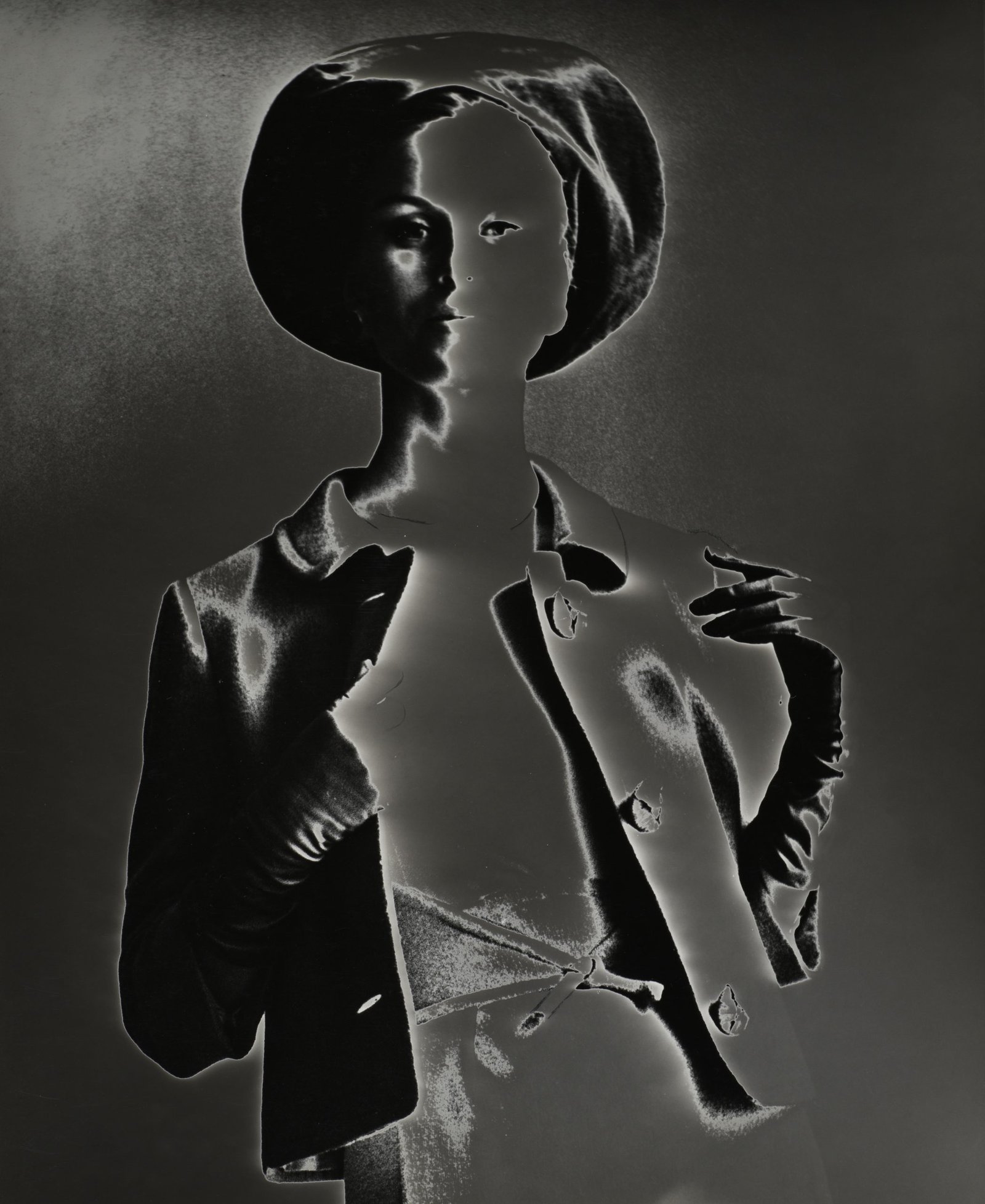
It was a straightforward fashion magazine assignment in 1950: shoot a new season’s coat and dress. After Lillian Bassman submitted her photographs to Harper’s Bazaar, the famed art director Alexey Brodovitch sent his protégée a note: “This is dangerous.” Another colleague went further, calling the images “sheer madness.”
Bassman’s photographs, in fact, looked more like illustrations. She achieved this effect through darkroom experimentation and manipulation: donning a cardboard mask with a pinhole aperture, she selectively exposed portions of the paper to light, tracing the contours of the garments until they seemed to dissolve into atmosphere.
Lillian Bassman, Variant of The Yellow Smock Coat (1950). Gelatin silver print with applied media. The Metropolitan Museum of Art, New York, Gift of Lizzie and Eric Himmel. © Estate of Lillian Bassman.
This was just one of many techniques she pioneered. “There is this atmospheric use of blur that would come to define her pictures,” said Virginia McBride, assistant curator of photography at New York’s Metropolitan Museum of Art. “She loved to work with cigarette smoke. Sometimes she would do so on the scene itself. Other times she would blow cigarette smoke under the enlarger while printing, just to accentuate this atmospheric haze. She was not one for the sharp or the objective, thinking instead that glamour was conjured in these moody and lyrical spaces.”
“Lillian was experimenting with chemistry to manipulate and distort the images that she made during fashion shoots, accentuating certain aspects of the clothing while allowing others to recede,” McBride added, “It’s an abstract impulse that tests the limits of commercial viability.”
McBride curated the illuminating new exhibition “Lillian Bassman: Harper’s Bazaar and Beyond,” on view at the Met through July 26, which reveals an idiosyncratic, technically astute talent. Trained as a graphic designer, Bassman made photographs in the 1940s and 1950s that could easily be mistaken for work from decades later. She was a fashion photographer whose images often reduced the clothes to mere suggestion. The show ultimately reads as a portrait of a maverick artist—supremely chic, with a taste level so exacting it bent the rules of the very industry she worked within.
Paul Himmel (American, 1914–2009), Portrait of Lillian Bassman, 1940s. Collection of Lizzie and Eric Himmel. © Estate of Paul Himmel.
Fashion wasn’t the artist’s calling. “Bassman has said that all of her fashion education came from the Metropolitan Museum of Art,” McBride explained. “She didn’t study fashion in any formal way. She wasn’t even that interested in couture. Over the course of many visits to the European painting galleries, she started to become enchanted with the way that a sleeve falls or a collar sits. This is what she was constantly thinking about.”
A Luminous Path
Bassman was born in 1917 and grew up between Brooklyn and Greenwich Village. “Her early life, she was sort of running around nude, hanging out with Isadora Duncan’s sisters, and going to demonstrations,” McBride said. “Art was very much in the air, but she did not imagine really that she was ever to become a photographer.” Bassman studied painting and tried her hand at nude modeling at the Art Students League. At 15, she began living with Paul Himmel, another photographer; they married in 1935 and remained together for 73 years, until his death in 2009. Bassman passed away three years later at 94.
Unknown maker, Lillian Bassman and Paul Himmel, Fire Island, 1940s. Collection of Lizzie and Eric Himmel.
Bassman first encountered Brodovitch as a student, initially through his influence at Manhattan’s Textile High School and then more directly in his design course at the New School for Social Research in the early 1940s. Struck by her work, he brought her into his orbit at Harper’s Bazaar, where he became a defining mentor and collaborator. “Brodovitch recognized her talent right away… he nudged her in the direction of a broader sort of graphic design ambition,” McBride said. “He had lived for many years in Paris, where he was exposed to Dada, surrealism, constructivism, this hotbed of graphic design and avant-garde innovation.” Bassman’s internship soon segued into a paid position at the magazine.
Junior Bazaar, January 1947. Design by Lillian Bassman and Alexey Brodovitch, featuring a photograph by Ernst Beadle. Collection of Vince Aletti. Courtesy of Harper’s BAZAAR/Hearst Magazine Media, Inc.
When Bassman joined the magazine in the postwar years, she entered a rarefied, art-minded moment, alongside image-makers like Irving Penn, Erwin Blumenfeld, and Man Ray, when fashion photography was being elevated into a sophisticated modern art form. “This was a golden age at Bazaar,” said McBride, “when the magnificent editor Carmel Snow was reinventing the magazine and reimagining its audience, working together with Brodovitch to reinvent how fashion appeared on the page. In the ‘20s and ‘30s it had been a staid social register, not particularly daring or lively—but with Snow and Brodovitch, things were starting to change, and Lillian was instrumental to that change.”
Lillian Bassman and Rouben Samberg, “Vocabulary of Courage,” 1944. Courtesy of The Metropolitan Museum of Art, Gift of Lizzie and Eric Himmel, 2025.
Bassman became head art director of Junior Bazaar, a youth-focused offshoot that didn’t speak down to its audience—at a moment when the very idea of the teenager was still being defined. Many of these spreads are on view in the exhibition; with their bold graphic flair, they can easily be mistaken for Junior Gaultier ads or pages from The Face in the 1980s. (Apparently, 14-year-olds in the 1940s wanted to read about Merce Cunningham and heated flooring.) Richard Avedon scored his first cover assignment shooting for the inaugural issue (in the summer Avedon and his wife shared a Fire Island house with Himmell and Bassman where they’d plot projects together). “Lillian was typically barefoot, crawling around rearranging layouts and giving orders,” McBride noted. Bassman soon began contributing her own ethereal photographs.
Lillian Bassman, Variant of Lighter Girdles, Rounder Curves (1948). The Metropolitan Museum of Art, New York, Gift of Lizzie and Eric Himmel. © Estate of Lillian Bassman.
Lingerie shoots were often seen as the B-list of fashion, but Bassman used them to push something far more experimental. “She relished the opportunity to showcase the more graceful and dancelike possibilities,” McBride said. “She’s testing the limits of what is possible according to propriety. Bassman had this tacit agreement, she would never show their faces, and consequently she devised all of these interesting techniques in the darkroom. This is born out of a very practical need yielding all of these intriguing formal results. The figure is only barely conjured, the clothes almost an afterthought—an extraordinary modernist proto-abstraction.”
Lillian Bassman, Variant of Paris: The Day-Length Dinner Dress, February 1949. The Metropolitan Museum of Art, New York, Gift of Lizzie and Eric Himmel. © Estate of Lillian Bassman.
One of Bassman’s most iconic photographs is a 1949 image of the model Barbara Mullen taken at the Ritz, her elongated neck and cigarette poised in an opera-gloved arm, the “swoosh” of a Dior hat suggesting the possibilities of postwar Paris. Richard Avedon, usually tasked with shooting the collections, was so taken with the image that he sent Bassman a telegram: “Next to myself you are my favorite photographer.”
The telegram is in the exhibition, as well as the Dior hat, which had been acquired in 1978. “It was like Christmas morning when I discovered that we had this hat in the collection,” McBride said. “It’s one of those only at the Met types of moments. To bring these two things back together in dialogue is amazing and it really shows her abilities as a photographer. That hat is an extraordinarily strange accessory to photograph. I’ve seen it photographed by one other person, for Town and Country,and it looks like a bat has landed on a horrible fence. This, by comparison, is a very elegant treatment of a challenging garment.”
Installation view of “Lillian Bassman: Harper’s Bazaar and Beyond.” Courtesy of The Metropolitan Museum of Art.
Stepping Back Into the Frame
Bassman left Bazaar in 1958 as fashion magazines shifted and her aesthetic began to fall out of step. She went on to launch her clothing line, The Looking Glass, in the early 1960s. “She made occasional fine art projects, photographing abstractions, cracks in the sidewalk, musclemen in Coney Island—completely far removed from the fashion world.” In the 1970s, Bassman gathered her prints, negatives, and commercial work and threw most of it away. A small cache survived, accidentally saved in trash bags.
Paul Himmel, Contact Sheet of Lillian Bassman at Work (1951). The Metropolitan Museum of Art, New York, Gift of Lizzie and Eric Himmel. © Estate of Lillian Bassman.
In later life, Bassman returned to this early material, radically reworking it through both chemical processes and new technologies like Photoshop. As McBride notes, “It’s remarkable that so much of this material survives given how casually she regarded the physical body of work from that period. Encouraged later by a friend to revisit what remained, she began reprinting her early photographs free from any art director or commercial constraint.”
Lillian Bassman, “Variant of The Wonders of Water,” 1959, printed ca. 2007. Courtesy of The Metropolitan Museum of Art, Gift of Lizzie and Eric Himmel, 2025.
The images that emerged—produced well into her nineties—register less as fashion than as glimpses into an ethereal dimension. “Her return to the darkroom was anarchic,” McBride said. “She eradicated figures and faces with ferricyanide bleach, smeared emulsions with her fingertips, and painted prints with dyes.”
