


We have the painter Henry Strater to thank for the Ogunquit Museum of American Art (OMAA), “the only museum in the country built, founded, and directed,” as he liked to say, “by a painter.” Opened in 1953 as the Museum of Art of Ogunquit, Strater wrote in the opening catalog: “It is dedicated to the people of Ogunquit, and of York County, and of the State of Maine, with the aim that the broad educational interests of the public shall be considered, rather than the interests of any one group or faction of the art world,” by which he meant—according to Michael Culver’s book, Sparring in the Dark: The Art and Life of Maine Painter Henry Strater—“the modernist clique in power.”
But a new exhibition at OMAA turns its focus toward a lesser-known influence on Strater himself and an important fellow patron of art in the Ogunquit community: his first wife, artist Maggie Strater. “Maggie Strater: In Her Own Light” (Apr. 10-Nov. 15), though modest in size, sheds deserved light on a promising talent who, like many women artists throughout the ages, were overshadowed by male artists in their lives, or by the overwhelmingly patriarchal art world and media.
“Her story is unfortunately not that uncommon,” says collections manager Andy Ritzo, “a very talented woman artist whose career was not what it might have been because of societal expectations in the shadow of a husband whose career is better known.”
Maggie Strater, untitled figure studies, c. 1940s, earthenware. (Image courtesy of Nick Strater)
Maggie Conner was born in Pennsylvania to Eli Taylor Conner, a mining engineer, and Caroline Yarnell Minshall, a Quaker and amateur sculptor. She attended Vassar in Poughkeepsie, New York, and later enrolled at the Pennsylvania Academy to study sculpture. It was there that she met Henry, who was studying painting.
They immediately fell in with each other. But for Henry, everything took a backseat to his art. After eight months of intimate friendship, he announced he was leaving to pursue independent studies in Europe and asked Maggie if she wanted to come along. She accepted, saying, “Oh yes, I’ll tell Mother you want to marry me.” Henry was taken aback, later insisting that the invitation had not been a proposal, and that he felt a bit ambushed into the marriage. This would cause resentment in the end stages of their relationship, but in 1920, the couple married and set off for Spain.
“Henry and Maggie’s relationship was troubled,” explains Ritzo. “But it seems like there were things about the early years that were positive for them. His writing at the time shows care and consideration for the wellbeing of Maggie and their family, and for a time they seemed happy together.”
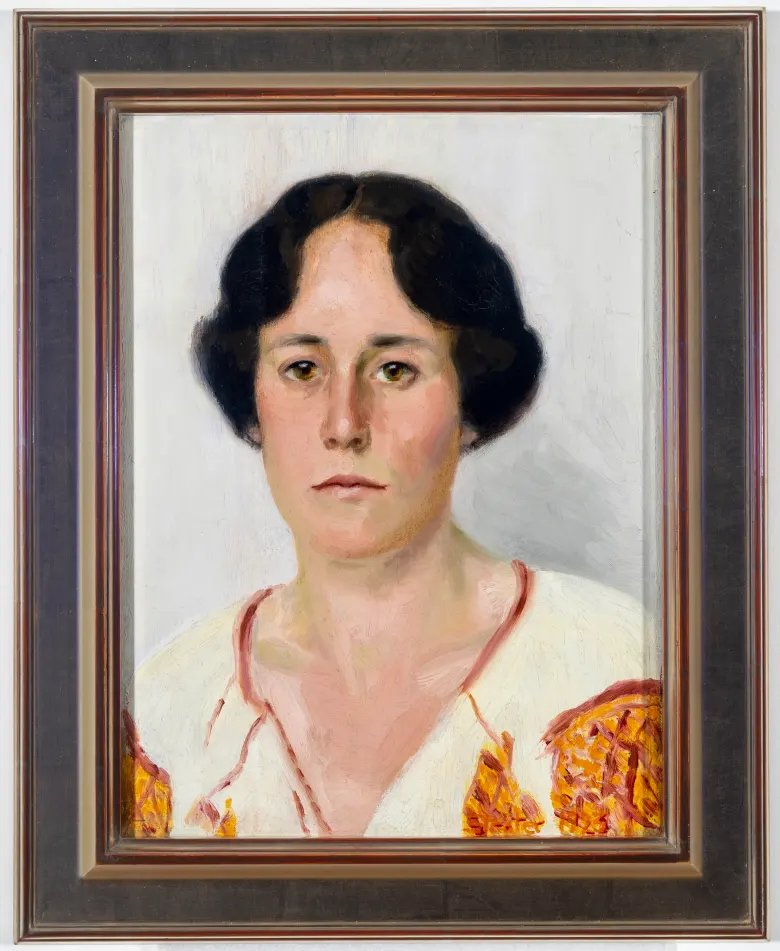
Portrait of Maggie Strater by Henry Strater, 1924, oil on panel. (Gift of the Estate of Henry Strater)
Nevertheless, Henry informed his new wife early on that “there was room for only one artist in the family” and, during their time in Spain and then France, often left Maggie in whatever humble quarters he’d rented (despite his considerable family wealth) while he spent long hours in his studio or painting en plein air. Might he have felt threatened by her talent? It’s hard to say.
“There’s a story that Henry abandoned sculpture after meeting Maggie and realizing he’d never be as good at it as she was,” says Ritzo. “Whether that’s fully accurate or not, she was talented, confident and highly trained. And by some accounts he was reluctant about having two artists in the family and discouraged her practice. Unfortunately, it’s unclear how much of the decision to put family before career was her own.”
Maggie Strater in an undated photo with her 1955 bronze portrait of her son Michael. (Photo courtesy of the Ogunquit Museum of American Art)
Quickly the couple connected with the art and literary circles wherever they settled for periods of time — in Spain with Ignacio Zuloaga and, after a move to Paris in 1921, with James Joyce and his wife Nora Barnacle Joyce, Ezra Pound and his wife Dorothy Shakespear, Marcel Duchamp, Constantin Brancusi, Ernest Hemingway and William Carlos Williams. Maggie bore their first son, David, in Paris (they would eventually have four children).
Henry Strater, “My Son Michael,” 1959, oil on masonite. (Gift of the Estate of Henry Strater)
Henry later admitted that, over the years, he had what he casually described in Culver’s book as “five or six drunken rolls in the hay.” But in 1923, an affair with a woman named Lavinia turned serious and, for the first time in their three-year marriage, threatened to end their covenant.
The couple returned to New York in 1924 and began summering in Ogunquit. They would have three more children together and live in various locales over the next several years, including Phoenix and Palm Beach, mostly due to Maggie’s struggles with asthma and sinus problems. By their own children’s accounts, the Straters were distant parents. They drank and argued often. But what eventually led to their divorce was another of Henry’s affairs, this time with one of his models, Janet Pierce, which commenced in 1941 and, to Maggie’s embarrassment, was widely known throughout the Ogunquit community.
Maggie refused to grant her husband the divorce he sought so he could marry Pierce, 16 years his junior. Culver relates that Maggie wrote “…the whole town is a dither” over the affair, as friends chose sides, Henry allegedly bribed friends to bear witness against her and accused Maggie of slandering him, and they both dragged their children into their marital contretemps. Maggie finally relented in 1942, granting Henry his divorce, but continued unsuccessfully for nearly a decade to pursue a larger settlement.
Despite the poisonous rift and Henry’s two subsequent marriages, the couple eventually declared a détente. Henry continued to visit Maggie, bearing flowers and expensive gifts, until her death in 1971, even asking her advice about women he was dating. Until his own passing in 1987, he also visited her grave every year on the anniversary of her birth, to place flowers on her headstone in Ogunquit’s Riverside Cemetery.
The Ogunquit Museum of American Art in October 2024. (Shawn Patrick Ouellette/Staff Photographer)
Purchase this image
The exhibition doesn’t focus on the later, torrid stages of their relationship, presenting instead a small selection of Maggie’s works and personal photographs from their early years together and those she produced after she returned to making art in the 1940s. Unfortunately, “not a lot survived or is known” about Maggie’s work, Ritzo said. “But we wanted to introduce her as an artist in her own right and not just a footnote in Henry’s career.”
On view are six of Maggie’s sculptures (four of them never before exhibited). We can also compare her bronze bust of their son Michael, seen in a photograph, with Henry’s painting of Michael made around the same time.
“She had a wonderful, confident style at a pivotal moment, a time when the dominant Beaux Arts style is breaking down and new influences are entering the picture,” said Ritzo. Rather than academic approaches in that Beaux Arts mode, which often depicted women in idealized mythical or allegorical contexts, Maggie’s sculptures are looser, less formal, more frankly sensual, and embody knowledge of the work of sculptors such as Rodin and Brancusi.
Ritzo also notes that Maggie also served as a vital mentor to many Ogunquit artists in her later years. “Maggie remained a devoted patron of the arts throughout her life. After her death in 1971, OMAA received a gift of artwork she had collected by artists including David Von Schlegell, William Zorach and Robert Laurent. Her involvement with the Ogunquit art scene was so significant that donations in her name to local arts organizations continued into the 1980s.”
Jorge S. Arango has written about art, design and architecture for over 35 years. He lives in Portland and can be reached at [email protected]. This column is supported by The Dorothea and Leo Rabkin Foundation.
IF YOU GO
“Maggie Strater: In Her Own Light,” Ogunquit Museum of American Art, 543 Shore Rd., Ogunquit. Through Nov. 13. Hours daily 10 a.m. to 5 p.m. $15 adults, $13 seniors and students, members and children under 12 free. 207-646-4909, ogunquitmuseum.org
