

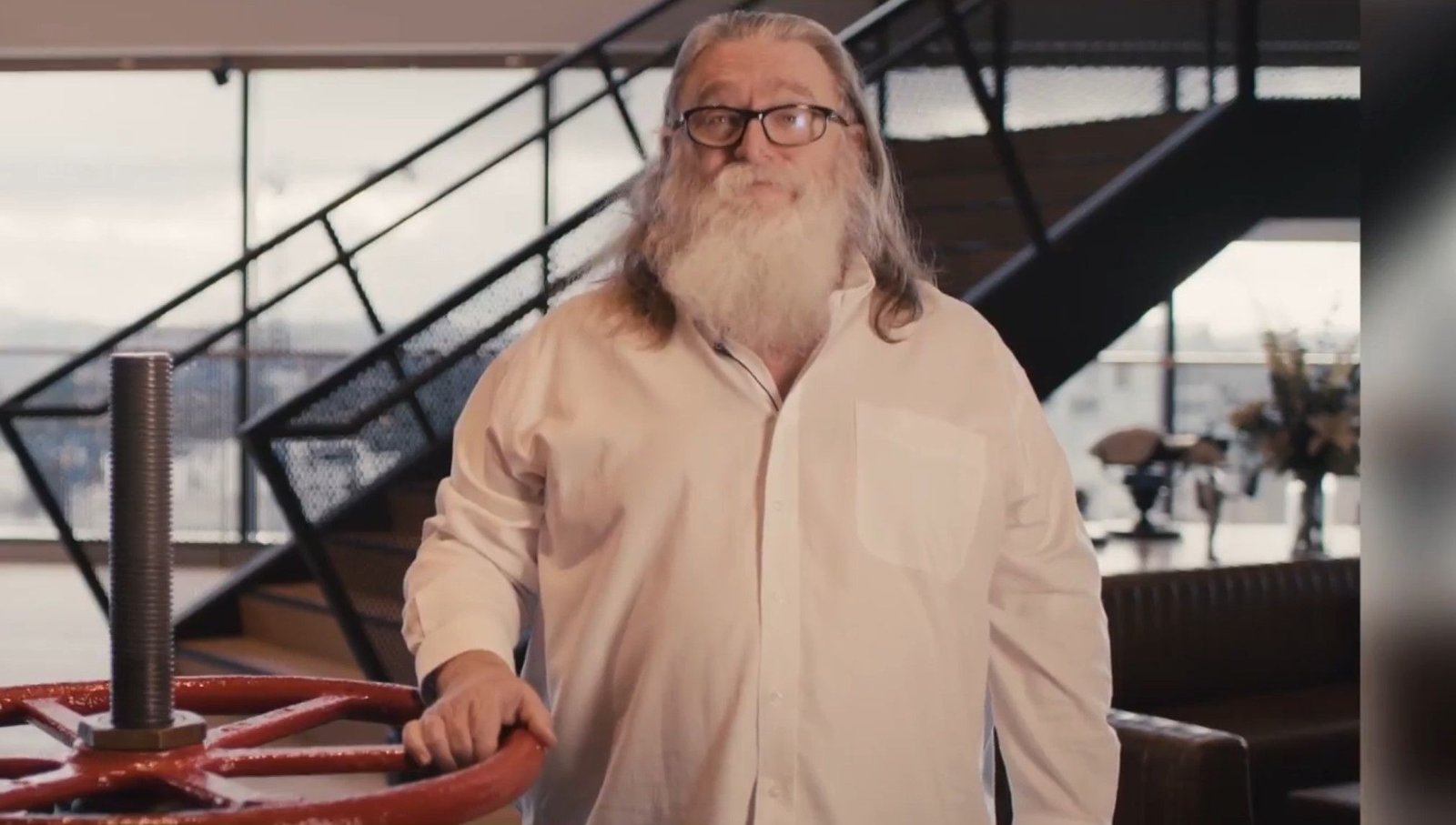
Gabe Newell remains the CEO of Valve, but it’s no secret that he stepped back from actively running the company some time ago: he says himself he’s been “retired for a long time.” Newell now divides his days between various other pursuits, including Starfish Neuroscience, a company he co-founded that focuses on neural interfaces, and Inkfish, a marine research operation. As well as buying $500 million superyachts.
I’ve always been a little fuzzy about exactly when Newell stepped back from the game design side of things, not least because Valve itself often credits staff equally, though he was clearly intimately involved in the design of Half-Life and its sequel, as well as spearheading the company’s acquisition of fan-made properties like Counter-Strike and Team Fortress. But an interview with Portal 2 project lead Josh Weier by Kiwi Talkz, recently resurfaced by PCG sister site GR+, gives a rough idea of the timeline for Newell moving away from being hands-on with development: and the main reason why.
Article continues below
You may like
Weier laughs: “Head down freaking out! And I think over time Gabe realised ‘oh OK, I should let the game teams do what I pay them for’ and he would stop in and give us feedback. I think his things were, he was worried about… we redesigned GLaDOS for Portal 2, because she was going to have a bigger role and felt like the old model wasn’t going to quite give us what we needed. He was very adamant about us giving GLaDOS a face and we were ‘ah don’t really think so, we’re gonna go a different direction.’
The real problem from Newell’s perspective though was that he’d become almost too forbidding a presence: even the kind of top-tier developer that works at Valve couldn’t quite bring themselves to push back hard enough.
“At that point I think he was realising… I think he always wanted to be part of the team, but being Gabe and being in his position, that never really worked,” says Weier. “Because people would be like, ‘whatever you say!’ And he was more ‘no no no, I want to be part of the team and come up with ideas.’
“And that was really hard for people, so I think there was a period where he stepped back and was like, ‘Alright I guess I’m just not going to be able to interact with everyone that way and I’ll just work at a higher level’, and that was alright.'”
Portal 2 began development after the release of the original (2007) and released in 2011. While Valve had always been a successful company, this was also roughly the time period where Steam was exploding in popularity and beginning to truly dominate the PC market, so obviously the company’s priorities were shifting from being solely a game development studio.
The danger, which Newell clearly spotted and avoided, was him becoming too dominant a creative presence for Valve, and ending up in a position where he was cramping the ideas of the company’s game developers rather than helping to refine and realise them. On the one hand that’s sad for obvious reasons, but on the other Newell obviously found many other outlets for his generational talents.
