

When you buy through links on our articles, Future and its syndication partners may earn a commission.
Credit: Kassini / Berenice Nelle / Shayleen Hulbert
We often look at a lot of fan art on Creative Bloq, whether it’s in the portfolios of digital artists or in workshops like Jiunn Kuo’s recent Photoshop KPop Demon Hunters art tutorial.
Writer and pop-culture maven Ray Bradbury – one of the first self proclaimed geeks for all things science fiction, fantasy and horror across all media – once offered a rallying cry for fandom: “Imagination should be the centre of your life.” That spirit of devotion and affection, and a vivid sense of just how cool a particular story and its characters are, lies at the heart of fan art and its culture.
From the gaming world of Fable to the anime world of My Neighbor Totoro, and from the comic Gothic of Batman and the bittersweet whimsy of Peanuts, fan art that responds to existing, copyrighted material expresses the investment of significant creative and emotional energy. It can also function as a showcase for both emerging and established talent (if you need the tools to take your own fan art to the next level, see our guides to the best drawing tablets and the best laptops for drawing).
Fan art: an existential question
Cody Taylor, an animation student at Birmingham City University, captures the ghoulish menace of The Joker | Credit: Cody Taylor
There’s an existential question in all of this, however, and that centres around issues of authenticity and originality. It’s a discussion that perhaps feels particularly acute at this moment in time.
When considering the bigger-picture ideas around fan art and its cultural variations, there is a handful of useful questions. Most pertinently, how can a fan artist maintain some degree of authenticity and originality in their work when it’s explicitly using an existing character design, visual style and aesthetic as its basis?
There are other important questions too. How can an existing character design be rendered to fit a given fan artist’s own style? Is this fundamental point a hindrance or a motivator? Why does fan art thrive and hold such a valuable place in illustration and image-making culture?
We spoke to artists and teachers to seek answers to these complicated questions.
Shayleen Hulbert reimagines Sheik from the Overwatch universe | Credit: Shayleen Hulbert
Perhaps one observation that ties together these questions is this observation made by M. Manifold in their essay, Fanart as Craft and the Creation of Culture, in which they write that the creation and consumption of fan art allows for a situation in which an “Appreciation of local and global aesthetic is quickened, and a desire to develop a high level of skill is inspired.”
That development of creative skill is evident in the work of artist Shayleen Hulbert, whose fan art has often been a creative response to game characters.
Shayleen’s interpretation of Sheik from Overwatch, made using Maya, Substance 3D Painter, ZBrush, 3DCoat and Photoshop, was a collaboration with artist Jack Hamilton. It led to the creation of a workable rig that was made freely available for personal projects and education. Meanwhile, Shayleen’s depiction of Sakura from Cardcaptors was inspired by their long-standing fandom for the game.
“Whenever I am lost and unsure what I want to create, I will turn to other pieces of existing fan art for inspiration,” says Shayleen. “Exploring fan art opens you up to a vast library of ideas and concepts to draw from, heavily reducing the fear caused by the ‘blank page’ problem many creatives face.”
“Knowing what to make can feel quite paralysing at times,” Shayleen continues, “but finding inspiration in media that excites you serves as a clear a jumping off point to further develop your design and technical skills. I always recommend putting your own spin on it by introducing something fresh, rather than merely replicating what already exists.”
Shayleen’s longstanding fandom Cardcaptor Sakura was the inspiration for this depiction | Credit: Shayleen Hulbert
The various dynamics around fan art culture can manifest themselves in the work of aspiring illustration students who may decide to include fan art in their portfolio submissions for a given course that they wish to pursue.
For illustration tutors, the complication arises when they have to explain that those images don’t qualify as true illustration, even though they have likely been rendered with devotion and great enthusiasm.
Helpful starting points
Illustrator Nicholas Stevenson in discussion with a student at Hereford College of Arts | Credit: Hereford College of Arts
With so much reference material available for fan artists, how can they leverage it to improve their own work in terms of accelerating skills and engaging with the demands of form and composition?
Neil Hadfield, Course Leader of the BA (Hons) Illustration & Animation course at Hereford College of Arts, notes: “We see many, many portfolios of bad fan art and have to painstakingly call out that the course does not condone it as true illustration. That said, it is useful to be challenged to find positivity in its existence, similar to our wrestling with AI.
“Working with pre-existing characters can free up the illustrator/designer by providing a fully formed cast, omitting the need to begin from scratch. It then becomes possible to place them in new situations by modifying and further developing their idiosyncrasies such as facial expressions, gestures and costumes to help create new narrative, further evolving the characters.”
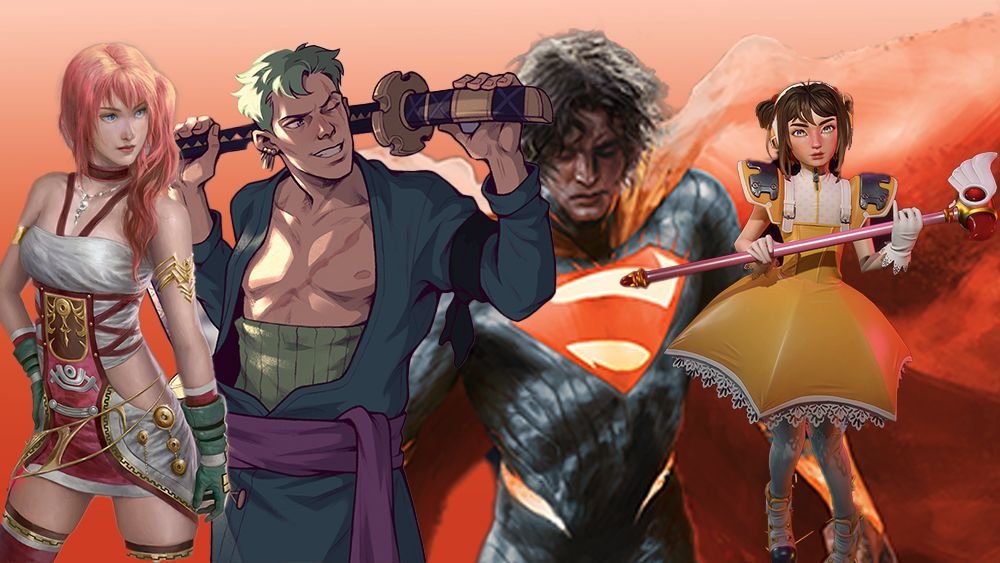
Kassini reimagines the intensity of Superman and Serah Farron from FinalFantasy XIIIKassini
Kassini
For illustrator and concept artist Kassini, the realms of superheroes and gaming offer inspirational starting points for his fan art that celebrates Trench Crusade and Silk Song.
Kassini says: “Being able to draw the characters I love is like waving to my childhood self, who did the same when watching a film, seeing an animation, or reading a comic. It’s not just a personal satisfaction, but also a way of feeling part of their creation by offering my own perspective on a character, just as their creators did.”
Kassini honours the heroism of Wonder Woman in this piece of fan art | Credit: Kassini
This confluence of originality and working with an existing aesthetic is a point that Hannah Berry, comic writer and also former UK Comics Laureate (2019 – 2021) also has a view on.
“For mainstream comics there is a fairly distinctive artistic style – which is not to say that artists can’t bring their own voices to it, but that there is a way of drawing, inking and colouring that is very recognisable,” she says.
“I largely work in the indie comics side of things, where the majority of comics are self-published and there are very few gatekeepers. This means most creators are writing and drawing exactly the kinds of stories they enjoy and become known more for their ‘voice’, and while having an income is important, artistic expression is usually the drive.”
Hannah Berry pays homage to the classic movie adaptation of Dracula | Credit: Hannah Berry
“For someone interested in working in this area, learning the ropes by taking known characters and, basically, having fun reproducing them, can be a good way to challenge yourself artistically, but can also build a portfolio that may help you with approaching these publishers in the future,” believes Hannah.
”Professional opportunities in mainstream comics are very competitive, and being able to demonstrate that you know a particular publishers’ canon inside out, and that you have a good grasp of their style and tone, can help you get a foot in the door.”
Hannah deployed Batman for a charitable cause | Credit: Hannah Berry
For Neil, the tension between original expression in the context of fan art requirements (that it’s recognisable and familiar) is one that is negotiated by illustration tutors and their students.
“Fan art characters, at their best, already follow many of the principles of good design, including proportion, anatomy and pose, which provide a solid, classical template on which to base new characters,” he says.
“There are also principles which help define staging or background/environmental art as scenes or locations for action. These principles can be learnt and used as a basis for original creations in set design in a wide range of media.”
Legal issues around fan art
In thinking through a set of ideas around creative expression and fan art, there’s another dynamic to be mindful of; namely the ever-present issue of copyright law. To some degree, a balance is understood to exist: fan art created solely as an expression of enthusiasm for a given character or story is permissible.
The problem will arise for the fan artist if they decide to sell their fan art of characters (properties) that are protected by copyright law. Different companies may utilise different strategies and responses to fan art: they may send a cease-and desist letter or a takedown notice or eventually initiate a lawsuit. The AI context intensifies this further.
Berenice Nelle’s enthusiasm for Legend of Zelda finds expression in this image of Link | Credit: Berenice Nelle
Indeed, during the writing of this piece, Disney sent out a cease-and desist to AI company ByteDance for infringement of their copyrighted characters. All of that said, some high profile companies, such as Marvel and Sony, recognise that fan art amplifies awareness of their output.
Beyond the considerations of style and aesthetics, fan art also taps into a broader cultural landscape that might see it placing established characters into a kind of stylistic stew that has the potential to produce something more inclusive.
Hannah says: “When I see fan art at comic conventions or shared on social media it’s never a direct replica; it’s always creators riffing on these characters or stories – sometimes from other comics, but more often from video games, cartoons, film and TV – to make their own fanzines, comics and prints.
“Rather than hindering creativity or self-expression, known characters and settings can provide a kind of jumping off point – not unlike using the specific tropes of a genre within a framework that the reader immediately recognises – in order to explore particular themes.
“I was sure somewhere on my shelves I had a neat little comic musing on the mundane pressures of secret relationships featuring Luigi and Bowser, but I can’t find it now…”
Kassini’s art relishing the doomladen world of Trench Crusade | Credit: Kassini
As a fan art creator, it’s time well spent familiarising yourself with the nuances of copyright and fair usage. There’s a lot readily available in print and online about what artists should know and be aware regarding (potential) copyright infringement.
Originators of characters and storyworlds (across various media) can vary in their acceptance and openness to fan art. It’s also useful to note that British copyright law differs in various ways to American copyright law.
Resources to consult in the UK include The Graphic Artist Guild, The UK government website’s details on copyright issues and The Writers and Artists’ Yearbook. The Comics Creators network is a membership group that operates as part of the work of The Society of Authors.
The power of ‘what if…’
Cody Taylor’s interpretation of Darth Vader in whimsically menacing mode | Credit: Cody Taylor
Fan art, then, can be thought as having the potential to occupy a place in a diverse artistic mix; in a kind of cultural gumbo. For Dr. Christopher Holliday of King’s College London, fan art’s power and possibility lies in the ways that “the culture of fan art is driven largely by control, ownership and participation.”
He explains: “Fan art gives an indication as to the ways that fans and fan communities immerse themselves into their objects of fascination, and, by extension, how they consume and re-negotiate popular culture. Yet fan art does not just enthusiastically respond to a particular artefact in playful and inconsequential ways, but it in fact helps shape the many ways that we can and do think about cultural products.”
A piece by Sebrina Stain, a student at Birmingham City University, illustrated using Procreate | Credit: Sebrina Stain
“This feedback loop is vital,” believes Dr. Holliday, who offers that “fans are devoted to a specific media text and feel compelled to take on its characters, icons and images to create new narratives through their art. Yet these visual stories should not be dismissed as frivolous activities by over the top participants, but rather they can be used as vital evidence that helps to map the trends, desires and fantasies that surround beloved cultural products.”
He continues: “Fan art can rework the classics just as much as it can recover things we have forgotten, whether this is providing characters with elaborate futures or generating new backstories and scenarios. The ‘what if’ power of fan art is necessary and lively precisely because it hinges on an indirect relationship between fan and text – there are, after all, so many positions and perspectives from which fans can engage with their objects of fascination.”
Personal connections with fan art
Berenice Nelle’s One Piece art celebrates the character of Zoro | Credit: Berenice Nelle
For Berenice Nelle, who worked as the illustrator of the graphic novel Hollow (2022) that reimagined the story of Sleepy Hollow, creating illustrations in the fan art space has real personal value to her as an artist.
“Fan art, to me, is a playful way to interact with the characters or stories that have moved me. It allows me to stay within a world and explore it further, even after the movie ended. To process a piece of media beyond pure consumption and to create something new from the inspiration it gave me. As a creative myself, it’s also a way for me to express my admiration for the hard work of other creatives and study it in each and every detail.”
Berenice’s work has recently included creative responses to the animated TV show Arcane and also to the worlds of Zelda and of One Piece.
Berenice’s portrait of Silco from Arcane | Credit: Berenice Nelle
Fan art is a complicated space that honours enthusiasm for a given piece of existing media, but that might also prove challenging for artists who want to express their own creative identity.
And yet, looking at fan art from another perspective, we might well be able to recognise fan art’s capacity to make connections across diverse creative voices and audiences. In doing so, fan art might also empower consumers of media to reinvent and reimagine it as a central point in their own creative lives.
This article originally appeared in ImagineFX. Subscribe to ImagineFX to never miss an issue. Print and digital subscriptions are available.
