


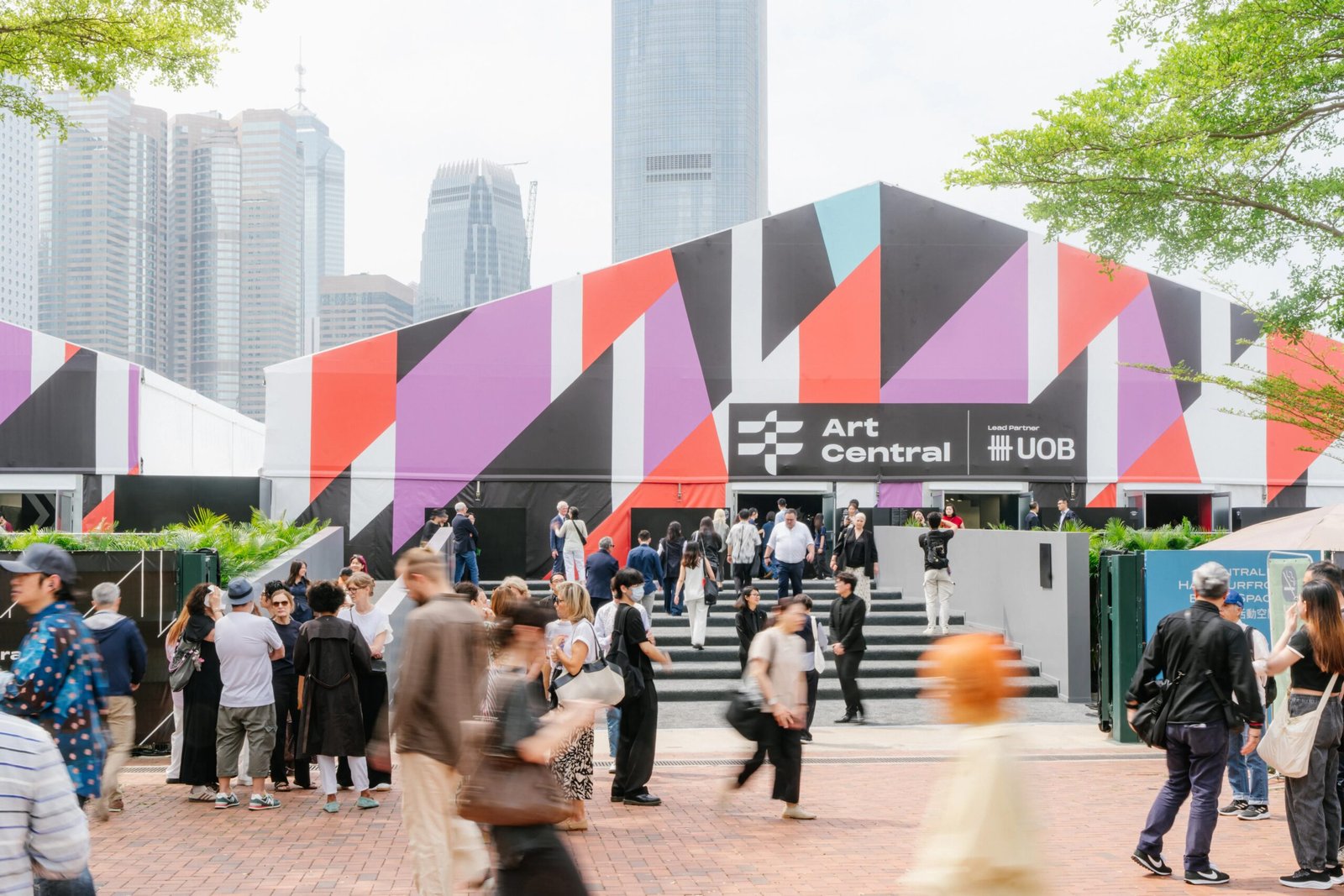
Art Central is presenting its largest edition to date, with 117 galleries and more than 500 artists from Hong Kong, Asia and around the world. Courtesy of Art Central
The tone at this year’s Art Central—which opened to VIPs ahead of Art Basel on March 24 in a tent on Hong Kong’s iconic Central Harbourfront—is reflected in the ambition of its installations and public programming, which have already expanded the fair beyond a site of trade and networking into a curatorial platform for research and discovery. Europe-based curator and artist Enoch Cheng was chosen to guide its curated gallery program, while Zoie Yung curated its ever-expanding non-commercial creative program that in 2026 encompasses a series of installations, moving images, performances and on-site dialogues, with a particular emphasis on new digital dimensions.
At the fair’s entrance, visitors are welcomed by a major installation: White Mirror – The Vista of Inner Worlds by young artist Ling Pui Sze. Drawing from her years-long study of cellular imagery, alongside recent research into the microscopic world at the University of Cambridge, she presents a whimsical, interactive sculptural Zen garden that evokes the complex entanglement between micro and macro cosmos. Hand-made paper sculptures appear to float—somewhere between galaxy and garden—offering a rare moment of stillness within the fair’s bustling atmosphere. Populating the space are abstract, radiating forms inspired by neurons, the cells responsible for transmitting information through the nervous system. It’s the largest installation by the artist to date and a poetic metaphor for reconsidering the emotional impact on the human body, suggesting a kinship between micro and macro universes and resonating with the Daoist notion of “Everything as One.”
Art Central remains predominantly region-focused. Among the 117 galleries participating, 30 percent are presenting Hong Kong-based artists and 85 percent represent the broader Asia-Pacific. It’s a big part of what makes this fair such a compelling site for discovery, particularly of emerging talent from Mainland China. London’s SWANFALL Gallery, for example, is spotlighting a group of young Chinese artists, including Li Shuangqiang (b. 1995, Beijing). His glitch-inflected compositions evoke a kind of retro-future, probing the limitations of technology while reflecting on our position as a civilization suspended between its systems and the order of the universe. Priced between HK$17,000 and HK$20,000, the works attracted immediate interest, with two sold within the first hour at the fair.
SWANFALL GALLERY. Courtesy SWANFALL GALLERY and the artist.
Shanghai-based Cubism Art Space presents another of their young painter talents, ShuChen Hua, whose solo booth of melancholic floral compositions reveals a painterly mastery. Here, the traditional still life becomes a site of resistance and quiet resilience against the accelerated, chaotic rhythms of contemporary urban life. As the curator notes, these works invite a mode of contemplation that moves beyond distracted looking—an appreciation that turns inward, toward the introspective. Priced between $3,000 and $9,000, the works attracted immediate collector interest. In a different register but equally seductive in their playful storytelling are the “delicious landscapes” by Haru K, presented by Seoul-based AN Inc. These vibrant compositions fold food into the terrain of everyday life, revealing the entangled relationship between human consumption and the natural world. Following strong sales last year, the gallery returns with heightened confidence, reflected in a price increase from $6,000 to $10,000.
A painting by Shuchen Hua presented by Cubism art space. Cubism art space.
Further along, Cut Art from Latvia is presenting Julia Silova’s kaleidoscopic, anti-idealized nudes—fractured, expressive bodies that resist classical conventions of beauty. Silova brings an intellectual rigor to her painterly deconstructions, finding in the mirrored accumulation of perspectives a depth of investigation into the sense of self in relation to the outside world.
Hailing from Miami for the second time, Jacob Arthur is presenting Los Angeles-based artist Dan Life, whose humorous, materially rich compositions—crafted from clay and crystals—are embedded into the covers of aspirational luxury interior design magazines. Oscillating between satire and seduction, the works’ glimmering surfaces and humor immediately attracted the attention of local collectors, with two larger works selling in the first hours, priced at $44,500 and $55,000 each. Equally striking are his cast-resin, clay and stone figures—Pikachu and Labubu forms rendered with similar meticulous craft—and larger two-dimensional works that require up to a month to complete, as the artist told Observer when we stopped by the booth.
Among local highlights, Hong Kong-born artist Lewis Lau, presented by Literati Space, offers a form of psychological hyperrealism tinged with longing. Now based in the U.K., his paintings echo a distinctly Hopper-esque solitude, capturing the quiet alienation and loneliness of urban life, particularly within the diasporic experience. Priced from HK$21,000 to HK$45,000, his works attracted early interest from both local and international visitors.
Silvester Mok’s The Digital Fossiliser presented by Touch Gallery. Courtesy of Art Central
More ambitious installations punctuate the fair, deepening the journey toward more layered narratives and research. A standout in this edition is Silvester Mok’s The Digital Fossiliser, presented by Touch Gallery—a live 3D-printing environment, part laboratory, part speculative archaeology. Drawing on Hong Kong’s first dinosaur fossil discovery in 2024, the project reflects on how life and objects are preserved across time. Inspired by natural fossilization and amber formation, Mok employs 3D scanning and printing as a form of “accelerated fossilisation,” transforming everyday objects into ceramic and resin artifacts. Presented as a living workshop within a fictional lab and realized in collaboration with Myron Lai, Carmen Tsui and Simon Wu, the installation probes questions of permanence, value and memory in the digital age.
LIS10 Gallery from Arezzo, Italy, brings a compelling intergenerational dialogue from the African continent, pairing the rigorous and tradition-tied abstractions of Esther Mahlangu—chosen for “Central Stage,” a new section of the fair curated by Enoch Cheng spotlighting six artists in Hong Kong whose practices have recently received significant institutional recognition—with the highly tactile and more instinctively gestural works of Jack Kabangu and Aboudia, bridging different geographies and painterly vocabularies. The gallery is also hosting a pop-up at M Place in Wong Chuk Hang, the same building where one can find Rossi & Rossi.
A dedicated section on Indonesian art, “Rising Currents,” curated by Manajemen Talenta Nasional (MTN), gathers a strong cohort of emerging and established galleries, offering a glimpse of its rapidly growing art scene. The group includes EDSU House (Yogyakarta), Galeri Ruang Dini (Bandung), ISA Art Gallery (Jakarta), Puri Art Gallery (Bali), RUCI Art Space (Jakarta), SAL Project (Jakarta) and SEWU SATU (Jakarta). At Jakarta’s Vice & Virtue, the surreal collages of Joko Nastain stand out—mysterious compositions populated by disparate symbolic presences, unfolding within impossible, dreamlike playgrounds. Priced between HK$9,800 and HK$11,000, several works had already sold in the early hours.
Niluh Pangesty presented by Puri Art Gallery. Photo by Irene Febry. Courtesy of the artist and Puri Art Gallery
Equally compelling are the mechanical puppets by Niluh Pangesty at Puri Art Gallery. Drawing from traditional symbologies, mythologies and folklore, Pangesty creates articulated works in ink and linoleum that interrogate the condition of women. Reframing the visual language of wayang, as seen in Kamasan painting and shadow puppetry, she reconstructs religious epics and moral tales, offering alternative perspectives on socio-cultural traditions. The works are all affordably priced between $1,100 and $3,100, despite their craftsmanship and the imaginative force of their symbolism. “As first-time exhibitors, we are pleased to get a wonderful response to our curated artists, with many visitors finding the works refreshing and compelling,” said director Yuanita Sawitri, who emphasized that the gallery’s mission is to champion Southeast Asian talent, specifically Indonesian artists, to a global audience.
At the center of the fair, Kaitlyn Hau’s Recursive Feedback Ritual 0.01—this year’s Hong Kong Artist Commission—anchors the curatorial proposition around new media and digital practice. Drawing from computer science’s logic of self-reference and game design’s notion of spatial folding, the work is a generative installation shaped by the artist’s experience navigating bipolar and obsessive-compulsive states. A split, low-poly torso recalls the heartless Tin Woodman from Baum’s The Wizard of Oz, while a mechanized percussion system echoes the fragmented mechanics of Duchamp’s Large Glass. Each looped motion enacts a Deleuzian “difference and repetition”—a recursive unfolding of variation that operates almost as forced mindfulness, imposing rhythm onto internal chaos. As gesture becomes data and emotion reverberates through percussion, the work searches, perhaps endlessly, for its elusive “termination condition.”
Director Corey Andrew Barr described the installation as emblematic of the next generation of art and digitally inflected artistic practice. “It drew significant attention during the well-attended previews and underscored the impact of this year’s curatorial direction as we look ahead to 2027.” Several other artists at the fair are engaging with technology and the digital realm.
“We’re seeing more interest in digital practices,” Barr acknowledged in a recent interview with Observer, noting how Hong Kong artists are especially adept at exploring the connections between digital culture and contemporary art. “They’re thinking about those relationships in very smart ways. We certainly see that presence within the artistic community here.”
Kaitlyn Hau’s Recursive Feedback Ritual 0.01, the 2026 Hong Kong Artist Commission. Courtesy of Art Central
On the other side of the tent, the tone shifts, blending blue-chip and more historical regional names with pop-art-inspired presentations. Opera gallery has a booth of blue-chip names spanning five- to six-digit price points, pairing works by KAWS and Keith Haring. Along another wall hangs an intimate Alex Katz study for Pas de Deux (1983), while a monumental red Infinity Net by Yayoi Kusama serves as a visual anchor.
The 2026 edition of Art Central demonstrates a clear evolution in its curatorial thinking. The fair moves fluidly between pop-inflected visual languages and regionally rooted sensibilities, balancing accessibility with depth. Most notably, it continues to assert itself as a vital platform for discovering emerging voices across Asia—artists whose practices, in their diversity and urgency, feel deeply attuned to the present moment while remaining rooted in the specificities of regional aesthetics and traditions.
Art Central is firmly rooted in its commitment to supporting Hong Kong’s arts ecosystem and engaging audiences globally. Courtesy of Art Central
