


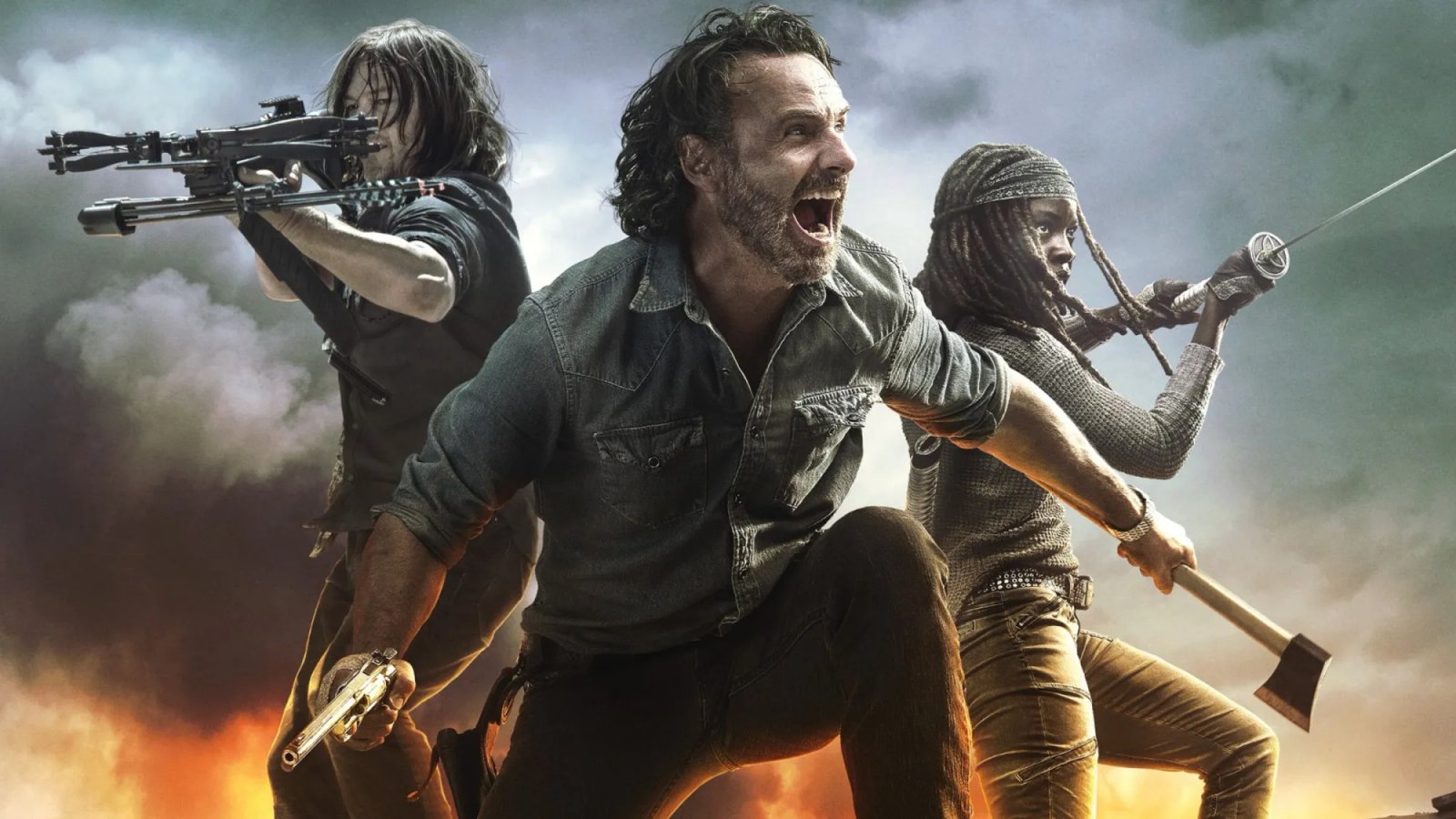
One of the most talked-about shows of all time, The Walking Dead spent over a decade proving that the biggest threat in the apocalypse was never the zombies; it was always other people. But with 11 seasons, the series also became a perfect example of how a story can feel brilliant one year and completely frustrating the next. There were seasons with episodes fans still talk about to this day, deaths that totally changed the direction of the story, and villains who basically carried the series on their backs. But there were also times where the plot felt like it was running in circles, repeating the same situations and dragging conflicts out way longer than necessary, testing everyone’s patience.
So here, the logic is simple: pacing, impact, character development, and how much each era really delivers something interesting, memorable, well-written, and overall positive. Ranked from worst to best, here are all the seasons of the show.
11) Season 8
image courtesy of amc
Season 8 was supposed to be the final war against Negan, but it actually ends up feeling like a season that just drags. The idea of a massive conflict between communities (especially considering how brutal the villain was) sounded amazing on paper, but the pacing is so uneven throughout the episodes that it never hits with the impact everyone expected. You’ve got Rick planning ambushes, Daryl trying to rally the troops, and even a few twists involving Dwight, but none of it ever builds real tension. Plus, Carl’s death, which should’ve been shocking, ends up feeling messy because it changes the group’s dynamic so abruptly without really leading to anything new.
The biggest reason this season lands at the bottom of the ranking is that so many episodes feel like filler: long fight scenes we’ve basically already seen before, secondary characters being wasted, and that constant feeling of wondering when it’s all finally going to be over. Sure, there’s action, and that helps to some extent, but the storytelling just isn’t balanced. Out of all the seasons, this is the least epic one.
10) Season 7
image courtesy of amc
Famous for its brutal opening shock with Glenn and Abraham being murdered right in front of everyone, Negan establishing his reign of terror, and Rick being practically humiliated, Season 7 definitely has memorable episodes. The problem is that the entire season leans on that oppression and violence without much real progression (and it’s no coincidence this is the point where the fanbase really started to split). You can absolutely feel the weight of Negan’s presence and the fear he brings, but after more than ten episodes of Rick being forced into submission, it gets exhausting. The tension is still there, but the execution isn’t strong enough to keep it engaging.
However, it’s not like the season has no strengths. Beyond introducing one of the most iconic TV villains ever, it also shows that The Walking Dead is operating on a new level in terms of survival stakes. Maggie dealing with Glenn’s death, Carol pushing through her trauma, and Michonne stepping up into a bigger leadership role are all solid highlights. Unfortunately, those arcs end up getting buried under the endless cycle of submission and the lack of real forward momentum. In the end, it becomes a period that’s memorable mostly because of the violence and shock factor, and not because the storytelling is firing on all cylinders.
9) Season 6
image courtesy of amc
Season 6 definitely has some strong moments, and there’s no denying that, but it’s also one of those seasons that always feels like it’s building toward something bigger without actually delivering. This is the time where we get the Wolves and the first real signs of the Saviors, and episodes like “Last Day on Earth” remind you exactly why The Walking Dead can be so good when it wants to be. But looking at the season as a whole, there’s a lot of filler in the middle. The cliffhanger technically works, but it also feels like the entire season was structured just to stall until that moment finally happened.
On the other hand, when you look at the bigger picture, it’s hard to overlook how much groundwork Season 6 lays for what comes next. Alexandria getting overrun, Rick and Morgan stepping into major leadership moments, and Daryl dealing with loss are all arcs that push the story into the full-scale war against Negan. So while this season isn’t flawless, it’s still important for the overall progression of the series and the characters’ growth (even if a few episodes make you roll your eyes). That’s why ranking it any lower would honestly be unfair.
8) Season 11
image courtesy of amc
Season 11 carries the weight of wrapping everything up, mixing action, politics, and character drama, but it works best once you accept what it really is: not a perfect finale, but a functional closing chapter for a big universe that was already branching out into spin-offs. The Commonwealth storyline is a solid shift in tone, bringing real urgency and danger, and placing the characters inside an actual political system built on privilege, inequality, and manipulation. It also delivers the kind of social commentary The Walking Dead always aimed for, but rarely handled with this much clarity.
But the season struggles because it’s simply too long and tries to tie up too many threads at once. Some arcs feel like they exist just to keep things moving, while others drag out longer than they need to. Still, it has strong payoffs, including Eugene’s growth, the resolution of Maggie and Negan’s complicated dynamic, and the final stretch where Daryl, Carol, and the others find a way to move forward. It’s a more competent ending than a lot of people give it credit for, even if it doesn’t reach the series’ all-time peak due to a lack of that classic consistency.
7) Season 10
image courtesy of amc
When people think of the Whisperers, they think of Season 10. This is where the show goes all-in on psychological tension, paranoia, and straight-up horror, especially in episodes like “The Tower.” It’s a smart move to portray Alpha’s group more like a cult than just another typical villain faction, because it makes them feel legitimately unsettling. And having Negan infiltrate the Whisperers is easily one of the best decisions of the show’s later era, since it strategically uses his charisma instead of just relying on shock value. So when Alpha finally dies, it doesn’t just feel like a big moment — it flips the board in a way that reminds you The Walking Dead can still surprise people.
Still, Season 10 is inconsistent: some episodes hit hard, while others feel like they’re just spinning their wheels. Carol is a good example of that, since she has strong moments (especially with her revenge obsession), but the season pushes her self-destruction (with lack of immediate consequences) so far that it starts to feel repetitive. That’s why this season lands here; it proves the show still had something left in the tank and could bring back real tension, but not enough to rank higher. It’s far from a bad season, but moving it further up the list? Not really.
6) Season 2
image courtesy of amc
Season 2 is honestly underrated. And that’s because it’s the moment when the show totally commits to being more of a character-driven human drama than a straight-up action and suspense production. At first, the entire Hershel farm storyline can feel slow, but it’s basically an emotional time bomb: the group may be stuck in one place, but they’re falling apart from the inside. And the Rick vs. Shane conflict is absolute gold: one of them sees the apocalypse as an excuse to turn into an animal, while the other is still trying to hold onto some version of civilization. So a lot of the season plays out like a cold war happening inside the group.
But the real peak is the Sophia arc, which is the best example of what Season 2 does right: it takes a simple search plot and turns it into psychological torture. The moment she walks out of the barn is still one of the best scenes in all of The Walking Dead — it’s inevitable and devastating at the same time. In terms of character-building, this season is more than essential, and it’s basically the reason the group becomes who they eventually turn into. But it does suffer from a few points where the arguments start feeling recycled, and the pacing slows down more than it needs to.
5) Season 9
image courtesy of amc
Season 9 had every reason to fall apart, especially with Rick leaving the show. But surprisingly, it ends up being one of the franchise’s best creative rebounds if you really pay attention. The tone shifts, and the six-year time jump gives the story a much-needed refresh: the characters are different, the communities have changed, and nobody fully trusts anyone anymore. That alone brings back an energy the series hadn’t had since its classic era. The storytelling also feels sharper overall because the episodes finally seem to have direction and purpose, instead of giving off that “let’s just survive this week” vibe.
And then comes the biggest win: the introduction of the Whisperers. Season 10 is where they reach their peak, but Season 9 is where you realize exactly what kind of territory The Walking Dead is about to step into — and it pulls it off incredibly well. The pike scene is one of those moments that instantly becomes part of the show’s legacy, and it’s brutal not just because of the violence, but because it proves the show still has real nerve. Season 9 is strong thanks to that creative revival, but it doesn’t climb even higher because so much of it still depends on post-Rick restructuring and rebuilding the show’s new status quo.
4) Season 1
image courtesy of amc
For some people, Season 1 might belong at the very top, after all, it’s where everything begins, and it absolutely nails precision. There’s no dragging, no wasted time, and it feels like it was made by people who knew exactly what they were doing. Every episode flows into the next with constant momentum, and the post-apocalyptic world feels huge and terrifying right from the start. Rick waking up in the hospital and walking through an empty Atlanta is still one of the most iconic sequences. And the best part? The season doesn’t even need human villains to work, because it keeps you hooked purely through basic survival and chaos. Besides, the group is written well enough that you actually get attached fast.
This is also where we meet characters like Shane, who already feels like an emotional bomb waiting to go off; Lori immediately creates moral tension; and the camp gives off that “found family” vibe that makes every death hit harder. The CDC finale might be divisive for comic fans, but it works really well as a season closer, since it’s the moment where The Walking Dead tries to offer answers while also reinforcing that there really aren’t any. Still, the beginning is naturally smaller and more introductory, and compared to later eras of the show, it loses a bit of strength.
3) Season 3
image courtesy of amc
A favorite for a lot of fans, Season 3 is basically The Walking Dead in its golden era. And honestly, who doesn’t remember the prison storyline? It’s the perfect setting: claustrophobic, dangerous, but still with real “this could be home” potential. And the Governor is an excellent villain since he isn’t just some loud psychopath — he’s political, manipulative, and knows exactly how to perform. So even though the characters later become more used to the horrors of the world, at this point, Woodbury is terrifying because it feels too normal. And the whole arc works so well because it puts two versions of civilization at war: Rick trying to build something real inside the prison, while the Governor sells a polished illusion of safety in his town.
This is also the season where Michonne steps in as a key character, the tension steadily builds until it turns into an all-out war, and Rick’s mental decline after Lori’s death becomes hard to miss. And even when the season slips up (and it definitely does in a few places, especially with some of the choices involving Andrea), it makes up for it with pure impact. Season 3 is big, intense, and insanely memorable. This was the show operating at full power, and it only loses a few points because some of the narrative decisions are kind of frustrating.
2) Season 4
image courtesy of amc
The Walking Dead works best as a mix of drama and thriller, and Season 4 knows exactly how to balance both. The first half, with the sickness outbreak in the prison, is brilliant as it’s a different kind of threat: it’s not just walkers, and it’s not just a human villain — it’s the apocalypse attacking from the inside. That shift gives characters like Hershel more room to shine and creates smaller, grounded moments that make the group feel more human. And just when it feels like the prison is finally becoming stable, the Governor shows up again and destroys everything. It’s one of the show’s biggest gut punches because it doesn’t feel forced or done purely for shock; it hits at the exact right moment and completely changes the game.
As for the second half, with the group scattered, it basically turns into a collection of really strong mini-stories: you’ve got Rick and Carl on their own, Michonne trying to connect with people again, Daryl and Beth building an unexpected dynamic, and Tyreese stepping up to protect the kids. All of it creates a rawer survival vibe, almost like the show going back to its roots. And ending with Terminus as the next safe haven is a smart hook, because you can tell right away that something is off. Season 4 stays consistent from start to finish, never feels like it’s missing an essential element, and gives meaningful character development in almost every episode. It’s the show hitting the perfect balance between story and emotion.
1) Season 5
image courtesy of amc
Here, the show is operating at its sharpest, like it finally cracked the formula. Season 5 kicks off with Terminus delivering one of the most tense sequences in the entire series, and the best part is that it resolves the whole thing quickly: it delivers the shock, the escape, the chaos, and moves on (and that alone already puts it above a lot of other seasons). The post-Terminus run, with the group completely broken and paranoid, is also one of the most interesting versions of these characters. And then Alexandria shows up as the season’s biggest win, given that it completely shifts the conflict — it’s no longer just about surviving, but about figuring out how to live after surviving.
Rick practically becomes an antagonist for a few episodes because of how damaged he is, Carol adapts way too quickly and turns into a walking weapon, and the group has to seriously ask themselves if there’s still room for humanity at all. On top of that, you get big episodes like “Them,” plus the whole Pete and Reg arc, which proves that danger doesn’t disappear just because a place looks safe. Basically, everything The Walking Dead becomes afterward is built off this phase. It has momentum, consequences, adrenaline, strong character arcs, and everything actually clicks into place.
What do you think? Leave a comment below and join the conversation now in the ComicBook Forum!
