


“Alaska Quarterly Review”
Winter and Spring 2026; Edited by Ronald Spatz; 232 pages; $12.
The latest volume, No. 42, of Alaska Quarterly Review has again delivered some of the best literary writing to be found anywhere in the country. This issue’s 10 short stories, 4 narrative essays and 19 poems come from writers and poets with a diversity of backgrounds, attitudes and approaches to understanding our shared world. The works of two Alaskans, in nonfiction and poetry, are included.
This time, more than half the volume is filled with short stories, and these fictions are uniformly memorable for reaching into history, current affairs and matters of the heart. Humorous, tragic or exploratory, they ask readers to join them in thinking about purpose and relationship. They are realistic, quasi-realistic, speculative or simply wildly imaginative. They most often don’t wrap up neatly but leave readers with more to consider. Several are of lengths that can qualify them as novellas. AQR is almost unique as a literary journal in its willingness to publish long selections; most journals strive to fit in as many writers as possible while saving pages and ink.
Among the most memorable of the fictions is a well-researched, very long story by Catherine Kim, called “Rome.” The Rome in the story is Rome, Georgia, and the year when it begins is 1872. In nine sections, the story moves around among characters — several siblings and a doctor — to tell of the treatment of Julia Omber’s reproductive system pain and the ways in which her entire family and the medical profession were influenced. The treatment, which involved surgically removing ovaries, was pioneered by a Dr. Robert Battey, who went on to teach his technique and become quite famous for it.
As the story begins in the present, “Today, it is possible to visit the Omberg home, which sits directly behind the city hall … On the front lawn of city hall stands a monument to Robert Battey. The stone obelisk has four sides, each emblazoned with one of his virtues. Modesty, of course, but also Originality, for Battey’s operation was the first to remove healthy ovaries, leading to hundreds of such operations before the 20th century.”
The story then leaps imaginatively from historical facts to develop characters and their humanity. An end note about sources states, “The characters of members of the Omberg family and their relationships with the Battey family are unknown.” By inviting readers into the imagined lives of those connected to medical history, Kim brings emotional understanding to the time period and particularly the treatment, medically and otherwise, of women.
Another very long story, Maria Kuznetsova’s “Outside the Window,” divides into three sections — June, July, August — to track the life of a young girl spending the summer with her grandparents in a community of Ukrainian immigrants. While there’s a plot involving the girl’s nightly sleuthing to search for a reported Peeping Tom, what’s more intriguing is the dynamics within the community, where there’s a great deal of intergenerational love and humor and with lots of contrast with the popular culture of mainstream America.
Other stories involve a fearful mother searching religion for “a higher power,” a life told through episodes of screaming, a dystopian future where half the population floats on water, workers at a pulled-pork sandwich counter, and a student who sells English papers to his fellow students.
The essay collection includes a brilliant essay by Alaskan Tom Kizzia, best known as a journalist and the author of “Pilgrim’s Wilderness.” “Art History,” which marks Kizzia’s first appearance in a literary journal, looks back on a time after his wife’s death when he took his two young children on a visit to Paris and locations associated with the artist Claude Monet — a journey his wife had planned to take with them. This essay, resonant with connections to family, brings Kizzia’s well-known journalistic attention to telling details and compassion home to a very personal story. What might by a lesser writer be steeped in nostalgia and sentiment is here introspectively modest, tender and ultimately comforting.
In the same essay section, Heather Seller’s long “Another Kind of Weather” takes readers through her experience in Florida during hurricanes Helene and Milton in 2024. Along with detailing her life before, during and after the hurricanes and examining how the destruction affected others, Seller indicts government actions and policies that encourage buying and rebuilding properties in flood zones and other environmentally unsafe areas.
April is poetry month, and AQR’s poetry section appropriately celebrates poetry in a variety of forms. Alaskan Sara Eliza Johnson’s “WARNING,” a prose poem or block of text, speaks to a “you” and later introduces an “I” that interacts with the “you.” It begins with, “Before you go looking, just remember: from some places you can’t truly come back.” Here, the beauty of the language and cadence contrast with ominous references to wounds, pain and blood. Like the rest of the work in the poetry section, “WARNING” rewards multiple readings and contemplation.
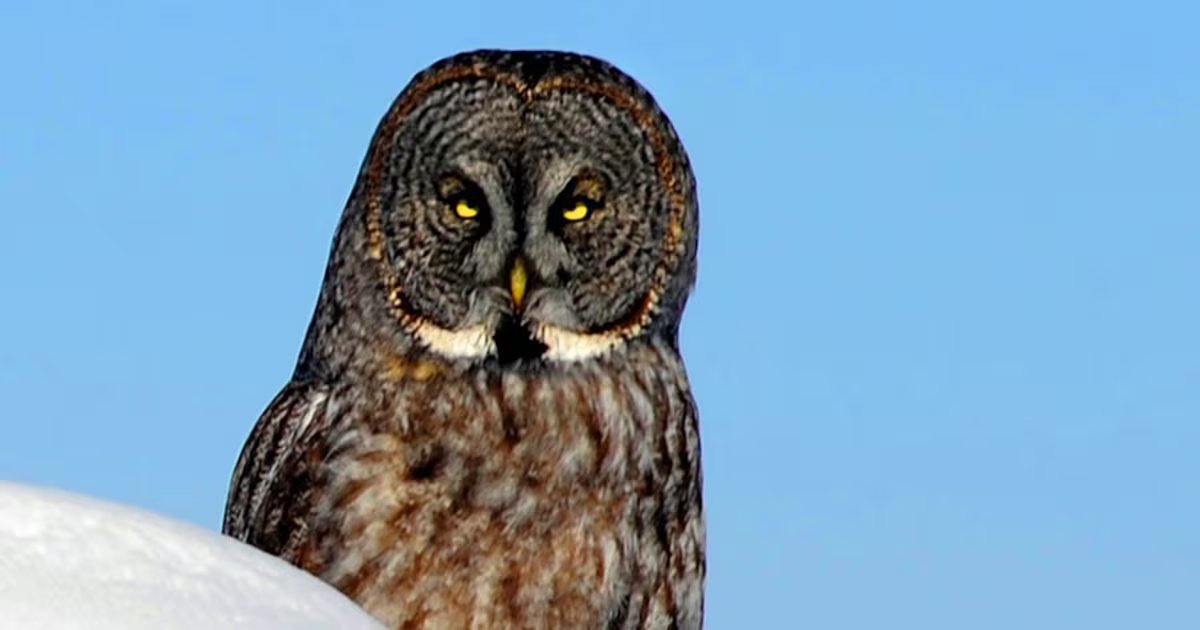
In addition to its literary quality, AQR is known for its artful covers by Alaska photographers. The current issue showcases a gorgeous great gray owl with golden eyes, photographed by Erik Hill.
