


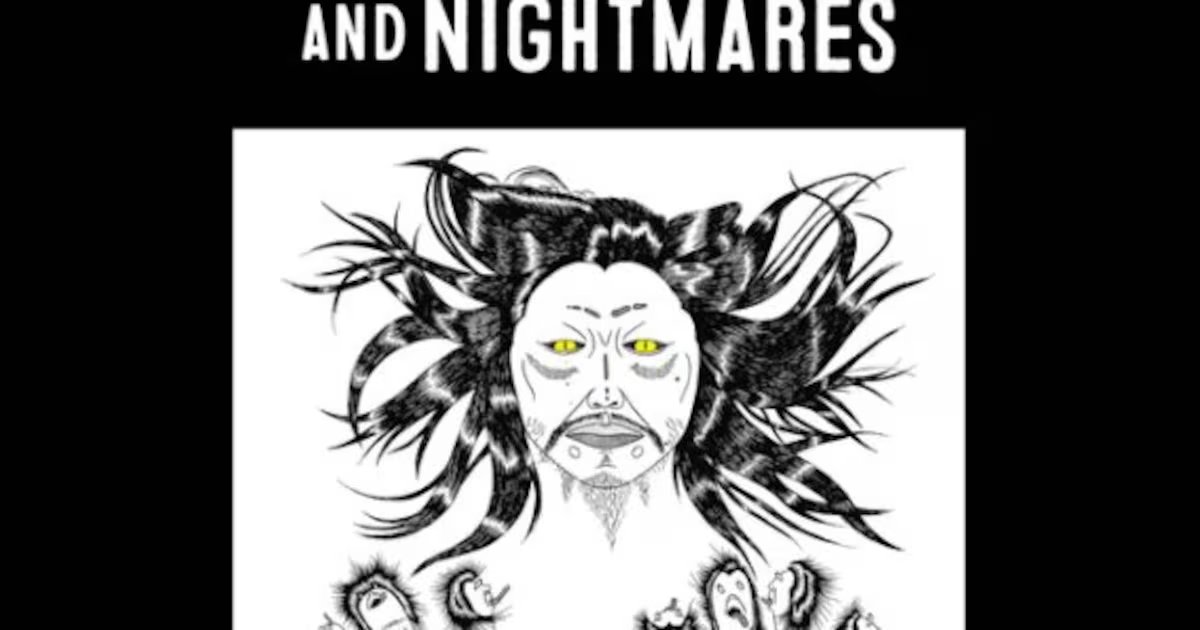
“Arctic Dreams and Nightmares” by Alootook Ipellie
“Arctic Dreams and Nightmares”
By Alootook Ipellie; Inhabit Media, 1993/2025; 166 pages; $16.95.
“I write essentially about the Arctic and its people, Inuit–the semi-nomads who were made to settle down, for better or worse,” the late Inuk artist, author, activist and more Alootook Ipellie tells us in the introduction to his book “Arctic Dreams and Nightmares.”
He goes on to add that, “I write about what I think is right in translating the failures and accomplishments of a distinct culture caught in an unpredictable cultural transition.”
That second sentence offers a summary of what is found in this collection, a reissue of a book originally published in 1993. “Arctic Dreams and Nightmares” offers short stories detailing the life of an Inuit shaman that are illustrated with black and white drawings. These tales range from grim to humorous and varied points between, blending traditional style storytelling with modern day references, an approach lending the assemblage a sense of an Inuit culture both ancient and fully a part of the contemporary world.
That mix of old and new elements is immediately found in the opening story, “Self-Portrait: Inverse Ten Commandments.” Here Ipellie lies half asleep, and a man appears before him with agonized faces on the tips of his fingers and thumbs. Realizing the unknown man is a satanic incarnation of himself, he struggles with it while being told “Thou Shalt! Thou Shalt! Thou Shalt!” in reverse of the Ten Commandments. Ipellie, in this story, is traveling through the cosmos, an aspect of shamanism, while confronting biblical teachings, which in the long span of Inuit culture, have only recently been introduced.
While that tale leans toward horror, another that upends Christian understandings is quite funny. Ipellie meets with God, here known as Sattaanassee, who’s down on his luck because the world has been beset by a recession, and the royalties he’s accustomed to receiving from sales of Bibles have dried up. Seeking succor, he and Ipellie descend to a nightclub on Earth where, with a crack house band behind him, God belts out a song titled “The Heavenly Blues” and the crowd goes wild.
In another story, “Trying to Get to Heaven,” the Christian god has been learned of by the people, and they are trying to reach paradise as best they know how. The famed blanket toss is deployed in the primary example told of here, while later a shaman attempts to achieve the goal by ascending through the hole of an igloo. These efforts fail, of course, although Ipellie and his dogs do soar into the darkness of the universe, never to return.
Digging more deeply into Inuit cosmology, “Summit with Sedna, the Mother of Sea Beasts” brings Ipellie, as shaman, face-to-face with the Goddess of the Sea. As with many mythologies — including Christian, if one truly thinks about it — spiritual beings in Inuit culture are imbued with human characteristics. In Sedna’s case, she’s in a state of sexual frustration rooted in abuse she suffered from her father.
To resolve her dilemma, Sedna has turned to the spirit helpers of shamans to fulfill her needs, and is exacting her revenge by inflicting a famine on all Inuit. Ipellie releases a Frankenstein-like monster upon her, and when her male equivalent, Andes, comes to her in a dream and satisfies her, human survival is assured.
This reflects what is found in the publisher’s note at the book’s opening. Some of the material here will offend or even disturb certain readers, and the book, for all its many merits, should be approached with caution by those sensitive to such things.
The crucifixion of a shaman might outrage the religious feelings of believers. The discovery that another shaman is a hermaphrodite and how this is dealt with could be too much for others. Violence permeates a number of these stories. Nudity, at least somewhat graphic in one instance, appears in the drawings. In one illustration, a naked woman reclined on her back is shown being pulled from her crotch by nine babies.
That art appears in the form of line drawings. The opening page of each story is accompanied by a single illustration to its left. The frequently somewhat surrealist works contain both the Inuit themselves, and/or humans and the animals that populate northern lands and waters. The aforementioned blues band combines a skin drum with Western instruments. A walrus sits with its fore-flippers folded in front like a somewhat annoyed person in a chair. A man attempts to capture a polar bear by both its incarnate and spiritual selves.
This surrealism can also be found in much of the writing. In particular, “The Dogteam Family,” which is reminiscent of the writing of William S. Burroughs. It begins with descriptions of the role dogs play in Inuit society, much as Burroughs would often open a passage with factual and even educational matters drawn from the real world. And then, again in Burroughs fashion, it suddenly shifts gears into a dark dreamscape, with a human body at the center of a rather gruesome activity, one that, within the context of the story, is entirely plausible.
The modern world intrudes frequently. Sometimes it’s a sly evocation, such as when Ipellie asks of another man, “What’s up, Doc?” Elsewhere it’s an outright inclusion. In one of the more humorous yet culturally pointed stories, the recently deceased French actress Brigitte Bardot, known for her animal rights activism, bedevils the Inuit by going after their means of subsistence, a commentary on the vast gulf between the urbanized understanding of nature and that of a traditional culture whose survival depends on harvesting wildlife.
The effect of bringing the outside world in with the old is to convey an Inuit culture at once attuned to its traditions, yet fully inhabiting our contemporary times. “The Arctic is a world unto its own where events are imagined yet real and true to life, as we experience them unfolding each day,” Ipellie tells us. This observation is reflected on every page of “Arctic Dreams and Nightmares.”
[Book review: Putting the work of Indigenous photographers throughout history in focus]
[Book review: A search for the elusive night sky detailed in ‘The Wild Dark’]
[Book review: Steeped in Inuit culture, ‘Leave Our Bones Where They Lay’ offers a universal message]
