


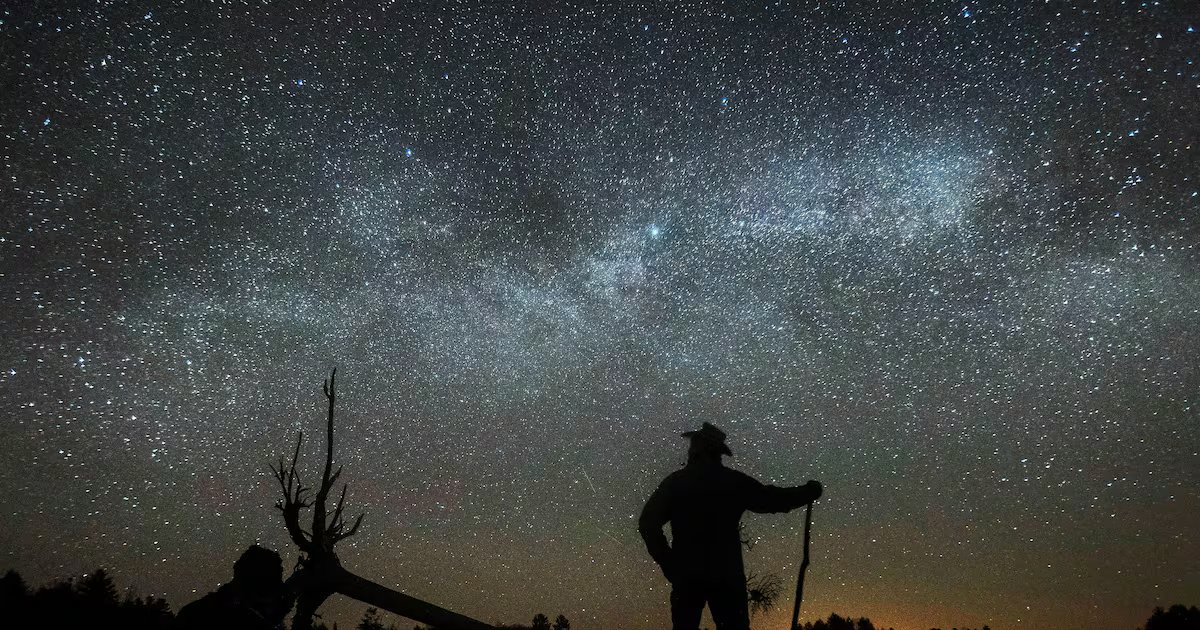
FILE – Dave Cooke observes the Milky Way over a frozen fish sanctuary in central Ontario, north of Highway 36 in Kawartha Lakes, Ontario, Canada, early Sunday, March 21, 2021. (Fred Thornhill/The Canadian Press via AP)
“The Wild Dark: Finding the Night Sky in the Age of Light”
By Craig Childs; Torrey House Press, 2025; 199 pages; $24.95.
In Alaska, we’re fortunate to experience dark skies; most of us frequently look up to see stars and often the aurora. That’s not the case in much of the world. Craig Childs, an explorer-writer who lives in southwest Colorado and whose Alaska connections extend to his years teaching in the University of Alaska Anchorage’s MFA program, informs us that 80% of people on Earth cannot see the Milky Way. And, that between 1992 and 2013, artificial light worldwide increased by 40%; much of this increase relates to the adoption of LED lighting.
Sadness related to the loss of dark skies has a name — noctalgia, meaning “night grief.” Childs writes, “You would feel noctalgic if you’d seen what was here before, if you got out from under artificial skyglow and realized how much beauty is being struck from the record.”
In “The Wild Dark” Childs sets up an experiment of sorts. With a companion, he begins in Las Vegas, certainly one of the brightest cities on Earth, and bicycles 200 miles across raw desert land and along dirt roads, deeper and deeper into darkness, taking measurements and tracking what he sees in the clear sky each of nine nights.
Childs has named his chapters Bortle 9 through Bortle 1, following a scale established in 2001 by an amateur astronomer named John Bortle. To the naked eye, Bortle 9 skies are brightly lit, as in Las Vegas, with only the moon and a few dim stars or planets visible. Each night Childs compares his view to the scale until, far out in the desert, he reaches “a sky I can no longer call dark . . . I’m up to my neck in stars . . . a menagerie of mythic, astronomical structures and possibilities, not just the void of space.”
Along the way, Childs infuses his adventure story with memoir, science, mythology, history, and all sorts of other fascinating personal and cultural matter. The light of Las Vegas is visible for a very long way, and an astounding number of satellites streak the sky each night. Childs writes, “Enough with the satellites already. Now it’s becoming absurd, nowhere to look without seeing little fairy seeds moving left and right.” According to Childs, 10,000 satellites are in orbit at present, with 50,000 expected by the end of this decade.
How does light affect lizards, manta rays, wolf spiders, foxes, turtles, moths, migrating birds, humans? Childs clearly and convincingly explains the science — and hazards associated with the artificial kind. He tells of visiting the World Trade Center memorial with its twin light beams. During migration, thousands of birds were drawn to the columns. “Their inflamed movements reflected in windows of surrounding buildings as if the skies were clogged by the end of aviary evolution … Many would die by exhausting themselves in their wild circling or from smashing into nearby windows, while those that survived would make little or no progress toward their ultimate destinations …”
“The Wild Dark” thus becomes both a eulogy for the loss of dark skies and a celebration of what we can see and learn when we observe the magnificence of what we discover overhead. Dark skies connect us to others across millennia, everyone who has looked up and wondered at what lies beyond our earthly footing. Childs asks us to feel the expansiveness and mystery — the “nothingness of forever” as Childs’ friend thinks of it — that extend past our daily lives and understandings.
Childs studied mythic cosmology in college and once taught wilderness skills to kids on river trips. He tells here of entertaining his charges around a campfire with origin stories, including a Dine one called Coyote Scatters the Stars. In his telling, Coyote stole a pouch of stars from a deity and threw them up so hard they stuck where they randomly hit. The powder in the bottom of the pouch, thrown last, became the Milky Way. When he got to that part of the story with his campers, Childs, dancing around like Coyote, would reach into his pocket for lemonade powder and throw it into the fire “where it would explode into a plume of rainbow colors.”
Toward the end, Childs writes of night sky advocacy and the movement to designate International Dark Sky Communities. His own small town, with his involvement, is one of 22 in the world that have joined that particular program. There are other, similar programs, with different names and lighting policies, including more than 230 Dark Sky Places in 20 countries. None of these are in Alaska, but this website recognizes some parks and other natural areas in the state with dark skies.
Childs is not just massively attentive to the world, wherever he travels, but pays close attention to language. His writing is precise and often very beautiful. On his last night biking into darkness, “A moon sharp and slender as the edge of a clamshell rides low in the west. It’s tipped on its side, freshly back from its newness, a sliver of honey milk bright enough to put a glow on my open hands.”
Readers of “The Wild Dark” will never again look at a night sky without thinking of Childs’ slow and sometimes tortuous pedal across a desert landscape along with his invitations to look up and contemplate our shared starry night. In doing so, we might consider turning off, dimming, or shading the sources of artificial light that blind us to the dark.
