


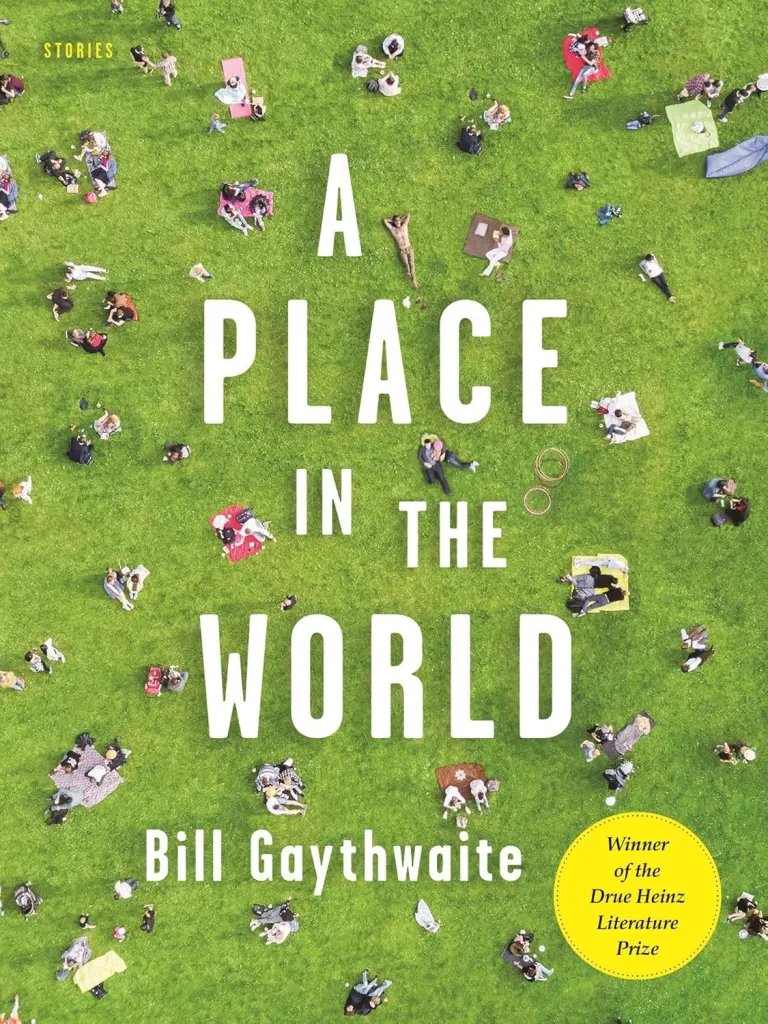
The most recent winner of the Drue Heinz Literature Prize, one of the premier awards for excellence in the short story, is Bill Gaythwaite, a writer with a deceptively casual style and an unerring eye for a good tale. In his new collection, A Place in the World, Gaythwaite introduces us to a cast of characters who have made poor choices in the past and are confronted with the aftermath of their decisions.
Several times, as in the title story, the narrator is a gay man who in his youth did an older lover wrong. In “A Place in the World,” the protagonist, Vincent, describes his long-ago lover, Fisher, as “the sweetest person I’d ever known. His sweetness fizzed up from deep within him like water from a secret spring or something.” But Vincent’s relationship with Fisher is built on lies, and when those lies are finally exposed, it all goes wrong, although Vincent, like most of the other protagonists in the book, ultimately lands on his feet.
We see a similar scenario play out in the collection’s final story, “The Lost Object Exercise,” when, at a weekend house party on Fire Island, the narrator, Nate, runs into Martin McDuff: a man he tells us, “I had hustled and robbed … 34 years earlier, when I was 22 years old.” Although Nate had given Martin a false name at that time, and he now sports a bushy beard, he is ultimately recognized. While Martin holds the power to tell Nate’s unsuspecting husband about what a lout Nate was back in the day, Martin settles instead for barbs: “I would never have recognized you…. You were very handsome once.” And: “You didn’t ruin my life…. You weren’t important enough to do that. You weren’t even important enough to get me sober.” The story, and the book, ends with Nate reflecting, “I was filled with relief because it had all been taken out of my hands. It felt like the other lucky times in my life, when suddenly, out of nowhere, I’d been saved.”
Indeed, unexpected redemption is a major theme of A Place in the World. We see it in “The Joy Factor,” when a prodigal brother finds refuge in the home of his long-suffering sister. And again in “The Simple Part,” when the narrator, still reeling from the betrayal of his now dead boyfriend, finds solace with another man who is perpetually sunny and forgiving. And then there’s Glen in “The Disaster Book,” who even though he’s quarreling with his girlfriend Eileen, imagines a time “when they are settled and married and all this is behind them, [when] they will barely remember the evening’s argument.”
Redemption isn’t always in the cards, of course. There’s the narrator of “If You Only Knew” who resembles his long-absent father in their shared “restlessness, the impatience, the always wishing for something better, and just out of reach, all of which will lead to my own failed marriages, an erratic sales career, and a grown daughter who rarely returns my calls.” And we also have the embezzling Jay in “Certain Healing Properties,” whose wife can already imagine the time when “I will pack my things, leave a note, and close the door quietly behind me, transforming my first marriage into nothing more than a footnote.”
However, even when his characters are making mistakes, which is frequently, Gaythwaite leaves us with the feeling that life goes on despite our troubles. However badly we mess up, he suggests, there will also be another day to remember, or to try and forget, all the unfortunate things we’ve done.
This review originally appeared in the California Review of Books.
