


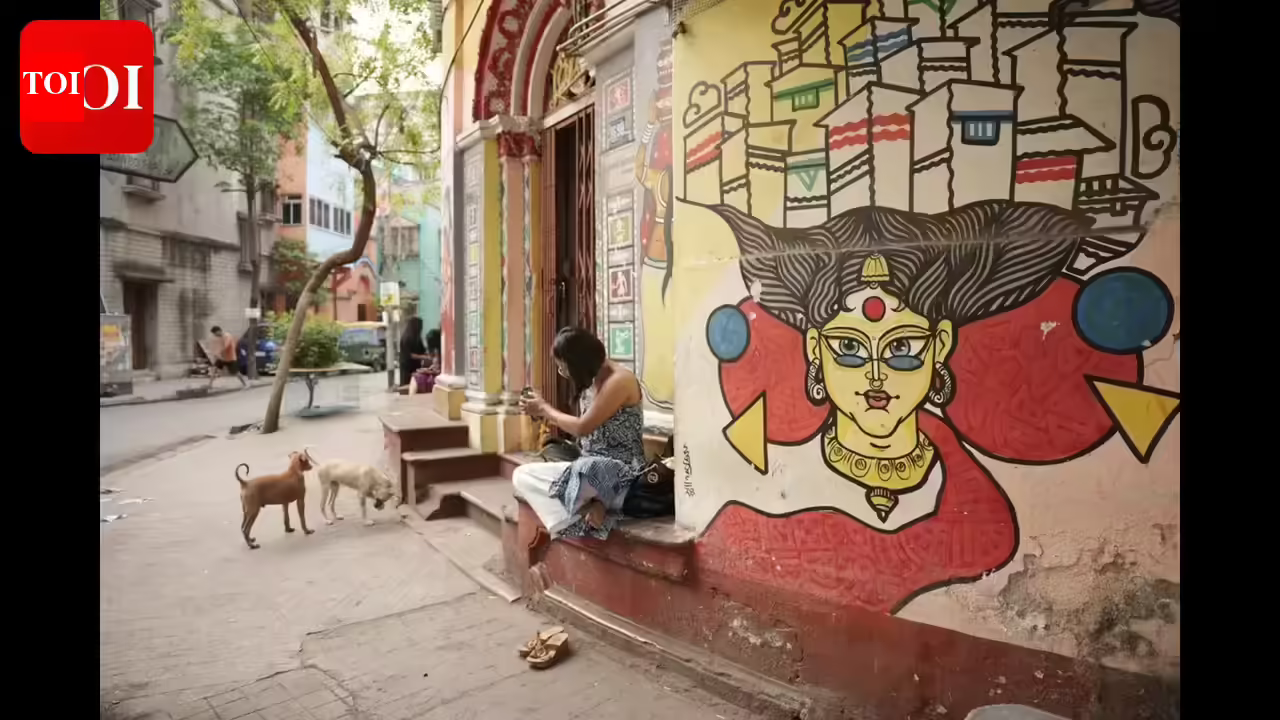
In the heart of Shyambazar, Uttorer Adda has emerged as a vibrant cultural hub where community, creativity and conversation intersect against the backdrop of colourful street art. Positioned along Raja Dinendra Street opposite Deshbandhu Park, the Instagram-worthy adda spot is shaped around iconic cha stalls, a growing tradition of annual graffiti murals painted ahead of Saraswati Puja, a free street library and wall magazine that showcase local children’s artworks and writings. Over the years, the place has become a popular destination for residents and visitors alike, drawing people for adda, cultural programmes, art, and photos – and reflecting the neighbourhood’s living heritage of tea, talk and collective creativity. What it wasFor decades, this lane of Shyambazar was a quaint corner where adda happened at two old tea shops near Deshbandhu Park, known to locals but little publicised. “About 12 years ago, we thought we should do something,” recalls Sambhu Saha, joint secretary of Uttorer Adda, describing the early days before the space took on a larger identity. In 2016, the initiative first came into reality with the Fanush festival, when around 2,000 sky lanterns lit up the streets, and the adda received its now-famous name, though it wasn’t officially registered until two years later. At the time, it was simply a gathering space, a meeting point for local residents and the young, where conversations flowed as freely as the tea, but its potential as a cultural hub was only beginning to emerge. The area’s walls, once blank or plastered with advertisements, were gradually transformed, yet the focus remained on community and the spirit of the adda rather than drawing a crowd.
A canvas painting competition for grown-ups at Uttorer Adda
What it is nowToday, Uttorer Adda has grown into a vibrant urban landmark, a space where culture, art, and community intersect seamlessly. Every year before Saraswati Puja, the walls are adorned with new graffiti – though some artworks, like those in 2024, have remained unchanged – attracting both locals and visitors from across the city. “People come from outside and explore it. Something good came out of this graffiti: advertisements on the walls stopped. The place gained respect, and people realised it can be used like this,” says Ganguly, whose signature style now shapes much of the area’s street art. Beyond graffiti, the adda hosts a five-day programme with music, drama, painting, and a canvas art competition that has run for nine years. In 2021, the community set up a street library and wall magazine featuring poems and paintings by neighbourhood children, with the support of councillor Dr Meenakshi Ganguly, while a statue of Dr Sarvapalli Radhakrishnan was installed that September. Young people, particularly those active on social media, now flock here, and seasonal stalls and cultural events keep the adda alive. As Saha notes, “It’s a collective effort,” reflecting the evolution of Uttorer Adda from a simple tea‑shop gathering to a celebrated space of art, learning, and conversation. Why we love it
- Uttorer Adda is covered in colourful graffiti and murals that change over the years.
- It hosts music, drama, painting, and canvas art competitions.
- Children and neighbours actively participate in cultural and creative activities.
- The street library and wall magazine encourage reading and artistic expression.
- The adda has stopped advertisements on the walls, giving the space a cleaner, more respectful look.
- It preserves the charm of old tea shops while supporting contemporary art.
- People from across the city come to explore, photograph, and enjoy the space.
- It is open to everyone and fosters a sense of community.
We began with simple programmes around Saraswati Puja, and over the years it became a place for music, painting, theatre and a street library, all of it a collective effort to keep the spirit of adda alive
Sambhu Saha, joint secretary, Uttorer Adda
There was no concrete plan, just a desire to make the place beautiful. None of us expected it to go this viral
Swadhin Ganguly, artist
