


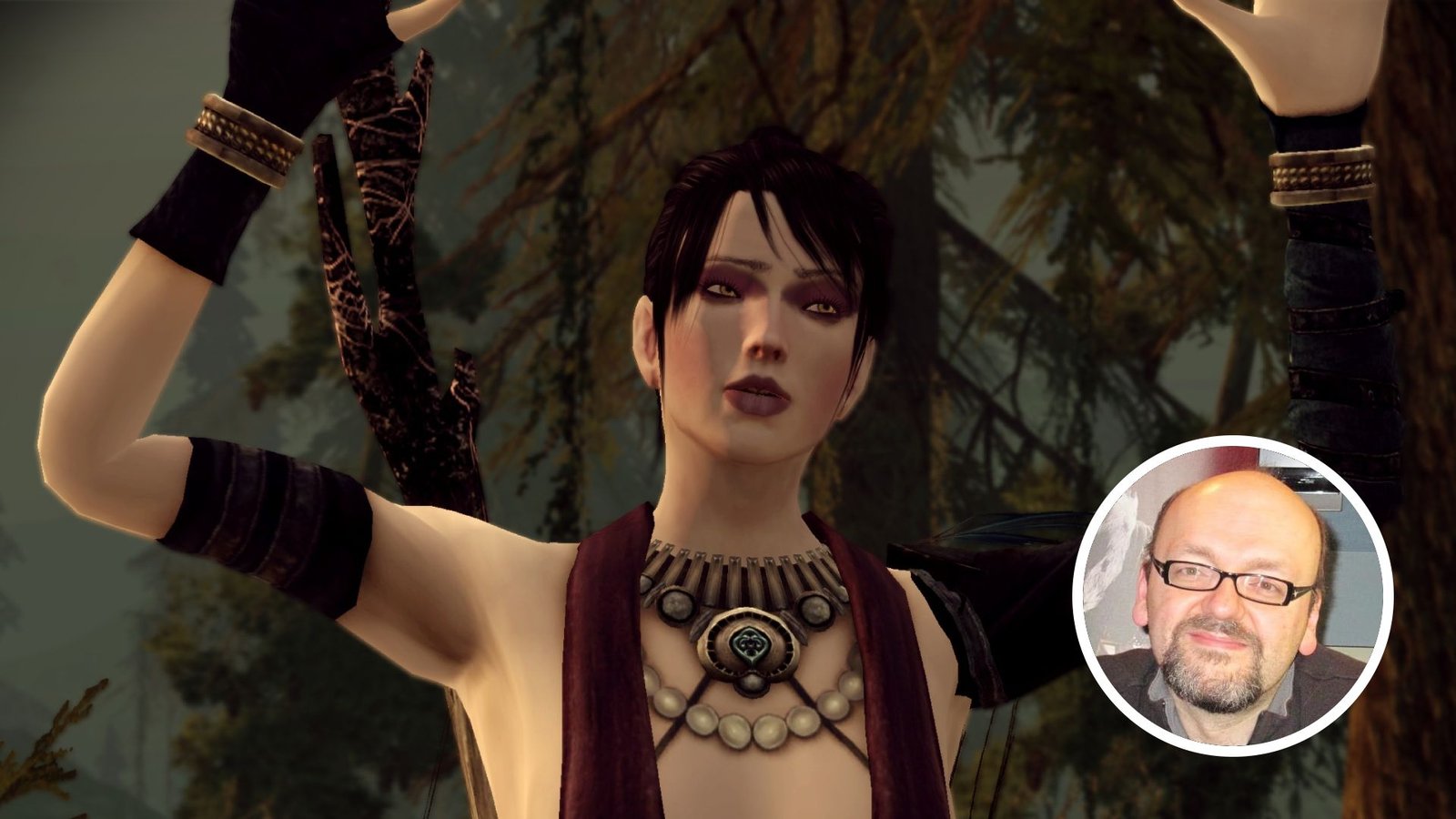
At the bidding of BioWare’s bosses, David Gaider created the world of Thedas, the setting of Dragon Age. And lo, it was beautiful, for a time. But he left the company after an abortive spell on Anthem, and today he’s working on a new RPG.
“You play a crew of rogues in an airship that go around performing heists,” he says. “And this leads you into a plot that becomes, maybe, your more typical RPG.”
Gaider is best known for his dark riffs on sword and sorcery—beginning with the half a million words he wrote for Baldur’s Gate 2, before taking on the all-timer Neverwinter Nights campaign Hordes of the Underdark. Then there was the decade he spent steering Dragon Age. But this time, he’s shooting for something a little more lighthearted.
Latest Videos From
“I wanted to do something that was not full-on comedy, but something that could make me smile,” he says. “It seems like at this point in the world, we could use something like that. I know I could. So that’s what we’ve been working on, and it’s been getting a great reception.”
The trouble is, the games industry is currently on fire. “It’s been almost three years it’s been going through this weird contraction,” Gaider says. “The most obvious effect of that is all the layoffs, but that’s just really a symptom of all the studios clenching at once. On the funding side, nobody wants to actually commit to a project unless they think it’s a sure thing, and that boils down to existing IPs, sequels, that sort of thing. New projects, almost nothing’s getting funded.”
You may like
And so, the praise that Gaider’s heist RPG has been getting from publishers hasn’t yet resulted in the cash needed to complete it. “Our first prototype was a much simpler version,” he says. “We had our vertical slice, roughly of the quality level that we would release at, and a bit more of the game at a simpler version to show the publisher what we were thinking. And then they’re like, ‘Well, we want to see this further along’. So we had to take that and expand on it quite a bit more.”
(Image credit: EA)
A lot of publishers today are looking primarily to fund games that are already 80% completed—minimising their risk as they help projects across the finish line. “With one publisher, we said to them, ‘Are you really waiting for us to finish the project before you commit to it?’ And they embarrassedly were like, ‘Well, in so many words, I guess, yeah.’ There’s a lot of smaller studios like ours that are really struggling at this point.”
There’s a lot of smaller studios like ours that are really struggling at this point.
David Gaider
Gaider co-founded Summerfall Studios in Australia almost a decade ago, and spearheaded the development of Stray Gods—which played like a classic Telltale story, only with musical numbers that adapted according to your choices. Though not a full-fledged RPG, it left me with the same queasy sense I’d felt playing Dragon Age: Origins—that perhaps my love of its characters had led me to make indefensible decisions.
Ironically enough, Gaider believes that Baldur’s Gate 3 torpedoed any chance Stray Gods had of commercial success. “I don’t think Larian were expecting Baldur’s Gate 3 to be a big hit,” he says. “They were hoping, maybe, but they were nervous. In fact, they moved their release date because they were really nervous about, of all things, Starfield.”
(Image credit: Summerfall Studios)
Larian pulled the launch date of Baldur’s Gate 3 forward—a move almost unheard of in game development—and plonked it right on top of Stray Gods. “I was kind of raw about that,” Gaider says. “Would Stray Gods have been a hit if that hadn’t happened? I don’t know, but it certainly meant that we had a real hard time getting noticed.”
What to read next
Afterwards, Summerfall made DLC, and built a narrative-focused deckbuilder named Malys, starring an exorcist on a motorbike. “We really didn’t expect Malys to make any money, actually. It was a little side project we did to keep all hands at the studio busy while we were working on this project,” Gaider says. “If Malys had sold better, maybe we could have had a bit of a longer runway to get this prototype finished up. But you know, we’re doing what we can.” Finding further funding for the heist RPG is “make it or break it for the studio,” Gaider says. “So, lots of stress.”
Meanwhile, at BioWare, the series Gaider helped birth has continued in his absence. Dragon Age: The Veilguard came out in 2024, though Gaider didn’t play it. “I know too much about what went on behind the scenes,” he says. “The ordeal that the team that remained went through to make it. And I know that they were handicapped from the get go. Electronic Arts really did a number on them in terms of setting them up to fail, honestly.”
(Image credit: BioWare)
In PC Gamer’s largely positive review of Dragon Age: The Veilguard, the major complaint was that there wasn’t enough friction in its world; too few of the conflicting ideologies which, in previous entries, had caused head-on clashes in beliefs between would-be allies.
They need the ability to be unhappy with your decisions, and possibly even turn on you.
David Gaider
“In terms of having characters with agency, I think that’s vital,” Gaider says. “They need the ability to be unhappy with your decisions, and possibly even turn on you. If you don’t follow it to its natural conclusion, it’s like playing a D&D game where you know that the DM will never kill your character.”
Without that potential for real loss, Gaider reckons, a game loses its tension and capacity to convince. “Is that what the writing team on Veilguard intended? I don’t know that’s necessarily the case. I think that’s what they were kind of forced into, would be my guess, without knowing details.”
(Image credit: BioWare, Electronic Arts)
Back in Baldur’s Gate 2, companions could betray the player, or become so appalled at their actions that they drew their swords and fought their former comrades to the death. And even later, in Dragon Age: Origins, a disagreement with a party member might mean losing their support right before the final battle—scuppering your well-honed battle strategies and spell synergies in the process.
But over time, BioWare shifted towards the path of least upset to the player. Companions became less like human beings, corralled into uneasy cooperation, and more like foils you could simply send to camp or a waiting spaceship—ready to be dusted off and reactivated at the hero’s convenience.
“That sort of sentiment was getting stronger and stronger even as Dragon Age went along,” Gaider says. “This idea that, ‘Oh, we can’t let the player accidentally screw themselves.’ I think that was part and parcel with, ‘We need to have as broad a player base as possible, so we can’t make it too difficult. We can’t let the player get themselves into a position where now they can’t finish the game.'”
(Image credit: BioWare)
Gaider thinks that kind of thinking was backwards. “This idea that we can’t permanently take someone out of a group, that followers have to be agreeable for purely gameplay reasons, runs contrary against the thing that made BioWare games most popular,” he says.
So why not just lean into what you do best, rather than trying to lean away from it in order to make other things more broadly acceptable?
David Gaider
“The earlier games, all the reviews that came out, they always talked about the amazing characters. So why not just lean into what you do best, rather than trying to lean away from it in order to make other things more broadly acceptable? If you’re not making a game for the audience that loves those games, you’re trying to make this game acceptable to some action gamer who, what, doesn’t like difficulty? Who is that?”
If Gaider gets to finish his heist RPG, it’s fair to assume it’ll hew close to the long-held philosophy hinted at here. A commitment to imbuing characters with inner lives which, at times, override the immediate desires of players.
(Image credit: BioWare, EA)
“We tried ‘all the romances are available to everyone’ in Dragon Age 2, and I didn’t like what effect that had on the characters,” he says. “I get it, players want what they want. But from a project level you have to answer the question: why are these characters here? Are they there just to provide enjoyment for the player? And if the answer is yes, perfectly valid answer. But if the answer is, ‘No, our goal with this writing is to create believable characters that have agency of their own, and that’s part of their appeal’? Then you should follow through with them having identities of their own. They should have the ability to turn down the player. This is not about wish fulfillment.”
Of course, if a publisher doesn’t bite, Gaider might not get to make his heist RPG at all. “I’m kind of philosophical about it,” he says. “Not everything lasts forever. Seven or eight years is a nice long run, and it’s been fantastic. As to what I would do afterwards, if that was the end of Summerfall, I don’t know. Is it even possible to find a job in the industry these days? Would I be competing with people of my own seniority, and begging for a job?”
One upside, in that scenario, would be setting aside the responsibility of running a studio and letting someone else handle the pitches. “Oh, what I wouldn’t give to work on Owlcat’s The Expanse game,” Gaider says. “The Expanse is right in there with my core interests. I’ve watched the show a few times, I’ve read the books. That’d be great. If I could find something that lit a fire under me, that’d be the ideal.”
(Image credit: Owlcat Games)
And Dragon Age? News recently circulated that Richard Garriott might get his hands on the copyright for Ultima, so it’s not impossible to imagine that Gaider might one day have an opportunity to play in Thedas again.
“If you’d asked me that in the past, I would have said absolutely not. That I’d done my time,” he says. “But I do like a challenge. So if, out of some weird alignment of the stars, somebody handed the Dragon Age franchise back to me and said, ‘Breathe the life back into this baby’? That’d be a tough one, but I think that’d be an interesting thing to do.
“To go back to the basics of what made Dragon Age appeal to so many people in the first place. And go somewhere dark and dangerous, and do things that will make people upset. I think that’s what I would want to do with it.”
