


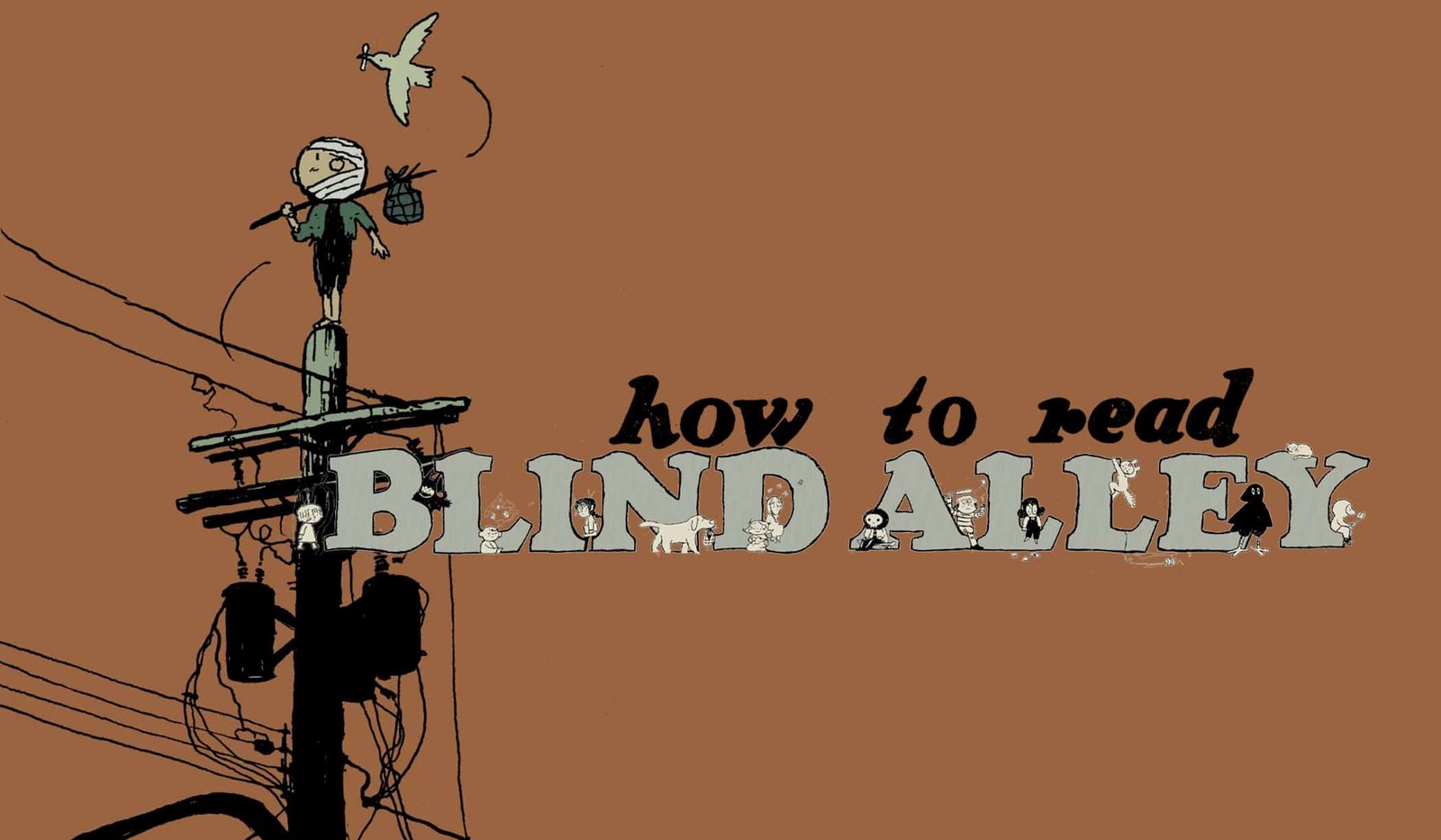
Blind Alley is a comic strip. So if you’re here reading this, I’m guessing you’ve got the essentials down already. Start with the first panel, and when you get to the end, stop. Did I say how to? I meant how you. Adam de Souza’s strip is mostly episodic (as in self-contained, rather than serialized) and leans heavily esoteric, so you can start at the start if you’d like. Or you can start anywhere. Kids, pets, a monster or two, no adults, no school, yes reasons but no answers. Gags. Moments of clarity. You got this. Blind Alley is sad and funny and cryptic and earnestly, brazenly vulnerable, often strange, occasionally haunting. In 2026 it enters its fifth year of publication, so it has had the time and room to be all kinds of different comics. And it is.
The kids who populate Blind Alley do what we do: collect comics and take care of each other, play dress up and have rivalries that are also friendships and vice versa, make mistakes, touch grass. Young enough that the distinction between what’s real and playing pretend is not yet set in stone. This state of somewhat-fiction is further obscured by the paranormal edges of the strange setting of the strip. A kind of abandoned neighborhood? A place big enough for town but not quite a city, what would be a town if there were people around. The monster who lives in the sewer is a Moominesque neighbor with a sweet tooth to be interacted with like any other resident of their odd borough. But there’s also a sense of real danger and destruction beyond the boundaries of the Alley, waiting. Implications and airs, underlined or undermined, depending on how you approach the text.
Blind Alley is a comic.
Blind Alley is a serial strip, but its story’s progression is buried in a long read of the whole, not by reading them in their release order. The moments that matter rise up and assert themselves as undeniably as a wave hits the surf, and dissipate just as instantly. Most Blind Alley strips are independent from plot, saturated with feeling. We return to themes as the personalities and interests of the kids develop over time and, in a sense, establish what they are. First stealing manga and spending whole strips just reading it, then making zines and trying to sell them at the iconic comic strip sidewalk stand (normally reserved for lemonade or psychiatric help), eventually neither reading nor making comics but agonizing over them like a real, professional cartoonist. This does happen, in that order, but it has taken years of real time to get there, breadcrumbs followed across volumes.
Adam de Souza is more interested in climbing trees than reaching plot milestones, prioritizing naming clouds, breaking stuff accidentally, breaking shit on purpose. Going too far, doing the right thing, collecting ephemera, watching television. Fixing what’s broken. Imagining things that aren’t. Taking a dump with the bathroom door open. Being chased to the cliff’s edge by shadow beasts. Being a nerd, a sibling, soft, strange, alone, annoyed, a baby with psychic powers, a tree that vibes, a dog, a vampire. A strip that mixes nostalgia and dystopia to create uncanny familiarity.
Rather than Peanuts, the movie Welcome, or No Trespassing! comes to mind, a surreal comedy where childlike wonder is given the reins. Innocent but not naive. The kids are old souls that will then react to things in a way that reminds you of their real age. How would a kid tell an adult story? Like The Adventures of Pete and Pete, unafraid to be ridiculous. It would be deadly serious, but also completely unguarded. Absurd, to us, because we’ve aged out, traded innocence for sense. So, melancholy, too.
They call ‘em “big foot comics” when they have that Harvey brand retro for-kids look. Their forebears had big feet, big hands, big heads, easy to identify facial expressions and clear gestures that did half the storytelling. The cartoonish proportions mostly receded over time, but the heads stayed big, and facial expressions are crucial to the vibe and humor of the big foot strip. Like, this strip. You can see when someone is having a hard time. Or a good one. The cast is coded to look like comic book kids. What they’re going through isn’t. And so there’s a quietness not present in Little Dot.
Blind Alley is spare and sketchy, more aesthetically in line with comic books than comic strips’ print-conscious clarity. For all its visual hat tips to cartoon comic conventions, stylistically de Souza’s linework stands closer to the expressiveness of Jillian Tamaki than the precise control of John Pham. Like Ben Sears’ singular and delightful Young Shadow comics, de Souza is a cartoonist deeply aware of that he plays in the halls of history, yet what it looks like is what it is: an indie comic made in the 2020s. There’s something bittersweet and sincere about de Souza’s hushed style that one could mistake for somber, if not mature, until there’s a fart joke. There’s an “ah” moment buried in every good graphic novel (see de Souza’s own The Gulf) where the whole read rushes up at you, and Blind Alley is that feeling plucked from its context, dropped into your social media feed.
Blind Alley is a comic strip.
How you read Blind Alley affects what it is. Give it your time, and structures will reveal themselves. But once you do start to put it together, the emotional focus shifts. Making Blind Alley a story draws the reader to narrative associations, details, expectations. The cartoonist is conscious of this loss, and de Souza decides to dance with mystery, resisting his own machinations and keeping explanations satisfyingly out of the reader’s reach. As time develops the series whether the cartoonist wishes it to or not, de Souza finds other ways to approach Blind Alley and keep what’s unresolved intact- comics outside the comics, comics with collaborators, future comics. What counts? Where is the real Blind Alley?
The natural habitat of the comic strip has drastically changed as the medium crossed centuries, the newspaper replaced by the newsfeed, the concept of a fixed news cycle destroyed completely. In the golden age of superstar cartoonists like Jackie Ormes, quality comics inserts like Carousel were added by newspapers to attract customers. I remember comics at the other end of the 1900s, in the back of the Magazine section, by the TV listings. The jump to digital has fractured comic strip distribution with the rest of the paper, and they too live on in the newsfeed- or can, if you choose to see them. Some comics on the internet you see whether you choose to or not.
As grim as that sounds, there is something to be said for encountering a comic strip’s installments unscheduled rather than seeking it for consumption from an outlet. That’s where the mood de Souza is cultivating works the most magically. The blossom that comes up from between concrete slabs. Scroll past and you’ll miss it.
But spend time with it, and you come to know the characters through their habits. Repeating scenarios are common to classic strips and Blind Alley is no different. Pursues little storylines, moments that tell a story together, but shuffles them into the mix with all the other slices of life, every other plot line, so that it moves forward in seasons, not serially. With the ensemble of characters, de Souza cuts from one story to the next, all of them in a sense ongoing and progressing, but each fully functioning as a stand-alone episode.
Blind Alley keeping the kids as kids also serves to preserve the mystique. Not being old enough to really understand a job but attempting it anyway is a recurring issue for latchkey kids in suburban Gormenghast. So when the kid is still a kid, when the well overflows and emotions ride out of control, it’s a relatable breakdown to anyone who grew up a human being. They lose things and break things, people get sick and there’s nothing you can do about it. Life gets away from you, sometimes for no reason at all. And that’s funny. But also, ow. A realness, buried in the comic deeper than the characters or the setting or punchlines, one that needs no backstory.
It’s a book on a shelf.
Part of what makes Blind Alley compelling is that it works in any of these scenarios, from a surprise amongst the horrors, to presentation in isolation as story elevation. You could argue that Blind Alley has a literary value worth removing from the feed so that it can be considered as a story (you’d be right). Coming to know the characters and the meaning of what they’re doing is a function of the reader. Whether collection facilitates understanding or manufactures it is a question for Kuleshov.
So imagine a dog, unable to wake, and another dog bringing her all sorts of things, hoping each will have the scent that brings her back, I guess, until she sleeps walled in by piles of food. This is perfectly the mood of a Blind Alley strip. It’s all you need. The cocktail of bittersweet anxiety intoxicates. But if you know what you’re looking at, there is a significant, additional emotional payoff.
Blind Alley conveys the feeling of being overwhelmed by the world. Out of context, acted out by kids and talking animals, there’s a shock to seeing ourselves. A reminder that we have locked up our reactions with rational grown up logic, but we still react that way nonetheless. Seeing them act it out is blackly humorous, strangely cathartic. Put into a structure that is expected/intended to recreate the comic’s reading as a coherent vision, it becomes an empathetic connection to the characters more than catching yourself in the mirror. Spending time with them makes their fate more important to the reading.
Take a character who’s on a journey: every time you see them, their four panels are spent walking, or tired, or both. A book sets these moments in sequence, covering a now-invented distance from start to finish. Before the setting was abstract, but upon arrival at a destination, suddenly where we are is a concrete consideration. Will the baby stay a baby forever? So far, the passage of time is reflected in the characters becoming more mature, but not so old that they grow up.
The thrust of the comic is emotional, it makes sense its development would be more internal than external. Characters change and their relationships do too. The gang’s bully becomes the friend who is tough to hang out with, without resolution or evolution or literary intent, just in the way that people change because some folks are like that. A testament to de Souza writing characters and not caricatures is that they can act completely differently from strip to strip, while staying true to who they are.
Again, this perception of the strip being at a crossroads of content arises. Reading it as a collection does make me wish for specific stories to develop, travelers to arrive, dogs to wake, tears to dry. But I don’t want the series to cast aside the magic of the unexpected just to follow a plot. Skull kid loses a dog (she’s still out there!), and feels shitty about it for a long enough time to accept being an emotional recluse, only to accidentally adopt a cat. I would not trade this for the world. I love this journey for the character, love how it was told in inspired bursts, and trust the series will continue to find a compromise I myself cannot settle on.
It’s a consensus.
So what is Blind Alley? If a world exists beyond the moment, as its collection/collation implies, where do its borders lie? Mutt Mag, another de Souza publication- this one an anthology in graphic novel format- has Blind Alley comics that aren’t the strip. You don’t even know it’s a Blind Alley comic until you stumble across some of the characters. Suddenly, all the weird alternate Alley stuff that the kids have encountered when they leave town is given a scope that puts to rest the question of the setting’s permanence.
It’s some kind of Heavenly Delusion situation, only on the outside people are normal proportions not uh postmodern big foot coded. Anatomically correct guest stars helping the iconic big foot-sized cartoon kids solve their mystery is actually pretty comics-accurate anyway. To say nothing of the body size mishmosh manga influences like Dragon Ball hold on the series. But now not only do readers (outside the strip) have to contend with Blind Alley being a world, a real world, they have to reconcile it as being within another world.
Comics outside the series, like Mutt Mag, add to the structure that the strip reveals when collected. A time jump comic set in Blind Alley’s near future has allowed de Souza around the frozen, eternal now of the central strip. He’s building the story without compromising the tone his strip’s pacing thrives in. So what happens to this critical narrative of mine when other cartoonists besides de Souza do Blind Alley strips?
His Guest Book peers are contributing to the conceptually/physically collected world by giving de Souza’s original strip comparative distinction, and by solidifying their identities as real enough to recognize and riff on. The claim that the strip is just vibes doesn’t stand up when someone else can read it and then get the character right. There’s more to Blind Alley now than just Adam. Since the guest comics get digitally published through the same organs as the strip proper, there are conceivably readers of de Souza’s Blind Alley who have never read anything by de Souza, including Blind Alley.
Adam de Souza is a person, and as such is subject to change. What I have observed as a reader about Blind Alley and its relationship to its cartoonist is not some concrete truth the strip is bound to adhere to. He isn’t the same cartoonist as when the strip began. The dance between story and mood will never cease because de Souza grows alongside his characters. The act of creating art produces its own unexpected perspectives, clues that one pursues. Blind Alley changes itself.
The obvious place to explore outside the text in the search for meaning would be the perspective of the cartoonist who drew it. I don’t subscribe to the notion that the work’s creator is its sole arbiter of its meaning, and neither does de Souza. When we talked, it was about format and intention, uncertainty and magic, collaboration. He doesn’t clarify lore, he says things like “I felt this longing to see people completely destroy or change what I made.”
Adam is humble, worried about seeming ungrateful for the success his work has brought him, calling up the names of friends and interests with unbridled admiration as clear as his troubles are murky, all things I’ve excised from our talk here. Who the cartoonist is lends perspective to what they try to say, but what follows is more concerned with whether there was a tension behind having a strip that works multiple ways (there is). How the author reads Blind Alley can color your take, but even de Souza admits that he doesn’t have the final say on what Blind Alley means to you. Furthermore, he doesn’t want to.
Blind Alley comes from a cartoonist.
ARPAD OKAY What I’ve focused on is different ways of reading the strip, different formats creating different impressions. I found that over time I went from enjoying the strip because “I relate to that” to liking it because “I relate to them.” Or I guess I went from feeling surprised to feel seen, catching myself in the mirror, to attributing what the characters are going through to the characters themselves, as I grew to recognize and care for them.
ADAM DE SOUZA Blind Alley is written with an understanding that it will be read in a lot of different contexts. At its best, I want it to be format agnostic, but that’s not actually true because it is something with a gentle forward momentum.
I want to make something that passively invites readers in. I think there’s a tension between wanting to write something that feels like a strip with a status-quo, but that is shifting gently over time. There’s a bit of a fear knowing I am always moving the strip forward, there’s this sense that I am constantly leaving things behind. But I’m not actually interested in keeping these characters safe and locked in amber.
I remember feeling somewhat bewildered when engaging with long-form serialised things like The Simpsons or even Peanuts. The characters have pretty selective memories. You’re not really supposed to engage with it like something on a fixed timeline- which is a thing I really admire now. But, as a kid, I always found myself wondering what stories mattered to them. What changed them about their experience? Was Charlie Brown thinking differently now?
All that said, I really love being a bit lost as a reader. I think my favourite stories are ones that are generous with a reader’s ability to fill in gaps. I think part of what I love about a comic strip is the form has a passive quality. It doesn’t require much from a reader– who was it said that you can’t help but read a good strip? You just kinda absorb them.
Blind Alley: Five Years On
I don’t know if I always nail it, but I want most strips to stand on their own. Or, if they make a reader feel lost, that it’s in an intriguing way. I try to do this by focusing on what characters are feeling as opposed to the specifics of the action or plot. I am interested in how small moments and the world shapes us.
AOK So it to some degree is a matter of format? Comic strips in their natural habitat are surrounded by other things. Blind Alley in the scroll with all the rest, but also historically in the newspaper, they are surrounded by para-text, ads, non-comics stuff in the same space.
While collected editions remove comics from their publishing context and present a version that’s supposed to represent the artist’s vision, the beau idéal of the comic, unblemished by uneven print quality and without the ads and other off-message stuff from cohabitation.
So people getting the “story” when they read the book makes sense, undiluted and collated, given a start and a finish that one can read the breadth of. But your intention is to not have a story.
ADS I actually think there’s something better about the context readers would find strips back-in-the-day, about our relationship to the newspapers as an object. It’s a finite thing. It’s something that arrives at your doorstep or is at the local cafe. Anyone who picks up a newspaper may find themselves reading a comic.
It feels like a feat to have any audience at all, so I am incredibly grateful for it. However, running a webcomic, I feel aware of how separate my audience is from a general one. The majority of people who read my work follow other cartoonists. They’re people I would meet at zine fairs and comic fests. They’re already bought into comics. There’s no obvious way to get work in front of people outside of your sub-group.
I say all this because I genuinely think the strip as a form is made to be casually encountered. But social media feels like the worst way to enjoy any kind of art. The contextless and endless scroll; my work next to the most horrible thing you’ve ever seen. I think it’s the endless quality of social media that makes it so incredibly numbing. I’m not sure how anyone could enjoy a Blind Alley strip after watching a video of grieving parents in Gaza. I don’t think anyone should enjoy my work next to that. It all loses meaning. It feels like a context that devours meaning, reflection, and patience.
I don’t need my work to be printed beautifully, with no other noise to clutter my narrative. I am okay with my work not being treated as an art object. I put a lot of care into my work, but I am not precious about it. That said, the book or the website is Blind Alley. For a curious reader, it’s how to understand the characters and what I am going for. I just kinda bemoan that there are walls around it.
I am mostly at peace with Blind Alley, or comics in general, being a private garden. I feel like everything exists in a trench; there are no open fields to discover comics or invite new readers in. I philosophically do not agree with a world where we are recommended things only based on what is similar to what we’ve already digested.
AOK I think that, over time, you get stuff through osmosis with Blind Alley (and all strips). But like I was saying earlier, I don’t feel like the unexplained pieces are missing, so much as I didn’t consider their existence at all. The setting being a real place, why? It lends visual character to the story, but the emotional character that drives the strips doesn’t rely on those kind of details. A grassy hillside is a great place for lying out and philosophizin’ whether it’s the east side of town or the west or whatever. It didn’t need to be anywhere to achieve what it existed for.
Richie Pope in Blind Alley: Guest Book
So on the subject of free-associating meaning behind Blind Alley, you’ve got friends contributing now. When they bring stuff from outside of your experience/expectations to the art, how does that affect what Blind Alley is? Do you think that other people’s tribute work is doomed to be imitative of yours, or are there aspects of Blind Alley that they can express that you can’t? Does Blind Alley stay yours?
ADS The more I write in Blind Alley, and the more I expand the world of it, the more cognizant I become of the fact that it could all become too much nebulousness and crush the weird little charade the strip has going. I always want the strip to exist on two plains.
As I build out Blind Alley through side stories like “Truffle Pig” in Mutt Mag, I become all the more aware of this. I feel like I am constantly juggling giving peeks at something but not wanting the shape to be clear. I think if the shape ever becomes clear the strip will be over. If I tease an audience too long it’ll feel frustrating. I feel certain that the longer I do this strip, the more likely it is to cave in.
Since Blind Alley is such a strange, nebulous, and personal project, it’s also been clarifying to see how the strip is seen from the outside, via cartoonists I respect. Obviously, this strip is something very different to me. It’s interesting to see what themes or characters other creators gravitate towards. I actually believe it’d be pretty fucking ridiculous for me to invite guests to draw my strip and then have any sort of expectation, value judgement, or strong feelings on what they should or shouldn’t do with my characters. I don’t think being “imitative” makes it “doomed,” I think it’s a game where I’ve handed cartoonists the characters and world and told them to play. I take collaboration seriously; you have to let people have their fun.
I grew up as one of those nerds who was deeply excited by the idea of stories sharing a universe. The shine of that mostly wore off — so often it demystifies or deflates what is special about the fantasy of a story. The pinnacle example of this is also the one I happen to still remain the most entangled in: Star Wars. It’s the most frustrating thing, that there’s this huge messy canon hanging over this play-space. When disparate stories don’t fit together, they try their best to shoehorn it in, and it all feels very sweaty and uninspired. I enjoy Star Wars so much more when there are gaps for me to wonder.
If Blind Alley had a fanbase that was updating a wiki I’d probably start to feel a desire to ruin the strip. I’d definitely feel this desire to take it in a direction where sense cannot be made. I want readers to have fun in the gaps of what I’ve made. I don’t want there to be a right or wrong way to read my strip. I don’t want them to feel like my answer is more important than theirs. It all isn’t real; by a comic’s very nature, there will always be spaces in the gutter where things that happen that you do not see- that’s yours.
The setting of Blind Alley is intentional and so are the characters that exist in it. They are experiencing mysteries that are weird to us, but it’s not about those things, it’s about kids growing up and feeling things. It’s about how this strange-to-us world shapes these kids. I mostly “know” what’s going on behind the scenes, but the strip isn’t exactly about that. If I gave readers all the answers it would be deflating. It would be boring. It’s a play-space for wondering and I am deeply uninterested in answers.
I don’t want it to be something finite.
Blind Alley is online at blind-alley.com and Patreon, and is available in print from de Souza or wherever niche comics are carried.
