


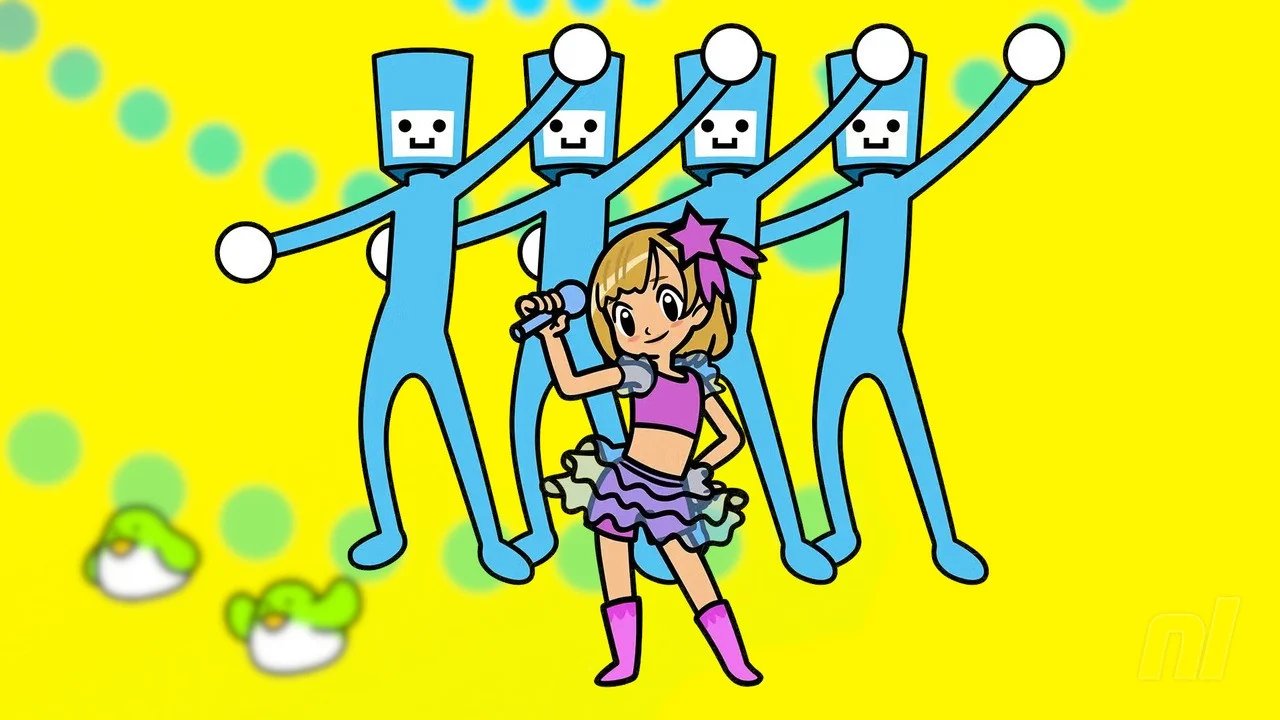
I remember thinking that 2023’s Tears of the Kingdom was the perfect bookend for Switch 1, a fitting sign-off for a generation which began with a transformative open-world take on Hyrule. But Switch 2 wouldn’t arrive for another couple of years, which means it’s a very different game that gets the ‘swansong’ label.
And low-key as it is, Rhythm Heaven Groove is the perfect encore for a little system that sought to match the rhythms of 21st-century gamers. It’s also perhaps the best justification for tabletop mode yet made, though for irritating reasons.
Captured on Nintendo Switch (Handheld/Undocked)
For fans of the series — which started on GBA in Japan as Rhythm Tengoku in 2006 before getting DS, Wii, and 3DS entries in the decade that followed — I’ll save you some time: this is a Rhythm Heaven game (unless you’re European, in which case it’s a Rhythm Paradise game), so skip to the end, check the pros and cons, then buy the game. It’s great, and you won’t be disappointed.
For the uninitiated, some background. Last seen in 2016’s Megamix, this is a rhythm series which relies on beat-synced button presses (buttons only this time, the touchscreen isn’t used). With surreal, anything-goes visuals and a bright, thick-outlined aesthetic, we’re only a hop, skip, and tap away from the WarioWare series here, but Rhythm Heaven is its own thing.
You get a grid of themed minigames that unlock sequentially: Groove’s first game has you jumping through hoops as a little round dude; the second, opening and closing a head-mounted umbrella as a little brolly dude; the third, catching a frisbee as a little dog; the fourth, chomping hearts ejected from flowers as a stomping little dino — all in time to the beat. If you like weird little dudes, you’re in for a treat.
Get through those four games and you’ll unlock a Remix stage that throws everything together, then advance to the next four, and so on. Some games feature later variants that escalate things, switching up the base task with new elements, obscuring parts of the screen to see if you’ve got the audio cues.
Captured on Nintendo Switch (Docked)
On paper, it sounds simplistic, but it’s got that WarioWare addictiveness with just a dash of Katamari Damacy’s irresistible energy and spirit. If you can’t resist tapping your foot or slapping your thigh when the beat takes you, well, you too can skip to the end. You’ll love Rhythm Heaven.
Highlights — the ones I’m allowed to discuss — include A for Effort (where words for beverages containing an ‘A’ zip across the screen while incongruent stock photos appear), Wiper Bosses (where two little aliens avoid wipers swishing across a windscreen), Football Dream (which has a very satisfying trap-and-volley combo), and Slice n Dice Kitchen (where you catch salad ingredients for the chop).
That last one has possibly the catchiest music in the entire game, although multiple songs will become lodged in your brain – real earworms that sneak into your subconscious and pop out in the early hours. There’s not a bad tune among them.
Captured on Nintendo Switch (Docked)
For all the gems, there will be some games you don’t jibe with. In particular, I struggled with Can Do, which sees you crushing cans with a big hammer, and Yum-Bot Simulator, where you catch falling puddings over a conveyor belt and zap defective ones with your laser eyes. Obviously.
Failing can often be hilarious, with your CPU-controlled counterparts giving you grade-A side-eye, but other times it’s just frustrating. With the two games above, I just couldn’t nail the timing consistently…before I realised a major factor affecting me: audio lag in docked mode.
Anyone who’s played Rock Band on a modern telly will be familiar with a calibration screen, and Rhythm Heaven Groove has one, too, asking you to tap ‘A’ on the fourth beat for 20 or 30 seconds in an attempt to counter lag introduced by a TV. Naturally, I did this first thing when booting up (and yes, I had Game Mode enabled on my TV), yet for some reason I needed to repeat the process a few days later after it began affecting my timing in a game I’d previously aced.
Captured on Nintendo Switch (Docked)
Lag in docked mode has such a negative effect on Rhythm Heaven that you’re specifically told that handheld mode is best for modes like Beatspell (more on that soon). Grabbing the system from the dock, everything felt so much better, with any errors 100% my own.
Your mileage will vary depending on your TV’s delay, the accuracy of your calibration efforts, and your own perception/ability. I’m cursed with a generally decent sense of rhythm — I can instantly tell when my timing isn’t perfect — but putting it into practice and really getting in the pocket is another matter. It’s almost as if I can perceive the signal delay between my brain and finger, and it makes me trigger-happy, overthinking something that’s best performed by emptying your head and just getting into the groove. Closing my eyes often improves things.
Captured on Nintendo Switch (Handheld/Undocked)
Regardless, throw input lag into the mix, and the uncertainty over accurate calibration made me never want to play the game docked again. Rhythm Heaven Groove may be the best advertisement for tabletop mode outside of playing Skyrim on a plane, and all but a necessity if you’re playing multiplayer.
And you’ll definitely want to assemble some friends for multiplayer, which has its own bespoke games on its own grid. Tennis Quest, like Beatspell, has a whiff of 3DS’ StreetPass games to it: you and up to three others (the CPU controls any unclaimed knight/jockey/tennis-player hybrids) take turns to whack a perfectly served ball at targets appearing in your respective lanes. Whiffing a shot causes enemies to switch lanes as you work together and progress towards a boss. It’s neat.
Elsewhere, Pet n Parcel has you delivering and defending packages with laser beams. Cake Wait is a first-to-three contest with whoever’s closest (to the millisecond) at grabbing the cake as the clock strikes three winning and growing an impressive quiff. Memo Rising dispenses with any input-based timing tests and has you pairing specific beats on face-down cards.
Captured on Nintendo Switch (Docked)
Whether you’re running wrestlers down a track, defending a caravan from a hail of arrows as a ninja, or tweezering hairs from a sentient onion, the variety is excellent, the spirit gently anarchic and infectious.
The text-to-speech feature from Tomodachi Life — also used in the single-player — is put to comical use in multiplayer, calling out each player’s registered name (and yes, you can assign any name within the character limit, filters-be-damned). For text in single-player, you have read-aloud, read-aloud plus description, or silent options.
Back to single-player, Groove introduces new elements like the aforementioned Beatspell. Flagged as a significant addition pre-release, it’s very much a side mode. If you ever played one of the 3DS’ StreetPass games, it’s got exactly that flavour and RPG-lite depth: you make your way through a set path of elemental monsters, acquiring magic, items, and buffs, and upgrading them while casting spells in time to the beat.
Captured on Nintendo Switch (Docked)
Spells are cleverly mapped on the ‘diamond’ surrounding your character, helping you visualise the different beats, and new spells introduce much-needed complexity in later stages. Landing with perfect rhythm gives you critical hits (each ‘node’ emits a meaty symbol sound if your timing is spot-on), and you can make short work of opponents with practice. Once you’re in the zone, it can be really satisfying.
Beatspell didn’t immediately grab me, and that’s not just because I fumbled through the first chapter for capture purposes. After going through all the main chapters and bosses, I’m not convinced I’ll return to improve my star ratings. It’s fine, but it’s incredibly repetitive by nature, a war of attrition against enemy health bars where music takes a backseat; it gets pretty metal, but battles of indefinite length necessitate looping beats, meaning that one of RGH’s main hooks — its irresistible tunes — isn’t such a factor in this mode.
I admire the effort to try something new, but Beatspell falls a little flat. Treated as a side mode in a minigame bonanza, though, it’s nothing to get upset about, and perhaps it’ll hit for you. There’s certainly more to it than meets the eye – it just didn’t grab me like everything else in the package.
Captured on Nintendo Switch (Docked)
Bolstering said package beyond the basic rhythm game grid, Drum Lessons map drums to buttons (you’ll need some very fine calibration to get that working well on the telly), Score Attack features its own games, plus there’s a good handful of unlockable single- and multiplayer Rhythm Toy Box games – novelties and soundboards that prove particularly handy if you’ve got kids who don’t yet have the skills to stick to the beat.
Throw in more unlockables to peruse in Rhythm Reference, a jukebox, and other secrets locked behind medals, and you’ve got loads to keep you going, whether you’re a Switch 1 stalwart or, like me, playing on Switch 2. Visually, the art style here means it’ll look fabulous wherever, which makes it a shame that TV play can be hit and miss.
If you’ve read all the words above and still aren’t convinced, download the demo and check that this definitely isn’t for you. I love Rhythm Heaven, but if you have zero timing or just can’t get into its groove (or TV play is a necessity), I can understand how it would be an impenetrable frivolity. However, if you have any funk whatsoever in your bones — or just the desire to get down with a sick beat — Rhythm Heaven is 100% worth the asking price.
