


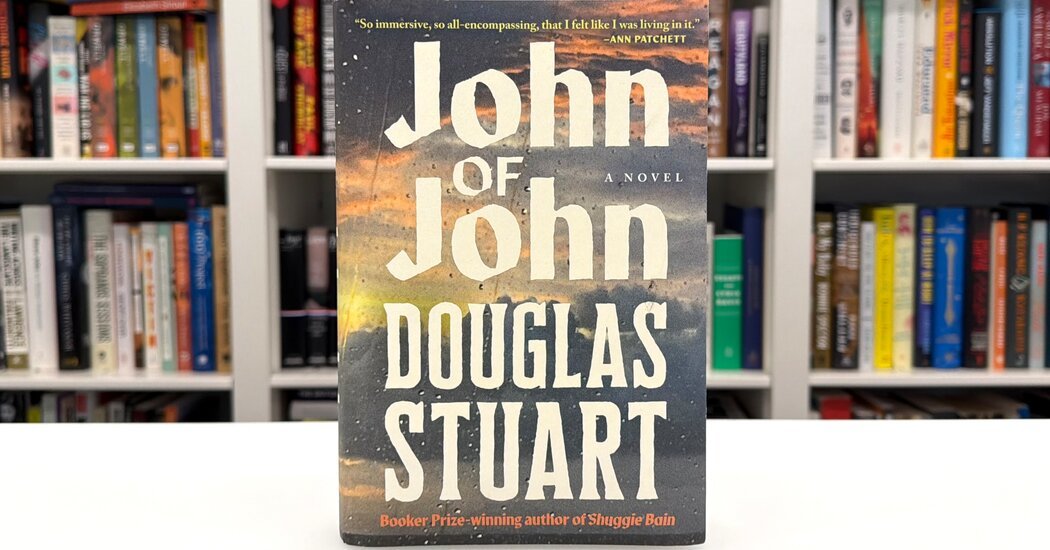
Welcome to the Book Review Book Club! Every month we select a book to discuss with our readers. Last month we read “Yesteryear,” by Caro Claire Burke. (You can also find past book club discussions in the Book Review podcast feed.)
Early in Douglas Stuart’s new novel, “John of John,” the Booker Prize-winning author describes a peculiar irony: “What skinned him was that the closer he got to home, the more lost he felt.”
It’s a passing line, but it captures the tension at the heart of this magnificent book: Here is a story of two men, each profoundly isolated, trying to figure out how to exist in a small, claustrophobic world.
The aforementioned traveler heading home and dreading it is Cal, a young gay man who has recently graduated from college in Edinburgh and has been floundering ever since. At the start of the novel, he is summoned back to the small village where he grew up to care for his sick grandmother. He obliges, but he’s not happy about the move — a rakish dreamer, Cal doesn’t fit into the provincial life of his village. His chief antagonist is his father, John. Traditional, religious and stoic, John hates Cal’s flamboyance and inertia, and he’s determined to mold Cal into an upstanding citizen of this tiny community. But John is hiding secrets of his own that, if they were to get out, could upend his life.
Bouncing between John’s and Cal’s stories, “John of John” asks: What does it mean to fit in, what’s the risk of standing out, and what’s the price of both?
In July, the Book Review Book Club will read and discuss “John of John,” by Douglas Stuart. We’ll be chatting about it on the Book Review podcast that airs on July 31, and we’d love for you to join the conversation. Share your thoughts about the novel in the comments section of this article by July 23, and we may mention your observations in the episode.
Here’s some related reading to get you started.
Our review of “John of John”: “‘John of John’ is a stick of dynamite waiting to go off in your hand, the steadily intensifying story of a fractured trio — grandmother, father and son — who are held together, barely, by their waning ability not to say the words to one another that will blow them apart.” Read our full review here.
Our review of Stuart’s previous book, “Young Mungo”: “There is crazy greatness in ‘Young Mungo,’ along with corny lapses and moments with the expository flatness of a TV voice-over. Still, faulting a novel of this register for intemperance feels like faulting an opera for being ‘too loud.’ The volume is part of the point. Sometimes you wince. Often you exult.” Read our full review here.
Our review of Stuart’s debut novel, “Shuggie Bain”: “He’s lovely, Douglas Stuart, fierce and loving and lovely. He shows us lots of monstrous behavior, but not a single monster — only damage. If he has a sharp eye for brokenness, he is even keener on the inextinguishable flicker of love that remains.” Read our full review.
We can’t wait to discuss the novel with you. In the meantime, happy reading!
MJ Franklin
Editor for the Book Review
Thank you for reading with us this month!To get the conversation started:— What did you think of the novel overall? Love it, hate it, feel mixed? And why? Please share your top level thoughts about the book.—In “John of John,” Stuart weaves together two separate storylines: Cal’s story and John’s story. Was there a storyline that particularly resonated with you? What, thematically, do you think the novel is saying with each story individually and what do you think the novel is saying as it brings those stories together?—The novel powerfully tackles ideas of family, repression, religion, community and queerness. Did the book make you think of any of those topics differently? Did it give you a new angle to explore those ideas? If so, how?— Is there a character, a quote, a writing element, etc that stood out to you? (In addition to the fractured family at the center of the novel, I, for instance, kept marveling over Stuart’s nature writing and the way he brought readers into environment of this Scottish island.)— What will you take away from this novel?Thanks, and looking forward to hearing what everyone thinks of “John of John.”
