


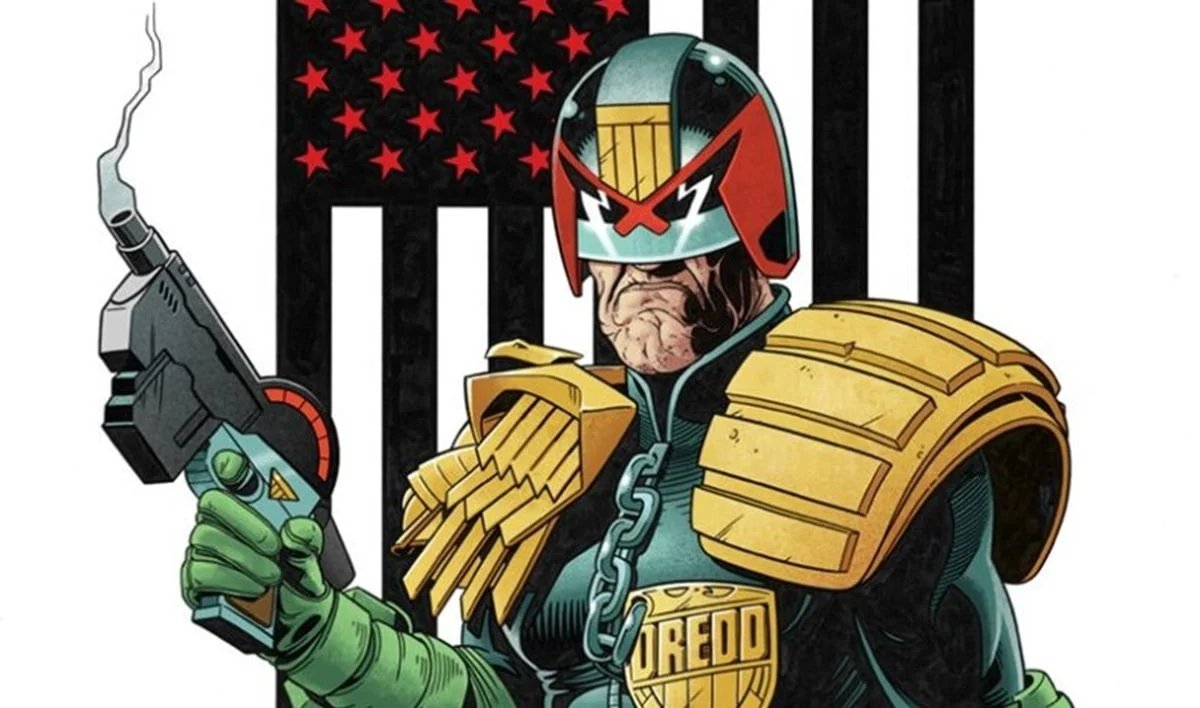
John Wagner has been given an honour from King Charles III recognising his work in comics and the British comics industry. Awarded the Member of the Order of the British Empire (MBE), it was announced June 12 as part of the official release of the sovereign’s birthday honours.
Born in America, raised in Scotland, resident of Shropshire, England, John Wagner has been a mainstay of the British comics scene since the late 1960s. He co-created classic British comics characters Judge Dredd and Strontium Dog with the late Carlos Ezquerra for weekly anthologies 2000 AD/Starlord, as well as other fan favourite series such as Button Man with Arthur Ranson, Robo Hunter with Ian Gibson (both for 2000 AD) and indie comic Bogie Man alongside frequent writing partner Alan Grant and artist Robin Smith. Not to mention graphic novel A History of Violence (1997), with Vince Locke, which was turned into a critically acclaimed 2005 motion picture directed by David Cronenberg.
Wagner’s considered one of the figures that revitalised British comics in the 1970s. From the mid 1970s, both John Wagner and 2000 AD founder Pat Mills were the two writer/editors assigned the task of rejuvenating London-based publisher IPC’s flagging kids comics line – launching or overhauling existing weekly anthology titles including Valiant, Battle Picture Weekly, Action, Misty and – or course – the still ongoing 2000 AD.
John Wagner co-created classic characters Judge Dredd (R) and Johnny Alpha/Strontium Dog (L) with Carlos Ezquerra
Recently announcing his intent to retire, Wagner wrote what could be his last Judge Dredd story Death of a Judge (with artist Mike Perkins), which was published in 2000 AD earlier this year. His only present work is the third and final series of soccer/sci-fi mashup Rok of the Reds with artist and co-creator Dan Cornwell in the pages of Judge Dredd Megazine (currently on a brief hiatus).
John Wagner is one of only a handful of comics names to ever be recognised with a royal honour – and he may be the first to explicitly be recognised for comics. Writers Grant Morrison and Mark Millar received MBEs for services to film and literature; Posy Simmonds got an MBE for services to the newspaper industry; Raymond Briggs received a CBE for literature; and longtime Beano cartoonist David Sutherland received an OBE for illustration.
Over 1,300 people were recognised in King Charles III’s official birthday honours for their service across society, education, the sciences, media, sport and industry. Other notable recipients in the June 2026 honours were children’s author Malorie Blackman, most famous for YA book series Noughts & Crosses, got an OBE; and cofounders of stop-motion studio Aardman Animations, Peter Lord and David Sproxton (the studio’s most famous animator Nick Park was surprisingly left out) received CBEs.
British honours have an order of hierarchy, with the lowest rung being the Member of the Order of the British Empire (MBE), followed by the Officer of the Order of the British Empire (OBE), then Commander of the Order… (CBE). The top two (Knight/Dame Commander… and Knight/Dame Grand Cross of the Order of the British Empire) are where the recipient gets the former Sir or Dame title – e.g. Sir Patrick Stewart.
To receive an award, a nominated individual will have their application overseen by an honours committee comprised of government and non-government officials who will then make the recommendation to the sitting sovereign. While the award is broadly a civic honour, the name preserves the term ‘British Empire’, which has regularly been considered controversial – with many individuals turning down the award in protest.
