


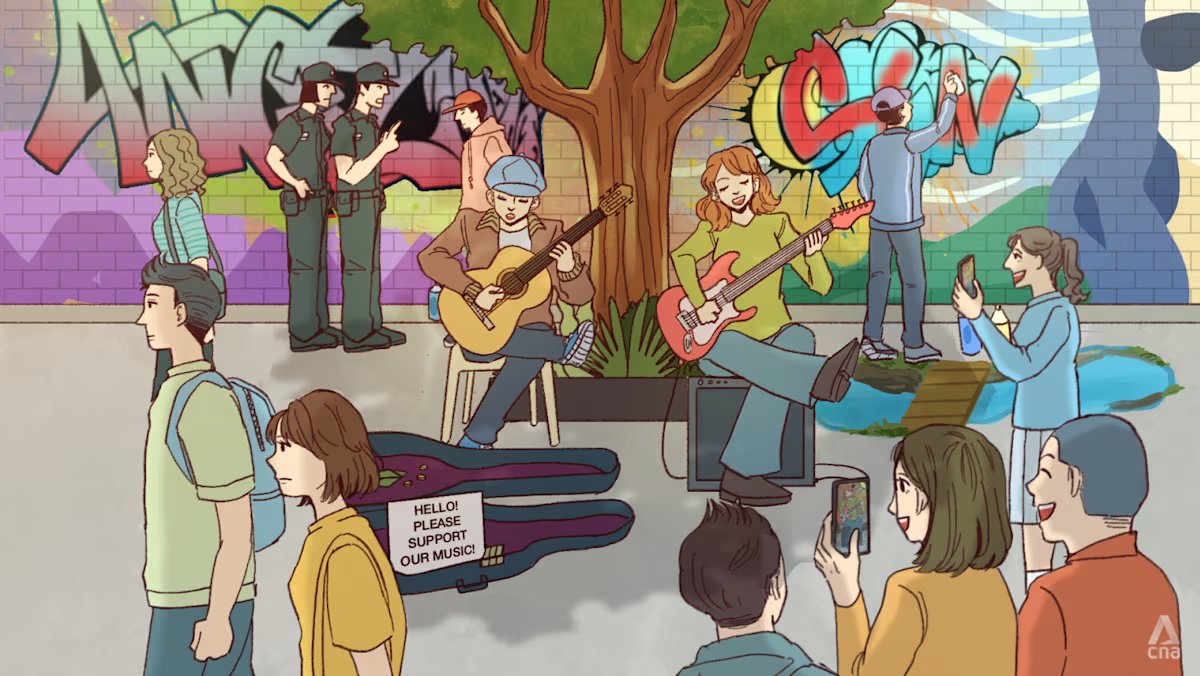
MORE STREET ART AROUND, BUT WHERE’S THE EDGINESS?
Even as Singapore has maintained its strict stance against vandalism and public nuisance, it has over the years made moves to embrace street art in its own way.
Artists and observers noted that commissioned murals are becoming more prevalent in public spaces all over the island.
One of the most notable platforms for such artwork is the Art in Transit programme, overseen by the Land Transport Authority and billed as “Singapore’s largest public art showcase”.
Launched along the North-East Line in 1997, it has expanded across all rail networks, with more than 500 artworks contributed by commissioned artists and through programme partners.
The National Arts Council (NAC) collaborates with artists, venue owners and public agencies to promote art in public spaces, too, including supporting community-led art projects.
In response to CNA TODAY’s queries, the council said: “Together, these efforts make it easier for Singaporeans to encounter and appreciate the arts first-hand, while fostering greater community engagement and interaction, and giving artists more opportunities to reach new audiences.”
There is no centralised authority issuing permits for wall or pavement murals in public spaces. For instance, any such planned artwork on common spaces at public flats may require approval from the relevant town council or the Housing and Development Board.
Murals on conserved buildings require endorsement from the building owner and URA’s approval. URA’s guidelines on murals stipulate, for example, that the artwork cannot obscure key architectural and heritage features of the building and “must be appropriate to the character of the building and area”.
Meanwhile, buskers have to audition with the NAC in order to receive a Letter of Endorsement before they busk.
The busking scheme was introduced in the 1990s with only three approved locations, but now there are more than 90 such spots.
Buskers said that it has also become more convenient to book busking locations, which can be done online and with greater flexibility than before, though there are still 15 busking spots that require balloting.
Circus act busker Jonathan Goh, 30, added that NAC now makes it a point to hold regular feedback sessions with registered buskers.
When he first started busking 10 years ago, such sessions happened on an ad hoc basis, as and when buskers asked to speak to the agency, said the co-chair of the Buskers’ Association of Singapore.
