


Published on June 16, 2026
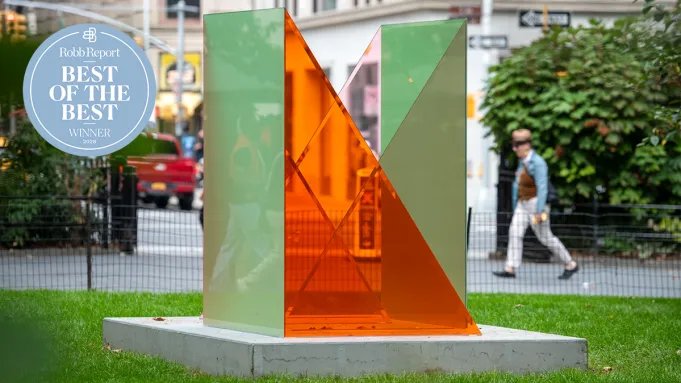
Courtesy of the Artist, Hauser and Wirth and Anthony Meier, Mill Valley. Photo by Timothy Schneck.
It might not have been a banner year for the commercial art world, with sales slumping and several small and midsize galleries closing, but the creative side did just fine. Artists continued to produce compelling work, while museums and nonprofits mounted exhibitions that were as mesmerizing as they were challenging.
From the poetic paintings, sculptures, photographs, and videos in Rashid Johnson’s Guggenheim survey to Larry Bell’s colorful new glass cubes alighting in Madison Square Park, recent presentations gave us hope for the future.
Reexaminations of earlier eras were equally eye-opening, including an ambitious historical exhibition about the rise of L.G.B.T.Q. art and a retrospective of the late Japanese American artist Ruth Asawa, whose crochet-like wire sculptures still feel startlingly fresh. Also getting his due was the great Alexander Calder, inventor of that nursery staple: the mobile. He is now celebrated in his native Philadelphia at Calder Gardens, a meditative museum where his abstract pieces look right at home.
Uniting the old and new in a way perhaps only visual art can, a skillfully assembled show in Los Angeles paired decommissioned Confederate statues with contemporary artists’ responses to them. Monuments offered a fitting answer to those still asking what should be done with heroic portrayals of such figures.
Even the market wasn’t without its bright spots. A Gustav Klimt portrait from the estate of the late cosmetics mogul Leonard Lauder sold at Sotheby’s for $236.4 million, a reminder that collectors will still open their wallets for quality.
Museum: Calder Gardens, Philadelphia
Image Credit: Iwan Baan/Calder Foundation, New York, Artists Rights Society, (ARS)
Alexander Calder was a giant of 20th-century abstract art, the inventor of the kinetic mobile, and equally renowned for his stabiles and monumental public commissions in Chicago and elsewhere. The son of two artists and grandson of another, he was also a native Philadelphian. So, when his namesake foundation— headed by his grandson Alexander S. C. Rower—decided to build a museum to celebrate his legacy, the City of Brotherly Love seemed the logical spot. Full of curving walls and textured surfaces, the result is an intimate, contemplative place to experience, say, the shadows Calder’s works cast or their gentle movements as air currents breeze past.
When it came to selecting a creative team, the founders went big, hiring the Swiss starchitects Herzog & de Meuron and the acclaimed Dutch landscape designer Piet Oudolf. Unassuming from the outside, the museum descends below ground and offers myriad vantage points from which to view the works. Some standing sculptures are placed in walled courtyards; a small piece hangs in a nook of a cave-like staircase. A mezzanine allows visitors to see mobiles hanging from the ceiling at eye level and large floor works from above.
Calder Gardens sits across the street from two esteemed neighbors—the Barnes Foundation, home to Renoir, Cezanne, and other European masters and a partner in managing the institution, as well as the Rodin Museum. It is also a short walk from the Philadelphia Museum of Art, placing it on a cultural crawl rivaled in the U.S. only by Manhattan’s Museum Mile.
Top: An installation view at Calder Gardens, with Alexander Calder’s sculptures 3 Segments, sheet metal, rod, wire, and paint, 1973 and Jerusalem Stabile II, sheet metal, bolts, and paint, 1976
Mid-career Survey: Rashid Johnson: A Poem for Deep Thinkers, Guggenheim New York
Image Credit: David Heald/Solomon R. Guggenheim Foundation, New York
The Guggenheim’s iconic spiral ramp was put to excellent use unraveling nearly three decades of Rashid Johnson’s thoughtful, wide-ranging practice. Johnson began as a photographer but has since branched into painting, mosaic, sculpture, and film (including the 2019 feature Native Son). His mother, Cheryl Johnson-Odim, is an African-studies scholar, and history and literature run through his oeuvre—one early work is Self-Portrait With My Hair Parted Like Frederick Douglass (2003); materials include African shea butter and black soap—but autobiography is just as central.
Among the most affecting pieces is Sanguine (2024), a short film that captures Johnson, his father, and his son simply spending time together: walking along the beach, rubbing sunscreen on one another’s backs, reading, holding African masks to their faces. That sense of filial comfort is set against his “Anxious Men” series, repeated expressionist, graffiti-like faces rendered in black soap and wax that cut to the heart of Black-male unease.
Johnson also dangled greenery through the Guggenheim’s six-story atrium and placed plants on modernist shelving grids. The idea, he told an audience at the museum, was to promote empathy, noting that indoor plants need someone to care for them. “People will step over a homeless person, come into the museum, and they’ll be like, ‘Who’s going to water the plants?’ ” he said. “However you want to read that, when empathy enters space, it transforms space.”
Above: Rashid Johnson in front of his “God Painting” The Spirit, oil on linen, 2025.
Auction: Gustav Klimt, Bildnis Elisabeth Lederer (Portrait of Elisabeth Lederer), Sotheby’s
Image Credit: Sotheby’s
Gustav Klimt’s Bildnis Elisabeth Lederer (Portrait of Elisabeth Lederer) (1914-16) checked every box when it came to auction at Sotheby’s in November: a beautiful young woman—the daughter of Klimt’s most loyal patrons—rendered in dazzling detail and surrounded by dreamlike references to Asia. It is a prime example of the canonical artist’s most revered works. As one of only two full-length Klimt portraits believed to still remain in private hands, it was also exceedingly rare. Plus, the painting hit the block with an enviable provenance: For nearly 40 years, it hung in the Fifth Avenue apartment of late cosmetics magnate Leonard Lauder, one of the preeminent art collectors of his era. (Though the Nazis had seized the work during World War II, it had been restituted to Elisabeth’s brother in 1948.)
Accordingly, the canvas was tipped to bring in upwards of $150 million. When the hammer fell, the price had reached $236.4 million (including fees), more than double Klimt’s previous auction record of $108.8 million, set in 2023, and the second highest sum ever doled out for a painting (after the $450.3 million spent on Salvator Mundi, controversially attributed to da Vinci, in 2017). The sale not only further burnished the reputation of the leader of the Vienna Secession movement, which embraced Modernism in art, architecture, and design, but it also gave the plateauing art market a much-needed jolt.
Top: Gustav Klimt, Bildnis Elisabeth Lederer (Portrait of Elisabeth Lederer), oil on canvas, 1914-1916.
Retrospective: Ruth Asawa: A Retrospective, San Francisco Museum of Art & Museum of Modern Art, New York City
Image Credit: Jonathan Dorado/The Museum of Modern Art, New York
Anticipation for a full-scale Ruth Asawa retrospective had been building for years, as the Japanese American artist, who died in 2013 at 87, was the subject of one well-received exhibition after another. SFMOMA and MoMA’s joint effort rose to the occasion.
Celebrated for her delicate, intricate wire sculptures, which explore positive and negative space, light and shadow, and the interplay between form and craft, Asawa traced her life as an artist to time spent as a teenager in concentration camps for Japanese Americans, where three incarcerated Disney animators taught her to draw. She later made her way to the avant-garde Black Mountain College in North Carolina, where abstractionist Josef Albers was her painting instructor.
Asawa continued to create—wire pieces, plant drawings, calligraphic paintings, bronze casts, and, beginning in the 1960s, public commissions that still adorn San Francisco—all while raising six children. In works both tiny and monumental, evoking the human figure, tangles of tree branches, or workaday baskets, her oeuvre has a quiet, meditative quality that demands slow looking.
For those who can’t get enough of Asawa, there’s good news: In May, her family was set to open a San Francisco gallery dedicated to her work, with the inaugural show curated by her daughters.
Top: Ruth Asawa’s intricate and curvaceous wire sculptures fill a MoMA gallery.
Group Show: The First Homosexuals: The Birth of a New Identity, 1869-1939, Wrightwood 659, Chicago
Image Credit: Daniel Eggert
Tucked away on a residential block of Chicago’s Lincoln Park neighborhood, Wrightwood 659 feels like the museum equivalent of a speakeasy: If you’re not in the know, you’re unlikely to stumble upon it; if you are, you’ll feel just a bit superior for having the password—in this case, a timed ticket. Founded by philanthropist Fred Eychaner and designed by Pritzker Prize winner Tadao Ando, the museum opened in 2018. But it really burst into art lovers’ consciousness last year with its sprawling, meticulously researched exhibition The First Homosexuals.
Featuring more than 300 works by 125 artists across mediums, the show took 1869—the year the word “homosexual” was coined—as its point of departure, tracing the rise of homosexuality as an identity. The result was a fascinating deep dive, covering everything from the evolution of the nude under a queer gaze to portraits of L.G.B.T.Q. luminaries such as Gertrude Stein and Walt Whitman. Numerous works also underscored the existence of transgender people long before there was a term for—or a cultural war surrounding—them.
Bonus point: While some institutions are turning up their noses at wall labels, Wrightwood 659 embraced them, drawing viewers deeper into the poignant histories behind the works. Among them: descriptions of the six-decade relationship between artists Frances Loring and Florence Wyle, who each made a plaster bust of the other, and a portrait by Jean Condé of a French spy and diplomat who, though anatomically male, assumed a female guise to gather intelligence in the Saint Petersburg court of Empress Elizabeth and was later offered a royal pension by King Louis XVI—to protect those state secrets and live out the rest of his life as a woman.
Above: A gallery wall at Wrightwood 659 featuring a range of international artists in The First Homosexuals.
Public Art: Larry Bell: Improvisations in the Park, Madison Square Park, New York City
Image Credit: Timothy Schneck/Larry Bell, Hauser and Wirth and Anthony Meier, Mill Valley
Known for its consistently engaging installations from some of contemporary art’s most original thinkers, Madison Square Park, in Manhattan’s Flatiron District, featured a quintessential West Coast artist for its recent must-see exhibition. Octogenarian Larry Bell dotted the landscape with his sharply geometric, brilliantly colored glass sculptures, more typically seen indoors than out. The boxes, cubes, and zigzagging forms, in red, blue, orange, purple, and green, served as both mirror and window, framing the grounds, sky, and surrounding built environment through the changing seasons. Autumn leaves and winter’s heavy snowfalls collected inside and atop them, while park denizens sipping coffee on benches or traversing the paths could be glimpsed through them, as if the translucent panels were screens.
A key contributor to the Light and Space movement, which originated in California in the 1960s and blended Minimalism with a focus on optical perception, Bell enjoyed early success for his experimentations with glass. In 1973, he retreated to New Mexico, where he has continued to make work while keeping his distance from the white-hot center of the commercial art world. He has reemerged with gusto in recent years—not a moment too soon, as monumental works are becoming more difficult for him to produce. “Part of [what I loved about] being a sculptor was grunting heavy shit around,” he told Robb Report in the lead-up to this show. “There was a sensuousness to doing those things, but it hurts too much now.”
Top: Larry Bell’s glass sculptures Blues from Aspen, 2018
Reassessment: Monuments, Museum of Contemporary Art & The Brick, Los Angeles
Image Credit: Fredrik Nilsen/the Museum of Contemporary Art (MOCA) and the Brick
In the aftermath of the mass shooting at Mother Emanuel AME Church in Charleston in 2015 and George Floyd’s murder in Minneapolis in 2020—both crimes perpetrated by white men against Black people—outcry over the nation’s deeply embedded racism led to the toppling of statues and monuments celebrating Confederate heroes across the U.S. Many called their removal long past due; others lamented what they saw as an erasure of history.
What to do with these discarded works remained an open question: Destroy them? Warehouse them? Attempt to contextualize them? This past year, MOCA and the Brick co-organized Monuments, which brought together 10 decommissioned pieces (any vandalism left intact) along with newly commissioned and existing works by 19 contemporary artists, among them Kara Walker, who also cocurated the exhibition. Her contribution, titled Unmanned Drone, began with an equestrian bronze of Thomas “Stonewall” Jackson that once stood in Charlottesville, Va., site of the infamous “Unite the Right” rally in 2017. Walker dismantled it, then reconfigured the elements into a disturbing assemblage of human and equine body parts—as if Guernica were in 3-D—as an apt metaphor for the legacy of white supremacy. In a talk at MOCA, Walker said she’d always been fascinated by “the mythologies that are seeped into the marrow of America.”
The debate over who and what deserve to be memorialized is far from over: In March, while Monuments was still on view, a statue of Christopher Columbus—a replica of one in Baltimore that protesters tore down and unceremoniously dumped into the harbor in 2020—was erected on the grounds of the White House.
Above: Inside MOCA’s presentation of Monuments, a 1948 equestrian bronze of Robert E. Lee and Stonewall Jackson by Laura Gardin Fraser is paired with Hank Willis Thomas’s 2019 sculpture A Suspension of Hostilities, which upends a 1969 Dodge Charger adorned with a Confederate flag on its roof.
Top: Larry Bell’s glass sculpture Cantaloupe but Honey 2025, installed in Madison Square Park.
