


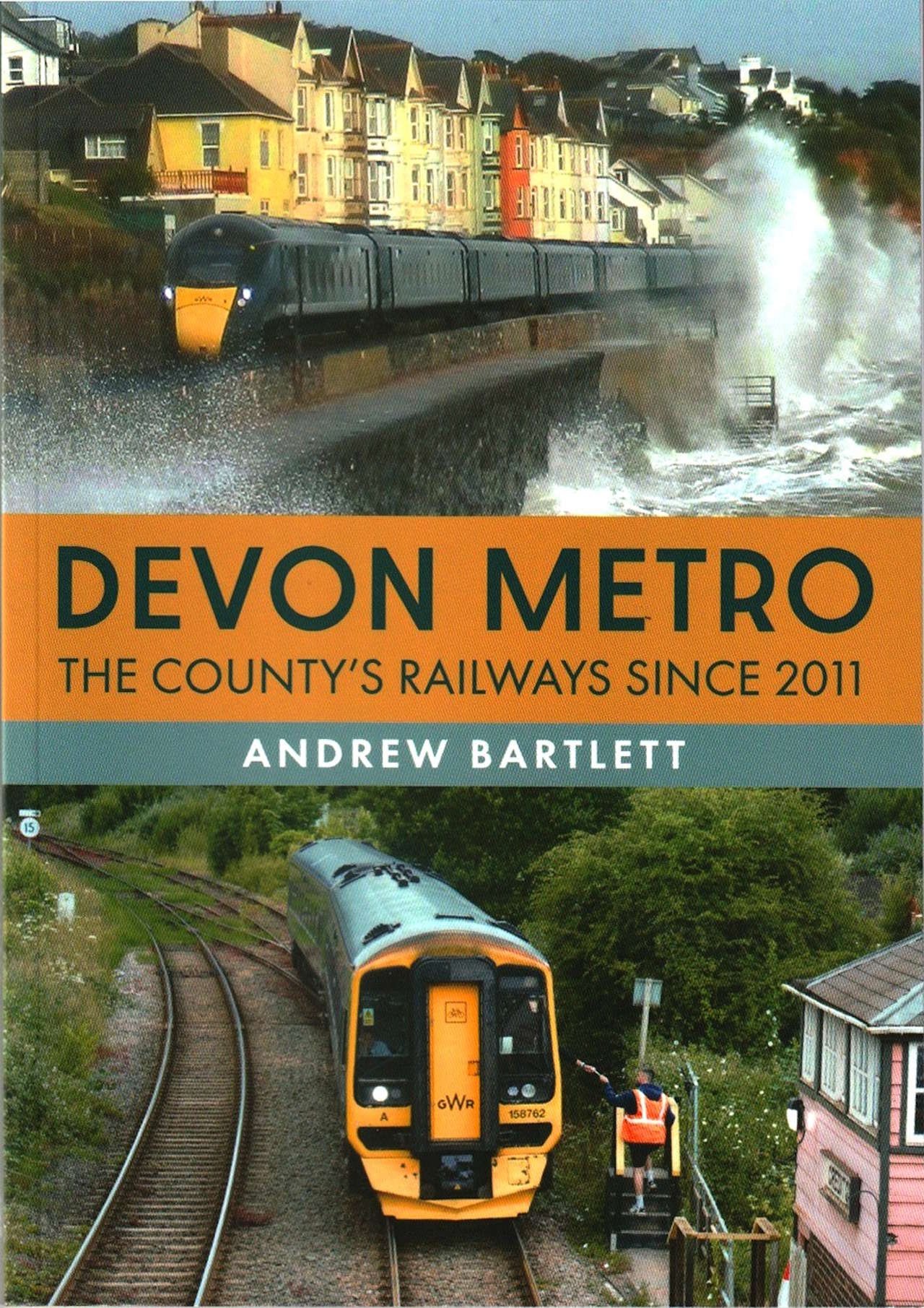
In 2011, Devon County Council suggested Devon could have a rapid-transit-style rail network. With the county having many branch lines, Andrew Bartlett examines them and considers whether the council’s plan could become a reality.
Published in June 2025 by Amberley Publishing and written by Andrew Bartlett, this soft-cover book measures around 23.4 cm x 16.5 cm, has 96 pages and 180 illustrations.
It has a published price of £15.99, but at the time of writing, it can be purchased for £14.39 from Amberley Publishing and for £15.97 from Amazon.
Devon County Council’s plan to develop a Metro network in the county included improvements to services and facilities, and the opening of new stations.
Andrew Bartlett explores how those plans have developed, and what might realistically be achieved in the near future.
A very brief introduction is followed by seven chapters covering Devon’s two main lines – the Great Western and the West of England main lines – and its five branch lines, namely the Riviera, Avocet, Tarka, Dartmoor, and Tamar Valley Lines.
A final single-page chapter titled The Future Put on Hold considers the projects envisaged under the government’s ‘Restoring Our Railway’ programme, but subsequently cancelled.
A perpetual problem on the Great Western Main Line is the stretch between Dawlish and Teignmouth, which runs literally on the edge of the sea, as seen in the photos below.
When storms rage, services are often cancelled, and the line is closed, a situation which could cause problems for the so-called Metro development.
Devon Metro pages 26/27. // Credit: RailAdvent
Devon’s premier main line is the Great Western Line to Plymouth, which is also used by CrossCountry services, as in the photo at the centre right.
At the bottom right, figures appended to the caption title show how the development of Ivybridge as a Park & Ride station for Plymouth has undoubtedly contributed to an increase in revenue.
Devon Metro pages 44/45. // Credit: RailAdvent
One line where a Metro-type development has started is the Riviera Line, from Exeter to Paignton, with services now continuing through Exeter to Exmouth on the Avocet Line.
As well as branch line services, Paignton is served by main line services to Paddington, and being a popular seaside resort, it is often the destination for steam excursions, such as with Britannia seen at the top left below.
Paignton station is also the terminus of the Dartmouth Steam Railway, which ironically doesn’t go to Dartmouth but terminates at Kingswear, a ferry ride away on the opposite side of the River Dart. The photo at the bottom right shows a train newly arrived from Kingswear.
Devon Metro pages 56/57. // Credit: RailAdvent
In the west of the county is the Tamar Valley Line, as seen below. It only has a single track, which would constrain any attempt to develop anything resembling a Metro-style service.
Trains to Plymouth currently run once every two hours, and it is questionable whether there is an economic justification for a more intensive service.
Devon Metro pages 94/95. // Credit: RailAdvent
The description on the back cover suggests that the book explores how the Metro plans have developed since 2011, and what might realistically be achieved in the next decade.
However, the content is more of an illustrated look at each of Devon’s main and branch lines, sometimes adding how many passengers used each station in 2022/23, and their percentage increase or decrease since 2011.
The captions adequately describe each photograph’s subject, but with very few exceptions, do not expand on what has changed since 2011, or what would be required to achieve the Metro vision.
The quality of photographs is good, with a variety of scenic and station views, and as a book illustrating Devon’s railways, it is to be recommended.
As an assessment of Devon County Council’s vision for a Devon Metro, it misses the mark. With its existing title of Devon Metro, the book can only be rated as 4/5, but if the title were changed to Devon’s Railways Since 2011, it would deserve a rating of 5/5.
The book is available to purchase from Amazon and from Amberley Publishing.
We would like to thank Amberley Publishing for providing us with a copy of the book for review.
