


A museum has issued a trigger warning over “outdated views” in a Janet and John children’s book.
The Black Country Living Museum, which allows visitors to immerse themselves in different historical periods, recently expanded its timeframe to include the post-Windrush decades.
A replica 1960s public library was built and stocked with contemporary reading material, but some books in the library were given trigger warnings.
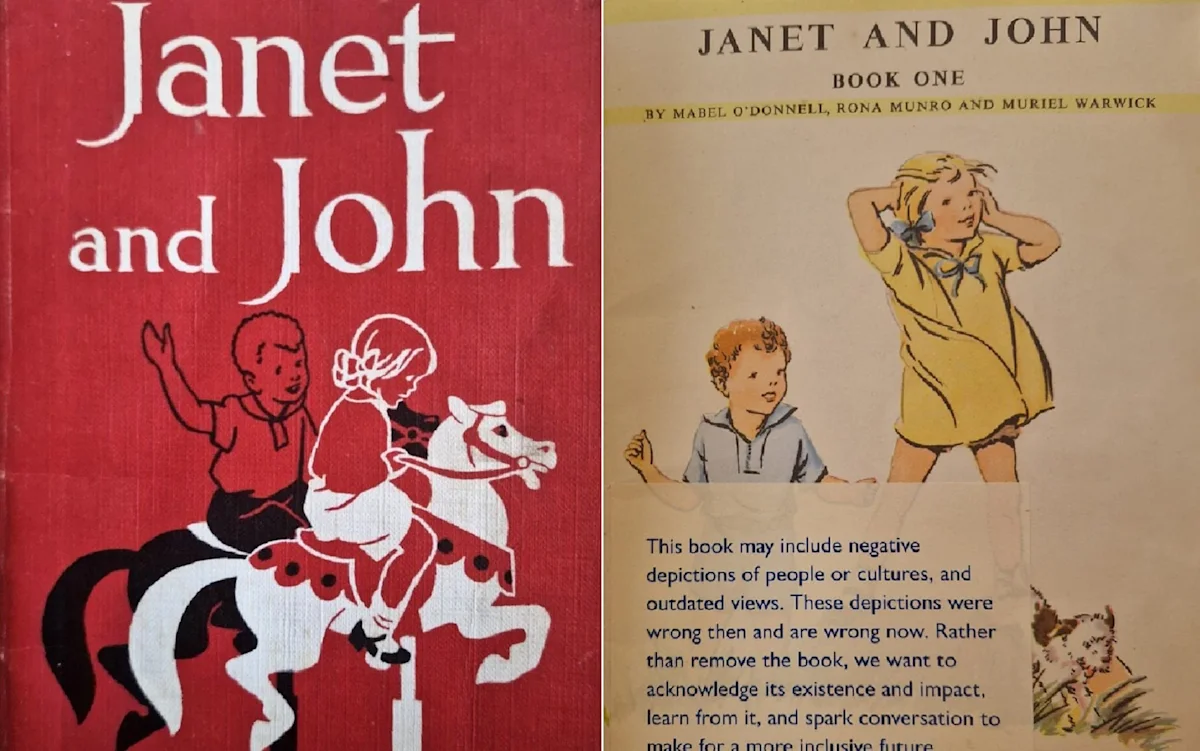
Volumes including a Janet and John book had a trigger warning inserted next to the illustrated title page about cultural attitudes deemed to be “wrong”.
A trigger warning inserted into a book at the BCLM
The Janet and John book tells the story of a brother and sister playing with their dog, but visitors flicking through it are warned: “This book may contain negative depictions of people or cultures, and outdated views.
“These depictions were wrong then and are wrong now. Rather than remove the book, we want to acknowledge its existence and impact, learn from it, and spark conversations to make for a more inclusive future.”
The book, first published in 1949, includes passages describing Janet and John looking at planes and speaking characteristically simple dialogue, such as “look at the aeroplane, I want to fly in it” and “the aeroplane can fly fast”.
A range of children’s titles have been given the same warning about potentially offensive content, as have a number of adult books, including copies of Ian Fleming’s James Bond novels.
In 2023, The Telegraph revealed that Bond spy thrillers had been edited with the help of sensitivity readers over concerns about racist language and attitudes.
The Black Country Living Museum has also inserted a warning in a copy of Murder at the Gallop by Agatha Christie, whose works were edited recently to avoid offending modern readers, and a collection of short stories by HG Wells.
Memoirs by First and Second World War veterans, including The Road to En-dor by Elias Henry Jones, have also had warnings placed in them about outdated attitudes.
The Black Country Living Museum allows visitors to immerse themselves in different historical periods
The museum expanded its scope to reflect British life from the 1940s to 1960s, decades of higher immigration that would allow displays to be made more diverse.
New characters, played by actors, were introduced to reflect these social changes, including the 1950s figure Fitzroy Barrett, who informs visitors of his Jamaican heritage and the racism he encountered in the UK.
Andrew Lovett, the chief executive of the museum, explained the expanded timeline by saying: “We are in one of the most culturally and ethnically diverse bits of the country, and yet we would readily have admitted that the story we were telling previously wasn’t representative of the modern-day Black Country.”
The museum has been contacted for comment on the addition of warnings to its book collection.
Try full access to The Telegraph free today. Unlock their award-winning website and essential news app, plus useful tools and expert guides for your money, health and holidays.
