


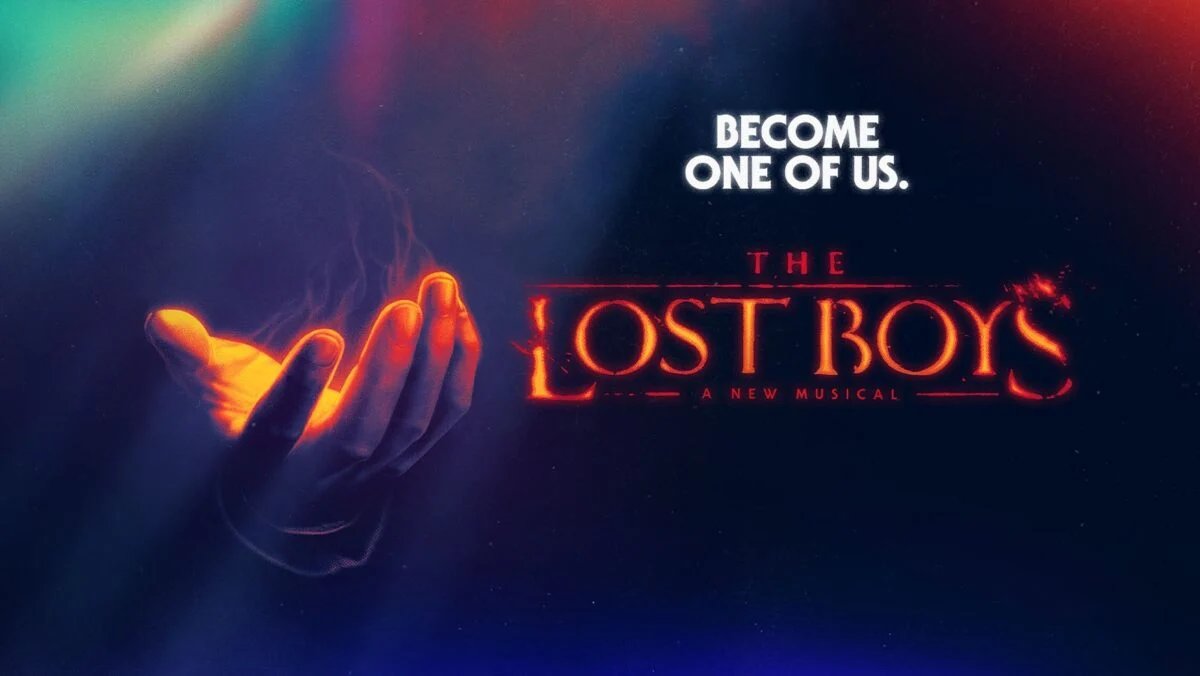
Joel Schumacher’s 1987 The Lost Boys is a story of outcasts, of proudly weird kids surviving in a hostile 1980s America with little adult supervision. The movie entranced audiences by capturing the dangerous excitement of youth and how it led to a life of partying and violence. In a sense, it made the argument that kids were essentially already vampires. They just didn’t have the fangs to show for it. And it was all bolstered by one of horror’s most iconic and diverse soundtracks of its kind.
With song like “Cry Little Sister” by Gerard McMahon, “Walk This Way” by Aerosmith, “Beauty Has Her Way” by Mummy Calls, the “People Are Strange” cover by Echo and the Bunnymen, and, of course, “I Still Believe” by sax extraordinaire Tim Cappello, Lost Boys gave 80s horror a unique combination of sounds that became synonymous with vampirism.
In a sense, Lost Boys was a song or two away from being a fully fledged musical. It’s why it made sense for it become one, and a Tony award-winning Broadway sensation at that.
The Lost Boys: A New Musical is an adaptation of the classic film that sticks close to the source material in terms of structure while making adjustments in important ways to function as a musical. Its book was written by David Hornsby and Chris Hoch, with music and lyrics by The Rescues and music supervision and orchestration by Ethan Popp. It’s directed by Michael Arden, with Julie McBride as music director.
Lucy Emerson (Shoshana Bean) and her two kids Michael (LJ Benet) and Sam (Benjamin Pajak) move to Santa Clara to start afresh after a bad divorce. While out at night on the town’s boardwalk, Michael comes across a rock band led by a pale, bleach blonde singer called David (Ali Louis Bourzgui). He’s following a girl that’s caught his eye called Star (Maria Wirries), who’s friendly with the band.
David, turns out, is a vampire. He wants Michael to be the newest addition to his merry band of bloodsuckers. Sam, on the other hand, meets the Frog Brothers, two kids who run a comics shop on the boardwalk that warn of vampire activity in the area. Michael gets turned, and then it’s all about how love, risk, bad decisions, family, and blood can turn daylight into eternal night.
Fans of the movie know that Gerard McMahon’s “Cry Little Sister” is the musical throughline of the story. It’s the piece of music that gets played the most in it (and even features in the film’s original score by Thomas Newman). The same applies to the new musical, though to a lesser extent. Some of the songs lyrics ring out just enough to establish the link, which also works to set the tone during crucial moments. It’s a heartfelt inclusion that fits well.
Those expecting a choreographed version of the film’s soundtrack need look elsewhere. The Rescues and Ethan Popp crafted an entirely new body of music that honors the spirit of the original story without being a copy of it. Nostalgia isn’t the aim here, nor is it to go retro for the sake of it. As such, the musical expands on established characters to deepen their emotional cores. Shoshan Bean’s Lucy Emerson benefits greatly from this, getting some of the best and more emotive songs in the show.
Exceptional wire work, astounding special effects, and superb performances round out an experience that earned four prizes at the 2026 Tony Awards. I sat down with Music Supervisor Ethan Popp do dive deeper into the process of turning a beloved horror movie into a musical that retains the vampiric spirit of the original as it carves its own path.
Ethan Popp, music supervisor for The Lost Boys: A New Musical
RICARDO SERRANO: The Lost Boys is one of the most musically diverse vampire films of all time. From saxophones to carny loops to Aerosmith. How did you land on a sound that would define the musical?
ETHAN POPP: Lost Boys has a wide range of music in it. Everything from the oiled-up sax guy on the boardwalk, to “People are Strange” by The Doors, to Aerosmith, to everyone else. We wanted to explore that while keeping it within the voice of The Rescues, our incredible composers. We truly wanted to service the story by making the sound of the show feel equally dangerous, emotional, and immersive as that of the movie.
I wanted to sort of carry the sonic language of the 1980s but not feel like it was trapped in amber, as a fossil.
There were a lot of synth textures and guitar sounds and drum sounds that were just very present in that decade. We tapped into that, but we didn’t want to come off as a show wearing an 80s Halloween costume. The larger goal was to make it feel immediate, like it had a real dramatic pressure to it. We wanted it to feel theatrical, but also contemporary in the way that it uses sound and space and texture. I think that balance was really important to me and important to us collectively.
SERRANO: Was there a particular song or number that helped you unlock the rest of the musical?
POPP: It was certainly defined by the style that The Rescues already carried with them, because so much of their music already carries the sort of mystery, sensuality, pressure, and excitement that is really key to a story like this.
We really had the chance to build a whole sonic world to surround the story with, and I think that was the big draw for me. You know, The Lost Boys had such a strong identity already. Danger and atmosphere mixed with sensuality, mythology, humor, and heartbreak. It’s a piece of intellectual property that already lives very vividly in people’s imaginations.
What excited me was not just adapting a well-known title. It was the chance to ask what this vampire story would sound like in the theater? How do we make it feel immersive and alive, and not just familiar? I get most excited whenever the music gets to participate in the worldbuilding in such a major way.
SERRANO: As fun as the movie is, it’s still a pretty damn intense vampire tale, with vicious bloodsuckers at the helm doing some nasty killings. How did you approach the more direct horror elements of the story to keep them alive in the music?
POPP: For me, horror has always really been about tension, atmosphere, and seduction. It’s about the fact that we know that sometimes things are even more scary when we feel them without seeing them. It’s the anticipation of the scare more than the scare itself. That’s the part that interested me.
I’m less interested in horror as mere impact or shock, and more interested in it as a kind of emotional and physical destabilization. That’s where we get to play with dread, desire, propulsion, and the feeling that the room itself is a little haunted. That’s where, specifically, the orchestration became really important because you’re not just supporting the scene in the show, you’re shaping the pressure of it. You’re helping the audience feel unease or seduction or danger before they even really register why.
SERRANO: Lost Boys comes with a built-in fanbase that is already expecting to see some key things make it from the movie to the stage. Did that level of expectation pose a few challenges you weren’t expecting?
POPP: There are so many iconic moments in the film. Certainly, we all know about the oiled-up sax guy and the music cues that go with some sequences. But much like I spoke about before, in terms of the sound of the score and wanting to have something that lived in both the 1980s and today, we wanted to pay homage to the story while also contemporizing it.
The musical parallel would be using synths from the 80s along with guitar sounds and drum sounds but sort of contemporizing the music around it. The same happened with the story. There were certain elements that we needed to have, like the Frog Brothers, the fashion sense, and even references to Grandpa Emerson. We needed to pay tribute to what came before while also looking to give a more contemporary view into this world.
