


Art as healing: A story from Tatev Harutyunyan’s experience
A 60-year-old woman entered psychotherapy with depression, psychosomatic headaches and a lifelong history of emotional suppression. Through art therapy, she introduced the image of a “forest fairy,” which came to symbolize the vulnerable, creative and emotionally restricted part of herself. Her early drawings were highly structured and controlled, reflecting an internalized fear of freedom and self-expression. Over time, therapeutic work focused on helping her move from this “old path” of control toward a “new path” of intuitive, spontaneous creativity.
In a breakthrough individual session, she was encouraged to paint freely — throwing paint, experimenting playfully and expressing long-repressed anger. The experience became a powerful moment of emotional liberation and redefined her relationship with fear, creativity and permission. Gradually, her artwork evolved into a space where freedom and control could coexist, allowing her to integrate previously fragmented parts of herself. By ultimately placing her “forest fairy” into a freer creative world, she symbolically reclaimed autonomy, emotional expression and a new internal sense of safety.
“Basics of Art Therapy: Art as a Path to Healing”
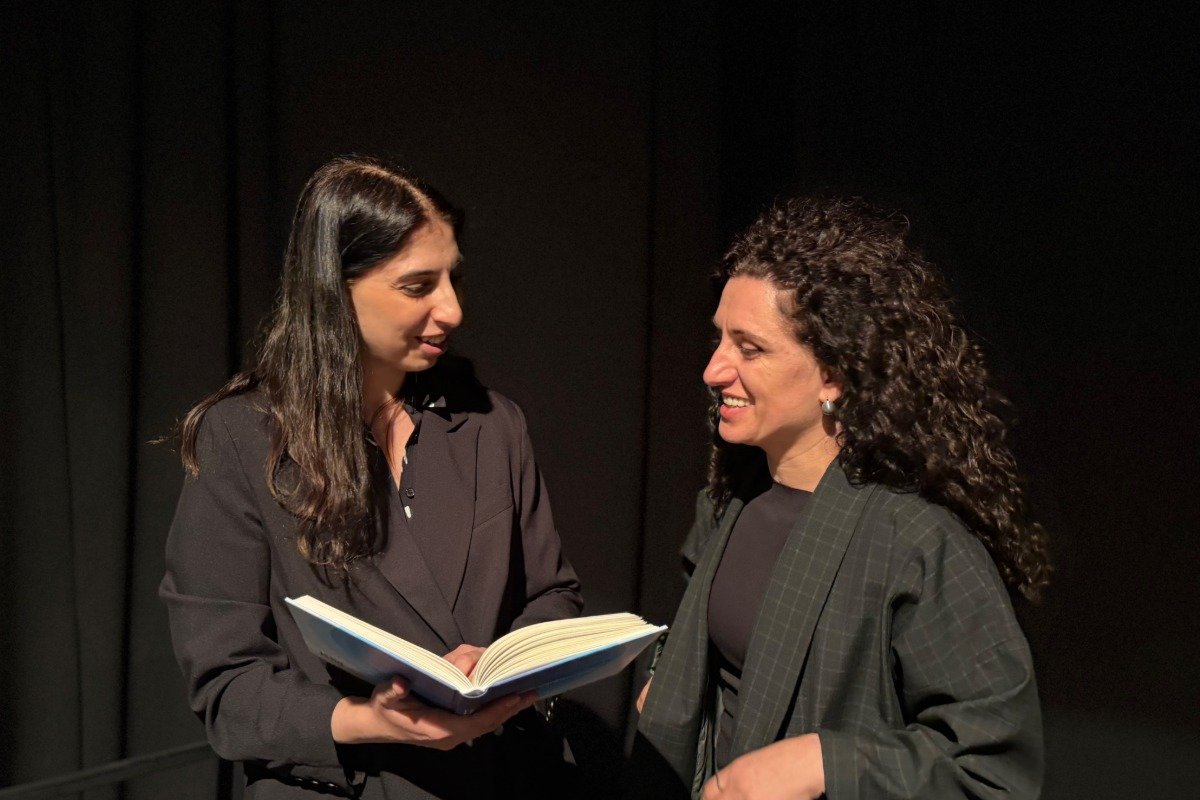
Art therapists Karine Khachaturyan and Tatev Harutyunyan first met in 2008 and soon became close friends. Even when Harutyunyan moved to Germany to study while Khachaturyan remained in Armenia, their connection never faded. Years of intense online conversations eventually led them to embark on a new and challenging journey — one they believed was worth pursuing. In 2026, after two years of work, online discussions and countless meetings, the two women published the first book on art therapy in Armenian: “Basics of Art Therapy: Art as a Path to Healing.”
Khachaturyan was highly engaged in creative work during her student years and personally experienced the healing power of art. This inspired her to explore alternative approaches in psychotherapy, eventually leading her to art therapy. From that moment, her deep love for and dedication to the field became a commitment that continues today through international training and ongoing professional development.
Advertisement
Harutyunyan’s professional path began at the Yerevan State Pedagogical University, where the study of psychology gradually evolved for her from a source of knowledge into a deeper space of self-awareness. Later, that interest led her to the Open University of Yerevan, where, in Samvel Baghdasaryan’s class, she was first introduced to contemporary artistic thinking. From then on, psychology and art were never separate in her life; they developed side by side, complementing each other. In 2022, after completing a master’s degree in art therapy at the Munich Academy of Fine Arts, she began working as an art therapist in psychiatric and psychosomatic clinical settings in Munich. In her practice, she accompanies people through inner processes of pain, recovery and transformation.
“Publishing a book in Armenian was a matter of principle,” Khachaturyan told the Weekly. “To this day, professional literature in this field in Armenian remains extremely limited. We wanted Armenian specialists and students to have the opportunity to learn in their native language, using professional terminology adapted to our linguistic and cultural way of thinking.”
For Harutyunyan, the decision was equally intentional. “Writing in Armenian was not simply a language choice for us; it was a conscious position,” she told the Weekly. “Art therapy, being deeply connected to a person’s inner world, self-expression and cultural layers, cannot be fully revealed through the mediation of a foreign language.”
The book is a professional guide for psychologists and psychotherapists, but its accessible language also makes it engaging for a wider audience interested in discovering the healing power of art. It fills an informational gap in art therapy and helps establish professional standards. It also clearly distinguishes between “simply creating” and scientifically grounded art therapy. Through the book, Khachaturyan and Harutyunyan aim to address the lack of Armenian-language professional literature and help shape a clearer, evidence-based field of art therapy in Armenia.
“The hardest part was condensing an enormous volume of material into a concise and understandable form without losing its scientific value,” Khachaturyan said.
They worked on the book for two years. Because they were living in different countries, the process relied on countless online discussions, meetings and revisions. Harutyunyan said the greatest challenge was finding a balance between professional depth and accessibility so the book would be both scientifically grounded and understandable to a broad readership. It was also difficult to formulate Armenian terminology for concepts that often either did not previously exist in the language or had no clearly established definitions.
At the book launch, both professionals and people who simply wanted to understand art therapy gathered. Many, like me, had assumed that participating in art therapy required knowing how to draw well. Art therapy is used as a supportive and rehabilitative approach for a wide range of mental and emotional difficulties, psychosomatic disorders, developmental differences and other conditions. At the same time, it can be effective for people who want to deepen self-awareness, develop their creative potential and expand their inner resources.
In Armenia, art therapy is still taking its first steps. Interest in the field is growing, but there remains a strong need for institutional development, clearer professional education standards and evidence-based understanding among both specialists and the broader public.
There are already psychological centers, educational programs and professionals applying art therapy methods, particularly in work with children, trauma and developmental challenges. Still, the field lacks unified professional standards, extensive scientific literature and a systematic tradition of training. Among the major stereotypes surrounding art therapy are the belief that participants must know how to draw well and the assumption that it is simply a light or pleasant activity. In reality, art therapy is a profound method that can create change even on a physiological level. It is a structured psychotherapeutic process with clear goals and a professional framework.
“The main difference between the practice of art therapy in Armenia and Germany lies in the level of systemization and institutional development,” Harutyunyan said. “In Germany, art therapy was established earlier as a recognized professional field, with clearly defined educational programs, licensing systems and broad application across health care and social sectors.”
At the same time, both countries share a similar trend: growing interest in art therapy and the expansion of its potential in both clinical and educational settings. Khachaturyan said that for the field to develop in Armenia, “it is necessary to create an educational model aligned with international standards, build a professional community guided by unified ethical principles and ensure the accessibility of art therapy within the public health care system.”
Harutyunyan added that “from Munich’s experience — by which I mean both clinical practice and studying for a master’s degree at the local academy — the most important thing Armenia can adopt is a systematic approach, both in education and in practical implementation. There, art therapy is integrated into health care, social and educational systems, which ensures its sustainable development and professional recognition.”
Equally important is the culture of interdisciplinary collaboration among psychologists, psychotherapists, doctors and social workers, which significantly increases the effectiveness of the work.
The two authors hope the book will become a foundational manual, raise awareness and inspire professionals who are just beginning their journey in the field. They included both theoretical material and practical examples from their own experience to make the therapeutic process more understandable for readers. The book can encourage more active interdisciplinary collaboration. Just as psychologists and psychiatrists have long worked together on individual cases, there is hope that this cooperation will expand further, including the integration of the art therapist as a distinct specialist. Finally, such work often lays early and important foundations for the formation of a professional community, linking local practice with international developments.
Trauma and rebirth, Karine Khachaturyan’s experience
Khachaturyan has encountered many cases, but this one carries exceptional strength. A young woman came to her after surviving severe traumatic experiences, including physical abuse and neglect in childhood and a recent sexual assault. She was struggling with deep anxiety and dissociation — episodes of detachment from reality. Her pain was so intense that at times, to escape it, she would simply “switch off” from reality.
In the first stage, while drawing on a large sheet of paper with her eyes closed and through spontaneous movements, the unnamed chaos and suppressed pain within her took the form of a tangible image. At the next session, she took a very courageous step: She tore up her previous drawing. This was not an act of rejection, but the end of a cycle of old trauma and the return of control over her own life. She then carefully placed the torn pieces into a box, learning to set boundaries and protect her complex inner experience.
The most moving moment came when she decided to take the torn pieces out again and create a collage from them. She was ready to confront her “broken” parts and unite them with new meaning. At the center of the collage appeared a small bird, symbolizing liberation and the flight of the soul. The client created a symbol of her own rebirth, demonstrating that even from the ashes of trauma, it is possible to be reborn stronger.
