


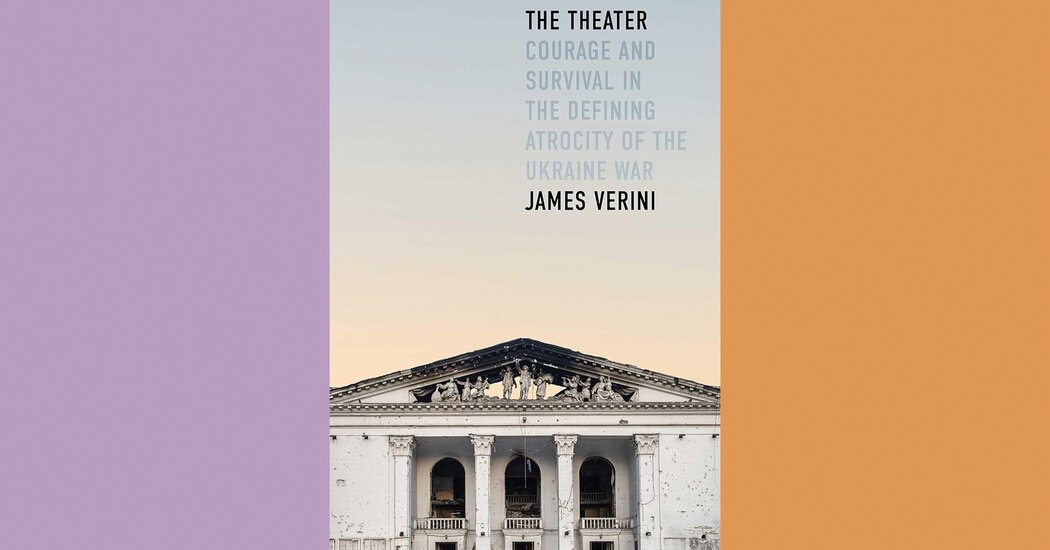
For him, as for many in Ukraine, the bombardment of a civilian structure — the word “CHILDREN” had been written in Russian in huge letters on the ground outside — was a landmark event in the war, evidence, as one survivor put it, that “the Russians had come to kill us. They didn’t come to fight with Ukrainian soldiers. They just wanted to kill us.”
Before the attack, over 1,000 refugees were drawn to the theater, which became a ramshackle village. Every usable feature was repurposed for some aspect of survival, from plush seats removed to serve as beds to stage props fashioned into toys for children. Out of the random assortment of people there emerged a core of stalwarts who improvised the essential elements of a functioning community from the debris.
The shelter’s only doctor, Olena Matiushyn, managed the makeshift infirmary. Igor Navka hauled buckets of water from an underground cistern, Verini writes, “from daybreak until dusk.” His wife, Nadia Navka, a metalworks technician, labored tirelessly in the “scullery” to eke out communal meals. And a team of scavengers known as The Searchers scoured the dangerous city for anything left by looters.
This panorama of fearful, resilient life is superbly conjured by Verini from interviews with the refugees. Directed by his instinct for the telling word, it is at once spare and precisely detailed. Readers should not be put off by the publisher’s subtitle, “Courage and Survival in the Defining Atrocity of the Ukraine War,” which is misguided on many levels; among other things, the war is ongoing.
The tenuous society that had been cobbled together with so much ingenuity and effort was shattered on March 16, 2022, when a Russian bomber dropped the equivalent of 1,200 kilograms of TNT on the theater. The evocation of this devastating event through the memories of different refugees is among the most haunting passages in the book. There was “a thunderstorm of building material,” one survivor recalls of the moment that brought the theater’s 1,500-pound chandelier crashing down. The number of fatalities is still unknown, with plausible estimates ranging from 50 to 200.
