


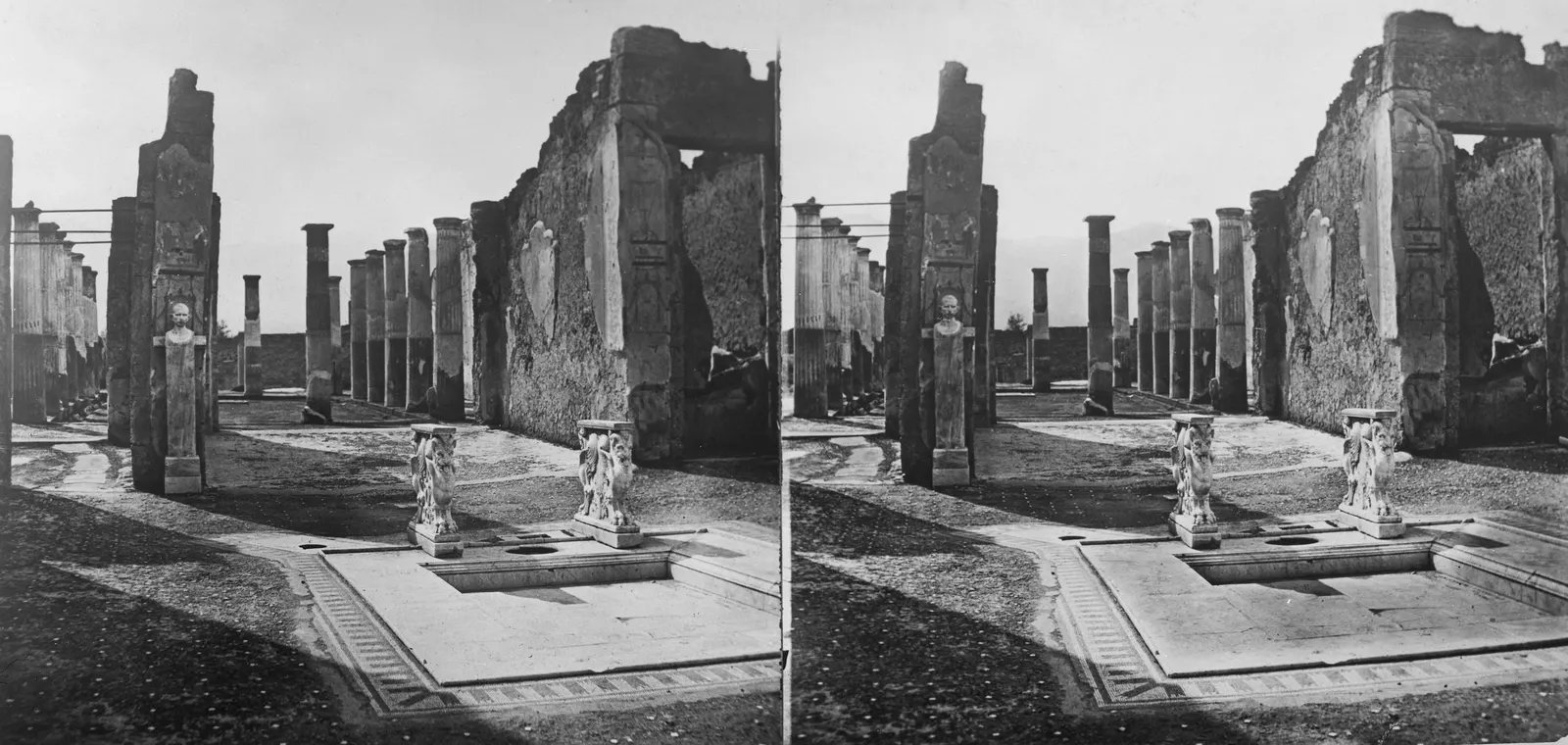
Stereoscopic image among the ruins of the House of Cornelius Rufus (also known as the Domus Cornelia) which was buried beneath volcanic ash in the 79AD eruption of Mount Vesuvius in Pompeii near Naples, Italy, circa 1875. (Photo by Graphic House/Archive Photos/Getty Images)
Getty Images
In Natalie Lemle’s debut novel, Artifacts, readers are confronted with an age old question: where do we come from? What we learn is that the answer is rarely as simple or as fixed as we grow up imagining. Told in alternating timelines, Artifacts follows Lena, as a college student enraptured by an enigmatic professor and his archeological dig, and later as a lawyer whose time on that dig visits her in unforeseen and treacherous ways.
It’s a poignant exploration of the murkiness that often complicates our understanding of the people that came before us and how we came to be who we are; as the novel’s characters wrestle with the provenance of an ancient artifact, Lena is forced to reckon with her own history. The intricacies of archeology and its intersection with history and property ownership makes for a lush backdrop to the novel’s interpersonal dramas, the two weaving seamlessly together without ever feeling heavy-handed. The novel’s prose is fresh and engaging and Lemle creates a world for readers that is as visual as it is emotive.
The art world proves a ripe terrain for fiction; writing for the Guardian, David Barnett points out: “Archives of the past, repositories of secrets, windows on to worlds and people long disappeared: museums are storehouses of stories. Cursed horrors lurk in dusty vaults, thrilling mysteries can be solved, magic can be woven from pieces of the past. Behind every piece of pottery or scrap of fabric, there lies a human life lived out long ago.”
Artifacts is one of a number of novels out in recent years situated within the world of art, artifacts, and museums; last year, Simon & Schuster published Heather McGowan’s Friends of the Museum a voyeuristic and layered look at a day behind the scenes at a struggling New York City museum which Town & Country heralded as, “a satirical and incisive look at arts institutions and those who love them.” The Nude by C. Michelle Lindley follows a young woman as she treks to Greece for an artifact with questionable provenance; Sirens & Muses by Antonia Angress turns it’s eye toward the rivalries and scandals of an elite art school; Ling Ling Huang’s Immaculate Conception charts the obsessive, fractured, and tortured relationship of two art students and the separate paths they chart after graduation.
I spoke with Lemle about the real world inspiration for her fiction debut, the nuance of provenance–personal, and historical–and what books and movies she recommends for fellow art lovers.
Caroline Reilly: I’m curious, how did you find your way into the museum world before you were a writer?
Natalie Lemle: I grew up in the suburbs of Chicago; my high school was so large and there were tons of AP classes so I took an AP Art History class in my senior year and I was like, I love this so much. So unlike Lena, I do love art and history. I love looking at slides in a dark classroom. I really love thinking about art, writing about art, having experiences with physical art. But basically I was like, how could I work with art? I would love to work in a museum. But the thing is I didn’t necessarily want to be a curator because I didn’t know that I would want to specialize that much.
So I knew, if I was to pursue this field, I would want to be on the business side of a museum, because then I would get to work with curators and be around the art but with more variety. I went to Tufts for undergrad and I got an internship at the Cloisters. It was like, this is what it would be like to work in a museum. I knew I loved it. I was like, yes, I want to work at a museum. But then I graduated into the recession. I graduated in undergrad in 2010. So no museums or galleries were hiring. So I ended up staying in Boston, getting a job in advertising; then slowly my way, worked at a gallery on Newberry Street and then got hired in corporate relations at the Museum of Fine Arts Boston.
I still go to stuff at the MFA all the time and I’m friends with all my colleagues and former colleagues and I’m actually trustee now at the ICA.
Caroline: What experiences during your time in museums did you bring into this book?
Natalie: So most of my research and experience with the specific provenance issues that figure into the novel came from various sources, but mostly surrounding the Mary and True case at the Getty.
And so the character that keeps getting brought up by Sy and Caroline, Marianne Flynn, is based on Marion True. There was a book that came out around 2010 called Chasing Aphrodite that looked into the whole history of the Gettys collecting practices and how some of the shady things they were doing for decades culminated in Italy and Greece suing Marian True and accusing her of furthering the market for looted antiquities and basically trying to throw her in jail her individually.
A shot from Lemle’s time on an archeological dig
Natalie Lemle
And what I’m so interested in about provenance is how it is a story–and stories are subjective and biased and it’s not necessarily wrong for a curator or a curator of provenance or a curator of antiquities or a collector or a dealer to attempt to fill in those gaps because it’s not always nefarious. And there is no really universal set of laws. We do have the UNESCO Convention, but it’s not that easily enforceable actually. Different countries have different ways of treating timing when things have been legally taken out of the ground or not. Very often it’s just a moral question rather than a legal question.
We as humans are wired to tell stories about things, about places, about ourselves. And so I just don’t think it’s necessarily lying in a super pejorative sense.
Caroline: It’s not dissimilar to how we’re taught about history; we’re given the idea that it’s fixed. It’s how we perceive even ourselves. But as we get older we learn how nuanced these stories we tell–about ourselves, our history–can be. And I love how Lena’s coming of age story parallels the archeological story in the book.
Natalie: I think I’m interested in this question of the tension between what do we inherit and what do we create for ourselves? And I see that in a broader cultural sense in the sense of an object or cultural heritage, but also in terms of genetics and what do we inherit from our parents and what do we create for ourselves? And I think not only Lena, but all the other characters in the book are in some way trying to distance themselves from their origins. They’re trying to reinvent themselves or even simply invent themselves or they’re trying to come up with a story that makes sense about why they are the way they are. Lots of conversations about parents, fathers, mothers.
And so I feel like why are these [artifacts,], these physical things resonant? Why do we care about them? Why do we assign them value? Well, because they’re inherently human. These things that we find in these sites, humans use them, they were important. They remained, they give us clues about our own heritage or somebody else’s heritage. But ultimately we’re all human. These objects can really connect us. Even our curiosity about them can connect us. So I definitely do see lots of synergy between the growth and the changes that Lena undergoes throughout the course of the novel, but it’s a bit abstract. But for me, as just a curious person, I wondered to myself, why do I care about all this ancient stuff?
Caroline: Artifacts also force us to reconcile our idea of ownership with what can be a changing and evolving history and often, we don’t have clear answers, or when we do, they’re subject to change the more we learn. And that’s true of life too; no one has a right answer for the family trauma Lena is experiencing.
Natalie: I agree with that completely. I think because I feel like art and archeology are inherently human, they’re human endeavors when they’re made in the first place and then they’re human endeavors when they’re written about or discovered or cared for. I just think you can’t leave out the human element in a character that’s really interested in these things. You just can’t leave out their flaws or their motivation. That’s why I do think that art and archeology are just such rich terrain for fiction. I mean, there’s so much good fiction about it, but I think basically studying these things as an undergrad, I never would’ve thought, oh, I’m learning all these things so that I can eventually make up stories.
Caroline: I’m curious, if you could give readers a syllabus for other books, or even movies or that teach us about how art is in conversation with our humanity–what would it include?
Natalie: My watchlist or reading list for Artifacts would include: Indiana Jones, La Chimera, and The Mastermind for movies. For non-fiction books, I would recommend Veritas by Ariel Sabar, The Art Thief by Michael Finkel, Chasing Aphrodite by Jason Felch and Ralph Frammolino, Empire of Pain by Patrick Radden Keefe, The Brutish Museum by Dan Hicks, The Twelve Caesars by Mary Beard, Christendom by Peter Heather, and Underland by Robert Macfarlane.
And for fiction, I would recommend, Wake, Siren by Nina Maclaughlin, People of the Book by Geraldine Brooks, The Golden Ass by Apuleius, translated by Sarah Rudens, Til We Have Faces by C.S. Lewis, Asunder by Chloe Aridjis, and The Eight Mountains by Paolo Cognetti.
The Dutch room at the Isabella Steward Gardner museum is still closed to the public as the museum re-opened following the theft of priceless art works 3/18. The frame from the Rembrandt painting “A Lady and Gentleman in Black (1633) is still on the floor where thieves left it after removing the oil on canvas painting. (Photo by Bettmann Archive/Getty Images)
Bettmann Archive
