


The Wadsworth Atheneum Museum of Art opened in Hartford in 1844, less than 70 years after the signing of the Declaration of Independence creating the United States of America. The Wadsworth, the oldest continuously operating art museum in the U.S., has gone all out to honor the 250th anniversary of the nation by filling several different gallery spaces with America-themed exhibits loosely grouped under the collective title “Framing American Democracy.”
The exhibits are not intrinsically connected, yet their themes flow into each other. “Radical Roots,” on the Avery building’s third level through Sept. 27, is an artistic look at 18th century America. “Contemporary Artists Reflect,” on display through Sept. 13 in The Wadsworth’s Avery Court and some adjacent rooms, is a reflection on democracy and independence from 20th and 21st century perspectives. “Rebel/Revolt/Resist” up until the spring of 2027 at the Amistad Center for Art & Culture, a separately run gallery space and art collection housed on The Wadsworth’s second level, is focused on civil rights and other Black struggles within the larger context of America’s history and supposed freedoms.
Christopher Arnott/Hartford Courant
The entranceway of the “Radical Roots” exhibit on level 3 of The Wadsworth. Connecticut’s historic Charter Oak features heavily in this section of “Framing American Democracy.” (Christopher Arnott/Hartford Courant)
Enhanced by the large amount of American art spanning centuries that is always a part of The Wadsworth’s permanent exhibitions, the whole multi-building complex proclaims a sense of independence, revolution and especially radicalism. The exhibits are eye-opening and thought-provoking. The artists approach concepts of American history and heritage from a wide range of perspectives, using a wide variety of styles. Even the historical pieces in “Radical Roots” are given a modern touch: Large chunks of the Charter Oak are roughly arrayed around a chair made out of that famous tree, and the walls of the whole display area are painted a gentle green rather than the accustomed white or gray.
The introductory texts in each of these disparate democracy-themed exhibits can be as strongly formed and provocative as the works they are discussing. A placard titled “Revival of the American Spirit” connects the founding of the country to its Civil War through art and culture. “As it attempted to rebuild and unify, the country was called upon to contemplate its foundational democratic ideals. While the Civil War tried the American spirit, events like the 100th anniversary of the United States created the opportunity for both commemoration and reflection.”
Christopher Arnott/Hartford Courant
The Wadsworth incorporates some of its own history into its “Radical Roots” exhibit. (Christopher Arnott/Hartford Courant)
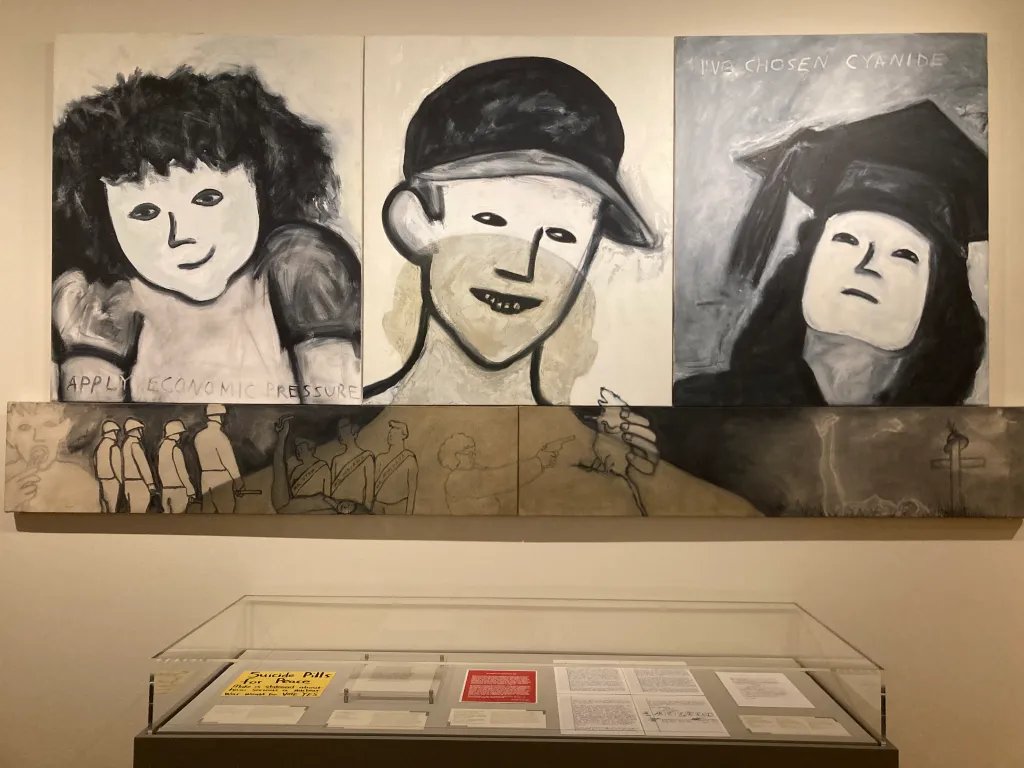
The “Contemporary Artists Reflect” section of the exhibit extends that idea another century and a half into the present day with protest artworks by Sam Durant, The Guerilla Girls and other artists showing oppression of various groups within the U.S. over the course of the country’s history. “Dunging the Ground,” a 1996 work by Edgar Heap of Birds (whose Cheyenne name is Hock E Aye Vi) inspired by the Pequot War in Mystic in the mid-1630s, is vibrant, calligraphic and very distressing text drawn from a Connecticut Colony Militia colonel’s memoirs that is framed with crosses.
“Rebel/Revolt/Resist” in the Amistad Center offers separate areas for each of the words in the exhibit’s title. “Rebel” is devoted to Jacob Lawrence’s many prints depicting the legacy of abolitionist John Brown and the 1859 raid on Harper’s Ferry in Virginia. The dozens of pieces have deceptively simple and direct images, often religious in nature, including a group praying and a crucifixion. The “Revolt” section is anchored by Sonya Clark’s “Unraveling,” an ongoing installation in which a Confederate battle flag from the Civil War is gradually pulled apart thread by thread. The flag on display is about 75% intact, evenly and artistically undone while maintaining its horrific repellent core.
Christopher Arnott/Hartford Courant
The middle section of the “Rebel/Revolt/Resist” exhibit at the Amistad Center for Art & Culture, one of three “Framing American Democracy” exhibits within the Wadsworth museum complex. (Christopher Arnott/Hartford Courant)
As its Charter Oak arrangement suggests, “Radical Roots” is highly Connecticut-centric. Robert Bakewell’s very wide “Panoramic View of New Haven from West Rock,” painted in 1844, has the same sharp color scheme and jagged rocky feel as European Futurist paintings of nearly a century later. The Wadsworth even inserts itself into this history mix with a letterpress broadside from 1846 announcing “100 oil paintings are now exhibiting in this gallery!,” listing nearly a dozen of them then adding “… forming altogether a splendid collection and is the largest and most valuable gallery of paintings in this country.”
The separate but cryptically interlocking “Framing American Democracty” exhibits demonstrate how The Wadsworth not only grew with the country but retains that knack for attitude and expression that defined this invaluable museum 180 years later.
The three exhibits comprising “Framing American Democracy” are at the Wadsworth, 600 Main St., Hartford. Visiting hours are Wednesday through Friday from noon to 5 p.m. and Saturday and Sunday from 10 a.m. to 5 p.m. $22, $18 seniors, $10 youth and students, free for Hartford residents. thewadsworth.org.
