


If you take a walk through downtown Fort Wayne, you will come across colorful murals, sculptures and other installations in parks, on walls and peeking out from alleys and parking garages.
But look closer at some of the pieces and you might notice signs of damage – a sculptural bike rack with rust spots, faces of bricks falling off a wall and writing scribbled on a mural.
Some damage is to be expected with public art, which is subject to the sun, extreme temperatures and other elements. The popular “77 Steps” light installation is being removed this spring after surpassing its expected five-year lifespan and incurring severe wind damage.
“I think Fort Wayne is really known now, and has been for some time, for its cultural vitality,” says Pam Holocher, who retired in 2018 as the city’s director of planning and policy. She is an advisory member of the city’s Public Art Commission.
Part of vitality is the art, and if it is not maintained, that designation begins to falter, she says.
Maintenance is an important element of public art management, local leaders say. Various agencies approach that work differently but with the same goal: to ensure longevity of work that elevates the community.
Management program
The city’s Public Art Commission in December approved a Collection Management Program to ensure that work created or overseen by the body is “maintained to a high standard and continues to enhance the visual environment of its public spaces.”
Officials, arts leaders and creatives in northeast Indiana talk about the impact of public art on communities, how organizations and artists e…
The program is administered by the commission’s collection management committee, which will perform an annual inspection and assessment of pieces in the body’s purview to look for structural issues and other damage. The commission owns 24 pieces, including 14 “Sculptures With Purpose” bike racks. It also oversees the East Columbia Street “Metaform” mural and sculpture, which is owned by the city’s Community Development division.
If damage is found during the annual assessment, a repair estimate will be sought from a professional, says Holocher, who chairs the committee. The program allows the management committee to authorize work costing up to 2% of the commission’s annual maintenance fund before going to the full commission for approval of a larger sum. For 2026, the threshold is $2,508.49.
The commission draws its budget from the Public Art Giveback Program, which requires developers of city-supported projects to put money into the Public Art Fund equal to 1% of the estimated value of the economic incentive, up to a maximum of $100,000.
Maintenance needs vary. For the “Pillars of Hope and Justice” monument to the late Rev. Martin Luther King Jr. at the northwest corner of West Main and Ewing streets, costs include electricity and replacing lightbulbs.
“We figured out that bulbs all dim at different rates,” Nate Lefever says with a touch of humor. “So when you change one, you probably need to change them all to make them look the same.”
Lefever is an historic preservation and culture planner with Community Development. He works with the Public Art Commission on projects including its Shout-Out program.
The metal columns in “Pillars” are powder-coated for longevity, but designers Norman Lee and Shane Allbritton provided a maintenance manual that included touchup paints, recommended torque ratings for the mounting bolts, the size of hex keys needed to open the lighting mounts, the type of bulbs needed, and manufacturers of various components.
That manual set a benchmark for the type of in-depth descriptions Lefever says he wants to see with similar projects moving forward. The commission included the expectation of a manual when it requested proposals for the light installation that will replace “77 Steps.”
“One of the things we hope with this program is it could serve as a prototype for other departments or other organizations that might start an art collection or have an art collection,” Holocher says.
From the start
Local artist and educator Tim Parsley says it is important to consider maintenance from the earliest stages of a project. He is vice chair of the Public Art Commission and chair of its review committee.
The committee’s members consider projects being supported with public money or being installed on public property, which require approval of the commission. The committee is also available to provide feedback on projects that do not require the commission’s approval. Commission-sponsored projects, such as the Shout-Out Fort Wayne neighborhood art program, have their own committees for review and management.
The review committee’s application includes questions about budget, community involvement and plans for sustainability. The committee might make recommendations such as which paint brands to use and how to properly prepare a wall for a mural installation.
As a muralist, Parsley knows how important it is to properly prepare a wall prior to installation. It must be thoroughly cleaned, and some masonry work might be required before it can be primed.
Taking longevity steps early is beneficial not only for the public art piece but also for the community. Installations become an extension of a neighborhood’s personality, creating a sort of anchor point, Parsley says.
“There’s a lot of money put into them, and when they start to get cruddy, the neighborhood (residents) who took pride in them start to feel like, ‘Oh, we don’t have nice things,’ ” he says. “There’s a sort of pride that wears down if the (art) wears down.”
Parsley admits some selfishness in hoping his murals survive: He wants his children to be able to bring their children to see the installations someday.
Estimating life
Local public art consultant Alexandra Hall estimated the following lifespans for various types of public art.
Crosswalk murals: After about two years, an installation starts to look rough because of regular wear by vehicles and winter weather treatments. Longer lasting materials are available at a higher cost, and touchups can extend the life of a piece.
Sidewalk murals: Pieces in the Clean Drains Fort Wayne: Be River SmArt project generally last about three to five years. They are subject to wear by pedestrians, as well as shovels and salt in the winter.
Wall murals: Color begins to fade in about 25 years. A piece likely should be restored or removed after 30 to 35 years.
Sculptures and statues: The lifespan depends on materials. Bronze is an investment that lasts a long time, while steel has a shorter shelf life. Electrified projects have shorter expected lifespans because the technology becomes obsolete over time.
Fiberglass: Many mastodon sculptures from a 2005 project honoring what was then IPFW are still going strong in the community more than 20 years later. The I Am Allen public art project honoring the county’s 2024 bicentennial also used fiberglass forms painted by local artists.
Lifespans vary
Different styles of public art have different expected lifespans. A painted mural might last 40 years with proper maintenance, while metal and stone sculptures are likely to be among the longest-lasting installations in the city. Some statues in the city’s parks are more than a century old.
“Most, if not all, of the pieces that are under Parks’ purview are … going to last generations if they’re taken care of,” says Chad Shaw, deputy director of planning and landscape for Fort Wayne Parks and Recreation.
The department has about 90 pieces in its collection, including large monuments, sculptures and plaques. Though many of its pieces are historical in nature, the department has the same goals as other groups, says Shaw, who is the Parks and Recreation appointee to the Public Art Commission.
He believes having statues in parks helps preserve culture and history. Other sculptural pieces, such as the more abstract “Convergence” at Promenade Park, are placemaking efforts that improve the experience of people visiting the space.
“It can make people think for all the same reasons that you go to an art museum and look at art,” Shaw says. “You just put that in the public realm, and it makes it more accessible to people.”
Around 2013, the parks department realized some of its statues needed work, Shaw says. A consultant assessed about a dozen prominent pieces, providing recommendations. Since then, the department has been allocating capital improvement funding each year toward restoration. The state of artwork is part of annual parks assessments.
The Gen. Anthony Wayne statue in Freimann Square was first on the list of recommendations and underwent a restoration project in summer 2014 using a laser-cleaning technique. Some damaged and missing parts of the statue, dedicated in 1918 in a different city park, were replaced, according to Journal Gazette archives. It had also undergone repairs in 1984.
The statue of David N. Foster, dedicated in 1922 at Swinney Park, underwent restoration in 2017.
The parks department most recently had maintenance work done on “Let’s Go Swimmin’,” a stone sculpture in Orff Park depicting two boys. The monument to the Old Aqueduct Club was erected in 1927. In 2023, the sculpture was cleaned and the base, which had shifted, was moved back into place and mortared. The bronze plaques on the sculpture were laser-cleaned and restored.
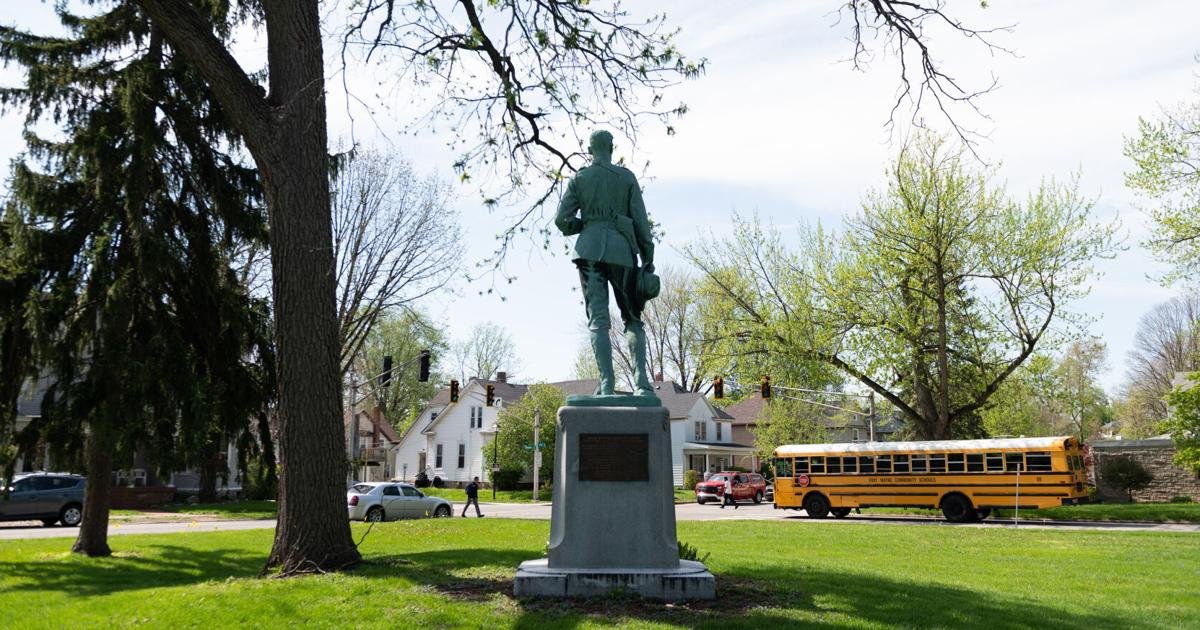
Shaw is currently considering quotes for work on a statue of Maj. Gen. Henry Lawton that faces the intersection of Lake and Crescent avenues from the lawn southwest of Lakeside Park. The restoration could cost $50,000 to $70,000.
“The patina is really bad on it,” he says of the bronze statue, which was installed in 1921. “It’s just looking more and more degraded, especially in comparison to some of the other pieces in the parks.”
Parks and Recreation employees have done some cleaning projects themselves, and the restoration consultant has provided maintenance plans for waxing bronze pieces to help prevent oxidation.
Installed in 2022, Cary Shafer’s “Megaflora” outside Foellinger-Freimann Botanical Conservatory is the most recent addition to the parks department sculpture collection. Shaw says maintenance is always in mind when considering adding a new piece – or doing any sort of park improvement.
“How are we going to maintain it? What’s the longevity of this? What are the costs associated with that?” Shaw says, listing some considerations.
Eye on longevity
Downtown Fort Wayne’s Art This Way public art program owns only a few installations but more often shares responsibilities for pieces such as the Clean Drains Fort Wayne sidewalk murals and alleyway activation projects. Most larger installations the organization programs are owned by whichever entity owns the property where they are painted.
Art This Way each spring revisits pieces created through its programming, which relies on donations, sponsorships and grants. With consent of the property owner, the organization will do maintenance work to repair vandalism or damage.
“That’s the nature of our partnership with those owners,” manager Alexandra Hall says. “We enter into a five-year term where we say (that type of monitoring and maintenance is) what we’re going to do.”
That agreement can be extended at the end of the term, or the property owner can decide to do something different with the wall.
Hall hired a local artist to repair damage to Shawn Dunwoody’s “Hello, Fort Wayne” mural in 2025. The piece again has some small writing on it this spring. Minor touchups like removing words written in marker, Hall says, cost less than covering the murals in anti-graffiti clear coating at the beginning. The expensive coating would need to be reapplied each time it was wiped away in the graffiti-removal process.
When artists are selected for an Art This Way project, the agreement they sign includes that another artist might be hired to perform fixes on the piece. That has been a part of agreements since the start of the program 10 years ago.
“I like that I can hire somebody like Theoplis Smith III, Jeremy Stroup or Julie Wall – someone from town – to fix these pieces,” Hall says. Stroup repaired the Dunwoody mural last year. Hall did the work herself when Bryan Ballinger’s “The Blue Birds” at 927 S. Calhoun St. was struck by a dump truck.
Other communities
Thorough her A H Public Spaces Consulting firm, Hall works with other communities including Ticonderoga and Seneca Falls in New York, along with the counties of Livingston and Chautauqua in that state; and Bellefonte, Pennsylvania. She helped lead the Make It Your Own Mural Fest that created a mural in each of northeast Indiana’s 11 counties in 2020.
Fort Wayne is larger than many of the communities she works in, some of which might be programming their first public art pieces or starting again after years without a public art program. But regardless of their size and experience, she approaches maintenance the same: A contract with property owners that includes terms for checks and touch-ups.
“If a mural is done properly, you don’t see a lot of issues with it, with the exception of human interference or some sort of infrastructure issue,” says Hall, who is a Public Art Commission advisory member.
Though the communities might be smaller, there is more access to funding streams in New York, Hall says. Many projects in Fort Wayne have smaller budgets than what might be found elsewhere. Larger initial budgets means being able to invest in higher-quality materials and maintenance plans, which increase the longevity of a piece.
She points to communities with wealthy anchor companies that support their city’s arts programs. Art projects in Cincinnati, for example, benefit from the philanthropy of Fifth Third Bank.
The popular “77 Steps” light installation downtown will be removed this spring. Lessons learned from damage to the piece are being incorporated into a new installation planned for this summer.
End of life
Though public art is ephemeral, that doesn’t mean short-term in many cases. A sidewalk or crosswalk mural might only last a few years because of constant wear, but other types of art could last a generation or more.
Hall makes that clear to communities with which she consults. A proposed sculpture trail will require decades of ownership responsibilities, including carrying insurance and removing pieces if they are damaged or become unsafe. Murals they help create on private property could be removed if the building is renovated or changes hands.
“I think the city of Fort Wayne and Art This Way have been approaching each of these projects as well as they can, because we understand that we’ll have to keep them up or we’ll have to retire them,” Hall says.
When pieces in the Public Art Commission’s collection reach the end of their lifespans, they will be removed, as is happening with the “77 Steps” installation. Several of the artistic bike racks, which were transferred to the commission’s ownership after a refurbishment project in 2022, have since been removed from public spaces. The collection management program specifically says the racks will not be repaired again beyond tightening loose mounting brackets.
Artists say
The Journal Gazette asked some mural artists who have worked on local projects to answer the following question.
Q. Why do you think public art is important for a community? And do you think it is important for that community to maintain that art after it is installed?
Shawn Dunwoody: Public art brings identity to a place. It reflects the people, the culture, the history; it gives a neighborhood a visual voice. It can spark pride, conversation, and connection.
But it doesn’t stop at installation. Maintenance is part of respect. If a community values the message, the story, and the impact of the work, then taking care of it becomes part of that relationship. A maintained mural says, “this still matters.” And that’s what keeps public art alive.
Lyndy Bazile: Yes, public art is an important part of creating a vibrant community! I feel that creating unique and thoughtful visuals in public spaces helps a community build identity, feel connected and inspire even more creativity. I’m sure we all have experienced pulling off a highway and seeing an Arbys, Panera, gas station and a Starbucks and thinking “This looks like a thousand other places I’ve seen!” Nothing about that indicated a unique community, and I find that to be one of the most depressing feelings. Copying and pasting large corporate chains and branding across the land is a community killer, creating intentional public art brings life and community.
Damien Mitchell: Public art can produce several positive outcomes in a community. Having art exhibited outside of the traditional gallery system allows the work to be accessible to everyone at all times of day. It can promote a dialogue in the community and form a sense of pride of place. Maintenance of the work allows this to continue and reflects the pride and unity of a community.
