


Opioids & Organs
Writer/Artist: Arizona O’Neill
Publisher: Drawn & Quarterly
Publication Date: May 19, 2026
When the opioid crisis hit Canada in the mid-2010s, Arizona O’Neill’s father—who had long struggled with addiction—overdosed on Fentanyl and was ruled braindead by his hospital care team. As his next of kin, O’Neill was “encouraged” to donate his organs and tissue to save or improve the lives of other patients who were awaiting transplants.
Not long after O’Neill signed the papers, she received a letter from the man who received her dad’s heart—a father himself, who expressed his condolences for her loss and thanked her “for choosing donation after [her] loved one’s passing.” Rather than comfort O’Neill, the letter sparks rage about how the opioid crisis closed the gap in Canada’s organ transplant system. O’Neill’s friends see this as a “silver lining”—but O’Neill sees it as a failure of Canada’s medical industry for seemingly allowing addicts to die young so their organs can be donated to more affluent patients.
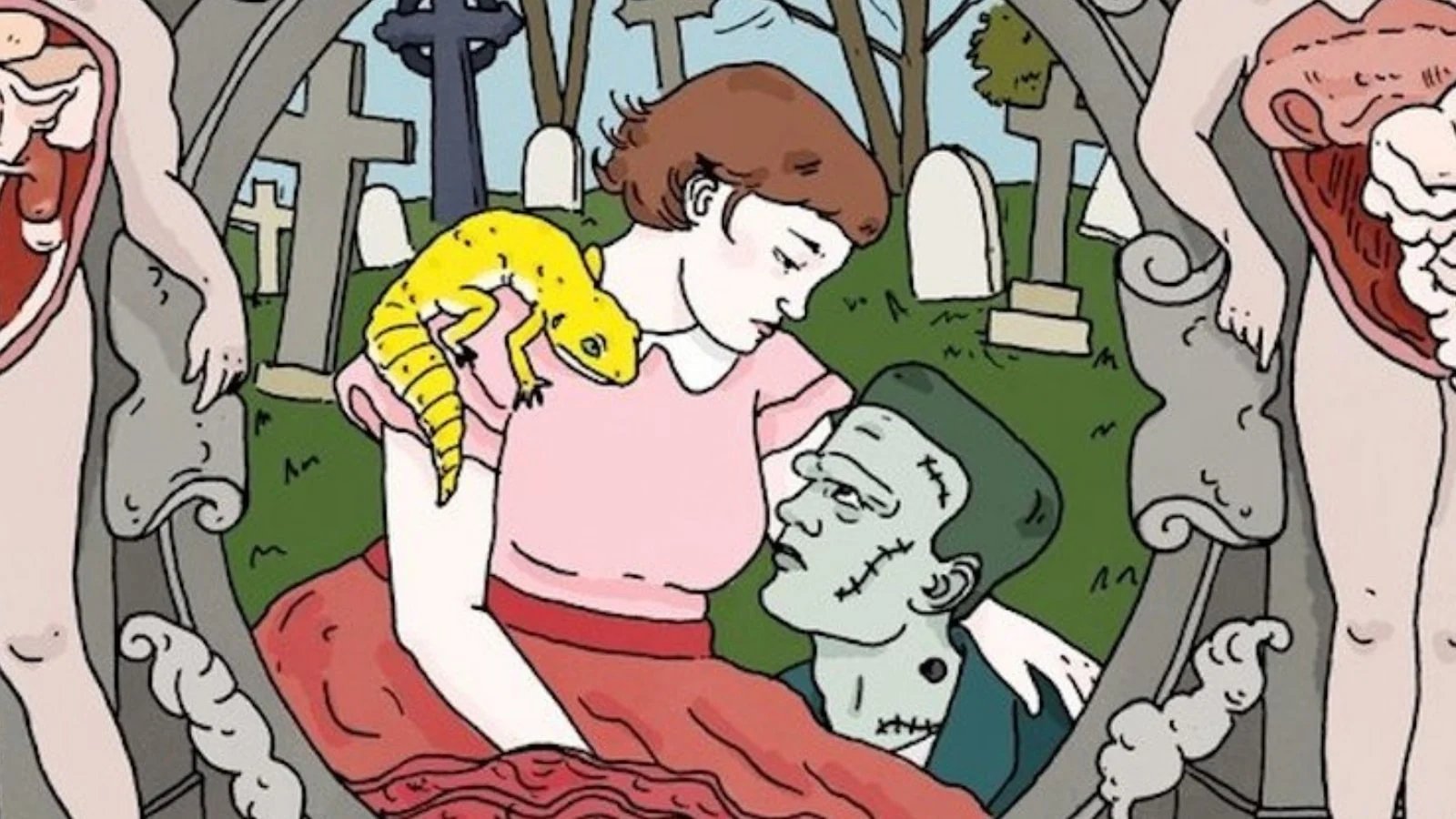
In Opioids & Organs, O’Neill’s graphic novel debut, a fictionalized version of herself researches the history of organ transplantation alongside an apparition of Frankenstein’s monster and a yellow lizard named Izzy that represents her anxiety, compulsions, and obsessions. Izzy and Frankie, as he prefers to be called, argue often—something like the angel and devil on O’Neill’s shoulders, only more visceral.
The inclusion of these characters makes Opioids & Organs sound glib, though it’s anything but. O’Neill’s rage feels like a character unto itself, screaming out from the pages as she learns about the gruesome history of what is now considered life-saving, interventional medicine. It doesn’t take long for her to find proof of her belief that “lesser-thans” are intentionally sacrificed (via medical neglect or intentional harm) so physicians can harvest their organs and transplant them in wealthier, more well-to-do patients.
When she visits her mother, an expert researcher who’s doing a residency in Dublin, O’Neill reads about the medieval tale depicted in the 14th century painting called “The Miracle of the Black Leg,” in which the Patron Saints of Medicine, Pharmacy, and Surgery, Cosmas and Damian, heal a living white man by swapping one of his legs with the leg of a dead Black man. “Now you have proof that the prejudice you have been suspecting in the organ trade has always been there,” her mother says. The tale in question dates back to the third century CE.
O’Neill also cites facts about grave robbing and the U.S. Cadaver Trade of the 18th century (not to be mistaken for “body brokering” today, which isn’t covered in O’Neill’s book), when American medical schools would purchase dead slaves to fill the demand for cadavers in classrooms. After slavery was outlawed, those who couldn’t afford cremation or burial—i.e., poor people—were automatically “donated” for dissection.
As O’Neill points out to her friends at several points in Opioids & Organs, “donation” implies voluntary consent. When someone is already dead and their next of kin is given no choice but to give away their loved one’s organs and tissue or their next of kin isn’t even consulted, it’s no longer a donation. It’s forced removal, or even theft. This is her major gripe with “presumed consent,” which is the law in some Canadian provinces.
Beyond studying the history of transplantation and medical science, O’Neill also visits sites where body parts have been preserved and displayed, including a museum of anatomy and the Parisian Catacombs. The former disturbs her in that there is no information about who the specimens came from, forcing her to create stories to humanize some of what she sees.
The Catacombs invoke a sense of calm, namely because of how the bones of France’s dead have been crafted into a memorial, with everyone—regardless of class—mixed together, anonymously. This is seemingly less exploitative to O’Neill, potentially because the Catacombs were created in response to the problem of Paris’s dead being packed into too-tight quarters with its living in the 14th-18th centuries. These bones weren’t rushed into surgery (as far as she knows) to save the life of someone else whose personality might have permanently changed after receiving a dead person’s organ.
There’s a lot to unpack in Opioids & Organs. O’Neill packs in a lot of information about the history of transplantation and medical science, and does so in a way that feels approachable regardless of one’s knowledge going into the book. She’s also blunt about her feelings on the rise in organ donations as a result of the opioid crisis in Canada, and how the so-called “silver lining” of saving lives with the organs of those who die by overdose seemingly dismisses the reality of how addicts are treated (or not treated, as the case may be) in the medical system. Her grief is palpable. Her rage is visceral. And her deft dismantling of the “hero” narrative of organ donation is perfectly executed through a balance of history, science fiction, surrealism, and memoir.
None of that even mentions how brilliant O’Neill’s illustration work is, and it is brilliant. Her fictionalized self is no more glamorous than Frankie or Izzy, and all three revel in ugliness across multiple pages as they process their feelings about their new knowledge and how it impacts them. The occasional transformation of people and everyday objects into individual organs, detached from their host bodies, adds an element of horror that underscores O’Neill’s writing beautifully, with some genuinely stomach-turning moments approached through surprising twists of perspective.
Opioids & Organs is a one-of-a-kind personal history that masterfully condemns a systemic problem impacting thousands. It will stick in a reader’s thoughts long after it they turn the final page—and so it should.
Verdict: Buy
Like this:
Loading…
