


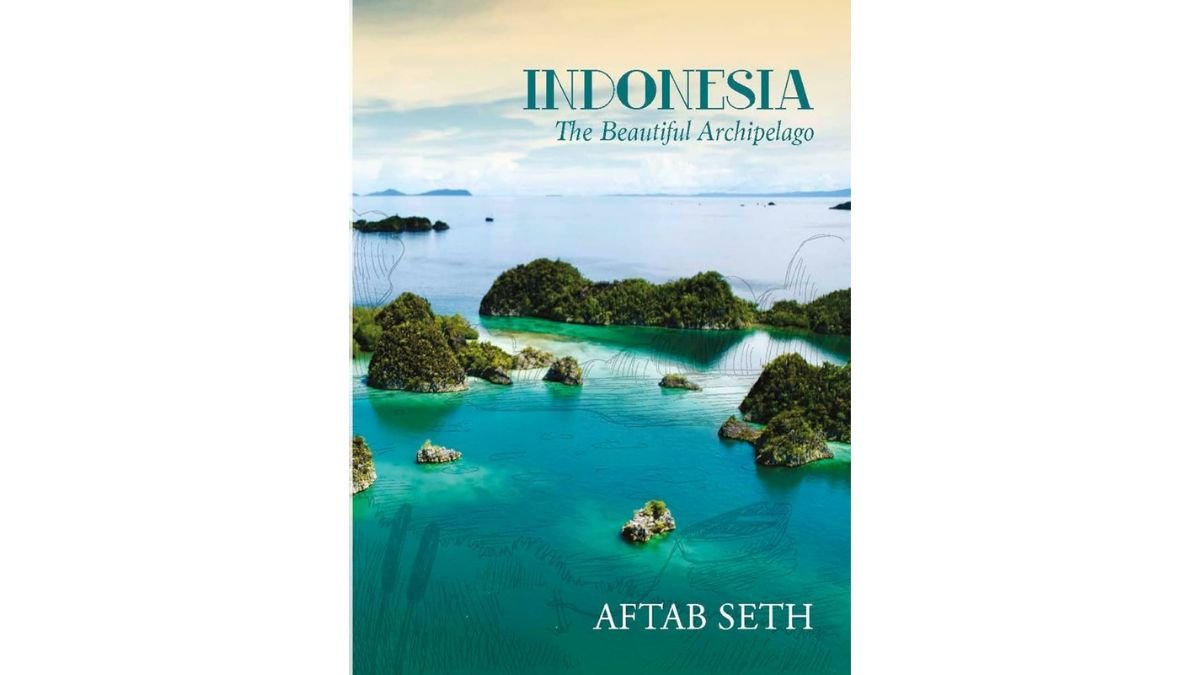
The book Indonesia: The Beautiful Archipelago, authored by ex-Ambassador Aftab Seth, is an in-depth examination of Indonesia’s post-independence history from the perspective of an Indian diplomat.
Aftab Seth comes across as an astute observer, and his commentary gives a unique perspective on political, social, and cultural developments in Indonesia. The underlying theme of the book is the melding together of a multi-ethnic and multi-religious society during the eight decades since Indonesia’s independence.
The author points out that Indonesia is a Muslim-majority country but it is not an Islamic State. Indonesia’s national motto, Bhineka Tungal Eka—“even though they appear to be separate, they are in fact one and the same”, or “unity and diversity”, gives an essence of how the country manages diversity while giving equal status to all religions.
Indonesia did not distance itself from religions by adopting a secular constitution, but rather by actively managing diversity through a Ministry of Religious Affairs.
Ambassador Seth observes that the ideology of Panchsila was the foundation of the Indonesian State: (1) Belief in one supreme God; (2) Just and civilised ideology; (3) Unity of Indonesia; (4) Democracy guided by wisdom of deliberation; and (5) Social justice.
Indeed, Seoharto, Indonesia’s second President, deliberately used syncretic culture as a counter-balance to Islamic orthodoxy.
The author avers that there are certain unique characteristics that have helped Indonesia maintain communal harmony.
Islam came to Indonesia through preachers and traders—including those from Gujarat. There is no legacy of conflict. The Indic legacy was overlayed by the gradual spread of Islam across the archipelago, resulting in the emergence of a syncretic Islam embracing important cultural elements from the pre-Islamic culture.
Ambassador Seth points out that a significant section of Indonesian Muslims are members of two nationwide Islamic organisations—the Nahdlatul Ulama (90 million) and the Muhammadiyah (70 million).
The NU runs a network of pesantren or religious schools in the countryside which are gradually being absorbed into the formal school system.
The Muhammadiyah emphasises Islamic education and has established schools and colleges across the country. The members of the Muhammadiyah are to be found in urban areas and are better represented in government and state institutions. The NU, which has relatively more members, is concentrated in the countryside.
The NU embraces some pre-Islamic customs and beliefs. The Muhammadiyah, on the other hand, would like to purge Indonesian Islam of pre-Islamic practices and beliefs and restore it to a level of religious purity.
The author recalls that when the Islamic Revolution occurred in Iran, the Indonesian government sought to keep an arm’s length from these developments and kept a close eye on activities of Iranian diplomats in Indonesia.
Saudi Arabia played an active role in Islamic education in Indonesia by arranging teachers and the funding of Islamic institutions.
One aspect of interest was the deep admiration in some circles in Indonesia towards Pakistan, which had established an Islamic State in 1947 whereas Indonesia had been unable to accomplish this to date.
Ambassador Seth also walks the reader through Indonesia’s post-independence era—the coup that dethroned Sukarno, the anti-communist purges of 1965-66, and the New Order regime that lasted till 1998.
He fondly recalls his meetings with Abdurrahman Wahid, the first democratically elected President of Indonesia. Wahid was a great friend of India and had great respect for India’s handling of religious diversity.
While the first half of the book is about Islam and political governance in Indonesia, the second half touches on a range of topics: the Vietnamese invasion of Kampuchea, the Chinese invasion of Vietnam, and the Indonesian provinces of Aceh and West Sumatra.
Aceh is significant, as it is the nearest to the Andamans. West Sumatra, for long a centre for education under the Dutch colonial rule, gave Indonesia many leaders during the independence movement. Notable among these was Vice President Hatta, who had personally known many leaders involved in India’s freedom movement.
The book concludes with a chapter on Tagore and his advocacy of an Asian cultural renaissance. Tagore visited Indonesia in 1927, hoping to see glimpses of India’s past in Indonesian fine arts and performing arts.
Instead, what he found was a rich indigenous cultural legacy of Indonesian art and culture. Tagore made a call for a swadeshi education. Pursuant to his efforts, some Indonesian artists studied at Shantiniketan. They included the famed Indonesian artist Affandi, who studied under Nandlal Bose.
The last chapter is about the author’s advocacy of, and contributions towards, the establishment of an Indian Cultural Center in Bali.
The book is an engaging work of history cum memoir that reflects the deep knowledge and empathy with which the author approaches his subject. The perspective of the book is situated majorly in the period from 1983-85, when Ambassador Seth was posted as Deputy Chief of Mission in Jakarta.
A few notable exceptions from a later period which find mention in the book are the events of 1997-98 (the collapse of the New Order State), the election of Wahid as the President of Indonesia in 1999, and the election of Probowo Subianto in 2024.
Published by Birch Books in 2026, the book is also elegantly designed and includes some beautiful photographs of the places referred to in the text.
Indonesia: The Beautiful Archipelago
Author: Aftab Seth
Publisher: Birch Books (2026)
Pages: 224
Price: Rs 648
Both the author and the reviewer are former Indian ambassadors.
