


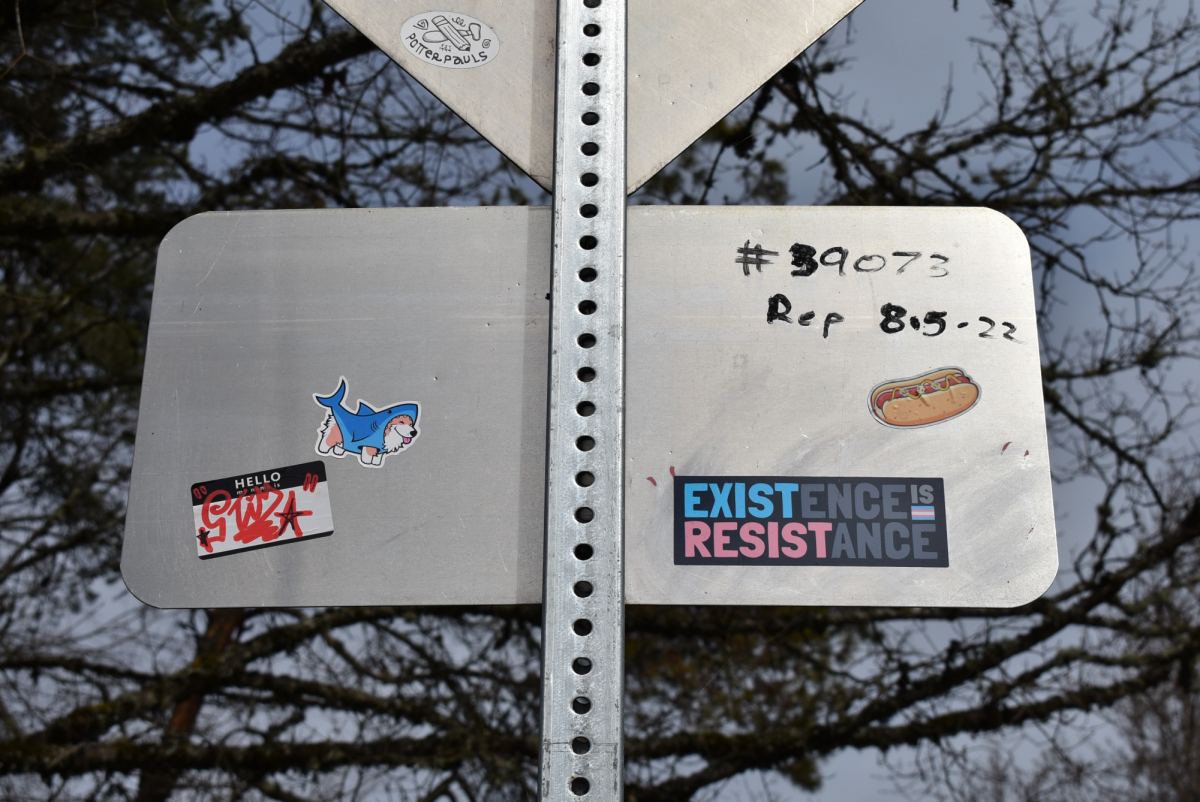
I recently went on a walk with the purpose of finding art and graffiti around the city. In doing so, I realized just how many little details are easy to miss if you don’t pay close attention — things like the hotdog stickers all around my apartment building, or the cryptic message spray-painted on the wall I pass every day on my walk home.
Some community art looks like big, beautifully thought out murals, silly little drawings or the letters L+S carved in a tree surrounded by a poorly sharpied-on heart. There are stickers with political messages slapped on lamp posts, flyers with cool visuals promoting the next protest and even anonymous cries for peace in affairs of global importance.
University of Oregon junior Gretchen Wackler remembered seeing particularly impactful artwork during the 2024 pro-Palestine encampment that took place on campus. She said one particular piece of sidewalk chalk art stood out to her as it labeled UO’s Johnson Hall as “Hind’s Hall.” This paid tribute to 5-year-old Hind Rajab, who was killed by Israel’s military forces in the Gaza Strip.
“I think that’s a really powerful thing to do. It gets people’s attention and forces people to reckon with the life of this child that was taken,” Wackler said. “I think it’s a peaceful form of protest, and I don’t think it hurts anybody.”
Wackler also shared her view on street art as having the unique ability to represent the values of everyday people in the community. “It’s so raw and unfiltered, especially graffiti. I think it’s kind of beautiful to see,” she said.
Graffiti grew in immense popularity back in 1960s New York and Philadelphia as a form of self-expression and rebellion, according to the East End Arts and Humanities Council. In an article, they wrote about the impact of the art form as having a great influence on community engagement and supporting grassroots movements by transforming blank spaces into places that capture the history and culture of an area.
Eugene has some truly beautiful murals, and the city often holds mural projects and programs to support local artists in making their mark.
UO Professor Julianne Newton, teaches visual communication and directs the doctoral program. She explained that graffiti and street design are “manifestations of human visual behavior.” These works reflect public opinion yet the impact of this art is often difficult to measure.
Professor Newton emphasized that the anonymity of these art forms allow artists to communicate
messages they may not feel safe attaching their name to. “It also carries an air of mystery, as with Banksy’s art. Credibility is bestowed by the viewer,” she said.
“Graffiti and street art offer meaningful platforms for messages a community needs to see and contemplate and that might not be publicly shared otherwise,” Newton said.
While many cities often commission murals, unauthorized graffiti is considered a criminal act, stickers and posters are commonly removed and written messages are painted over.
Because this art is used as a form of urban and suburban protest, it plays an important role in our local community. It not only entertains, it also informs. The thoughts of our neighbors are painted around the city like it’s Eugene’s living opinion column.
