


Captured on Nintendo Switch (Docked)
2D platformers are easy to find. They’re one of the oldest genres in video games, and thanks to that long pedigree, they’ve been getting made for nearly the entire industry’s history. It would be impossible to play through them all in your lifetime.
Great 2D platformers, though, are rare. TetherGeist belongs in that rare category, and it may be my favourite 2D platformer I’ve played since Celeste. It follows in the footsteps of the very best, and yet, it blazes its own trail with something new. Smart level design and progression keep things constantly fresh, and collectibles galore offer extra challenges and reward exploration.
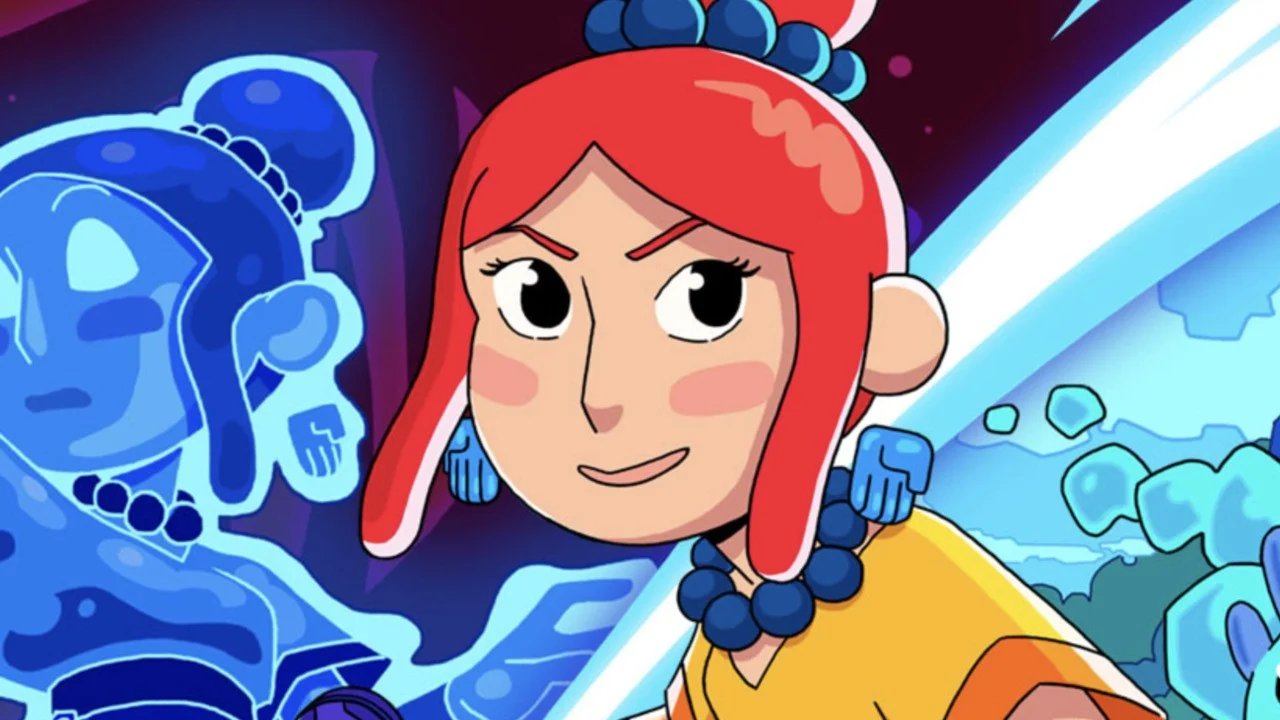
You play as Mae, a young girl from a village of shamans. Every year, a group from the village takes part in a ritual where they leave their physical bodies and take a “spirit flight” to the Fount of Souls. It’s a big moment in every shaman’s life, with everyone in Mae’s village talking about how it changed their lives.
Captured on Nintendo Switch (Handheld/Undocked)
Mae, however, is not like the other shamans. She’s tethered, meaning she can only leave her physical body for a short time and short distance. So, her journey looks a little different than the other girls in the village. Luckily, Mae’s the one starring in a precision platformer.
The tether is the crux of what makes the game so special. At first, I found myself wondering how the game could sustain itself on this single mechanic; I was so happy to be proven wrong. As you progress, you’ll find new types of tethers, each with their own properties. One gives you the ability to shoot an orb and later teleport to it. Another gives you a speed boost after you use it, à la Metroid’s Shinespark, allowing you to quickly run across hot magma without burning.
Each level contains the basic tether and the area’s newly introduced variant, letting you get the basics down while introducing new mechanics that interact with each one in unique ways. These different tethers make some areas feel like puzzles, forcing you to think about how to use them, what order to collect them in, and when to use your more basic platforming moveset like wall jumping to save your resources. There’s an ‘intended’ solution for each screen, sure. But it’s also a glorious feeling to get to the end of a screen with resources left over and feel like you pulled one over on the game.
Captured on Nintendo Switch (Handheld/Undocked)
Mae’s tether and the precision platformer genre are natural pairs, and the way that the game works pairs well with the game’s theme of disability. Mae’s journey is intentionally very different, and it is difficult. But respawns are instant. For every setback (I had 1,664 “setbacks,” to be exact), Mae always gets right back up, ready to try again.
Beyond getting to the end of each level, there’s more to find. Specifically, Atropa Blossoms. These collectibles can be hidden behind foliage or in secret rooms, or require you to pull off a challenging manoeuvre to collect them close to the main path. I was never bored trying to find them.
It’s easy, too, to hunt down those last collectibles for your checklist. Stages are split into different sections, and those sections have their own tracker for how many blossoms there are. It was handy to go back and try to hunt down stray blossoms, though I’m still far from 100%.
Captured on Nintendo Switch (Handheld/Undocked)
Between standard levels, you’ll also stop in various towns on your pilgrimage. These towns are well worth exploring, not just because they contain a few Atropa Blossoms, found by exploring or helping out citizens in town, but because the people in them are well worth meeting.
Take Monty in Shellwood, for instance. Every year in this town, there’s a ceremony where they burn a traditional worm effigy. Monty, the town crier, has always lit the effigy. But, in recent years, Monty has been losing his eyesight. This boiled over at the previous ceremony, where he burned a house down instead of lighting the effigy. One villager suggests the solution is to “sneak up behind him and conk him over the head.” Mae decides to go talk to him instead.
This interaction defines the writing in Tethergeist at its best. When Mae finally does have the conversation with Monty, she suggests that Monty transitions to be “torch bearer emeritus,” a way for him to be present, but pass the torch to someone else – literally and figuratively. It’s still an absurd situation, but there’s also an undeniable heart at its centre.
Captured on Nintendo Switch (Docked)
It’s unfortunate, then, that Tethergeist’s main narrative is its Achilles heel. It’s delivered well enough, mostly told through short dialogue exchanges you have with various characters during levels. But the problem is, as fun as Mae is, and as much as she helps other people, she goes through very little growth of her own, leaving her as more of a caricature than a character.
Presentation-wise, Tethergeist isn’t especially memorable, but it gets the job done. The pixel art looks great in action, and I really like the character portraits in main story dialogue exchanges. The music isn’t memorable, either, but the sound effects when using your abilities are quite satisfying. The stylish art looks great on handheld and in docked mode, and there are no performance issues to speak of.
One issue that came up was some visual bugs in the form of screen tearing, where the entire screen was taken over by lines of colours. It was easy enough to wait around and let it pass within a few seconds, but it was a bit distracting.
Captured on Nintendo Switch (Docked)
It’s obvious that developer O. and Co. was majorly influenced by Celeste, but in most ways, it rises to the occasion. Its gameplay has just as many varied mechanics, if not more. It’s built for speedrunners (there’s an optional in-game timer), and begging to be broken open. It lacks in some of those presentation areas Maddy Thorson’s classic thrived in — music and story in particular — but if you like Celeste for its gameplay, you’d be hard-pressed to find a better ‘successor’ this year.
Conclusion
Tethergeist is a great precision platformer. A flat narrative and some small visual bugs somewhat muddy the waters, but it’s filled with fresh ideas. The tether mechanic at its core tests your reflexes and brains in equal measure, and I found myself always on the hunt for the Atropa Blossoms. Between those levels, I found a lot of fun in interacting with villagers across the world.
Perfectly paced, no one mechanic overstays its welcome, and it felt like it ended at the perfect time, around 10 hours in length. I’m not a completionist, but I can definitely see myself picking away at some collectibles. And if they ever drop a challenge level pack, testing my knowledge of all the tethers? I’ll be there day one.
