


On the international biennial circuit, what are the definitive themes and styles of the last four years?
In a separate article, I laid out the artists who appeared in the greatest number of editions of the 130 biennials I analyzed. Those individuals—who appeared in nine or more shows—are as follows:
Ali Eyal
Apichatpong Weerasethakul
Basel Abbas & Ruanne Abou-Rahme
Carolina Caycedo
Christian Nyampeta
Joana Hadjithomas & Khalil Joreige
Jumana Manna
Kader Attia
Kapwani Kiwanga
Kiluanji Kia Henda
Lawrence Abu Hamdan
Monira Al Qadiri
Nolan Oswald Dennis
Raven Chacon
Saodat Ismailova
Sammy Baloji
Seba Calfuqueo
Sky Hopinka
Tabita Rezaire
Tarek Atoui
Torkwase Dyson
Tuan Andrew Nguyen
This cast of characters not only dominates the recent past, but the near future: No fewer than eight also feature in “In Minor Keys,” the show curated by the late South African curator Koyo Kouoh for the soon-to-open 61st Venice Biennale: Attia, Baloji, Caycedo, Dennis, Dyson, Hadjithomas and Joreige, Nguyen, and Rezaire.
Some thoughts on what the success of these figures suggests.
Post-Colonial Post-Conceptualism
The most-visible type is an artist who digs into the history of colonialism, surfaces some charged document or symbol, and highlights it by doing something poetic with it. The tone is more reflective than truly didactic. Often, the art is channeling the look of an exhibit in a science or history museum.
Kapwani Kiwanga’s Flowers for Africa: Rwanda (2019) at Art Basel Unlimited 2019. Courtesy the artist, Galerie Jérôme Poggi, Paris, Goodman Gallery, Johannesburg, and Tanja Wagner, Berlin.
An almost programmatic version of this style is Nolan Oswald Dennis‘s garden for fanon (2021), a display of globular glass containers full of earthworms, which are fed pages from the text of philosopher Frantz Fanon‘s The Wretched of the Earth (1961)—a staple of post-colonial studies—turning it into soil. Another is Kapwani Kiwanga‘s long-running Flowers for Africa (2013–ongoing), where the artist finds historic flower and plant arrangements from documentation of African liberation ceremonies, which she recreates and lets wilt.
Tuan Andrew Nguyen, Circle Burst (2024) in Lullaby of Cannons for the Night at James Cohan, NY. Courtesy of the artist.
Incorporating actual materials that are connected to historical violence is another mode. Tuan Andrew Nguyen has made sculptural mobiles from the leftover of bombs from the Vietnam War. Sammy Baloji has made planters out of shell casings.
Alternative histories and critical science fiction are major poles of attraction. In fact, two separate artists on my list have made works about the history of the space race, through the historical lens of Third World politics: Joana Hadjithomas and Khalil Joreige with The Lebanese Rocket Society (2012) and Kiluanji Kia Henda with Icarus 13: The First Journey to the Sun (2008).
Nolan Oswald Dennis, Isviviane (2023). The 12 Seoul Mediacity Biennale, Seoul Museum of Art, 2023. Photo: GLIMWORKERS.
Thematically, many of these artists make work about resource extraction, from Monira Al Qadiri‘s spacey sculptures that adopt the form of drill bits for oil rigs, presented like alien works of art, to Dennis’s isivivane (2023-ongoing), which involves 3-D printing rock samples extracted for Western geological museums as a gesture of symbolically reclaiming the land.
Families and Networks
Many of these artists have made works about their own parents and relatives, directly linking political and family histories. Aside from the legacy of colonialism, family history may be the single biggest theme here.
Sky Hopinka‘s film Kicking the Clouds (2021) deploys audio of his grandmother being taught the Pechanga language from her mother. Kader Attia‘s The Forgotten Suitcase (2024) involved him unpacking a suitcase that belonged to his mother. Basel Abbas and Ruanne Abou-Rahme incorporate drawings by Abou-Rahme’s father from 1970s Jerusalem into their current film installation at the Whitney Biennial.
Kader Attia, Installation view of La Valise oubliée (A mala esquecida) at 36th Bienal de São Paulo, 2025. © Natt Fejfar / Fundação Bienal de São Paulo.
In addition, many of these artists have a history of working collectively or collaboratively, creating research and advocacy organizations.
Dennis and Rezaire were co-founders of NTU (with Bogosi Sekhukhuni), a group that sought to raise “awareness of African sciences and technologies”; Ali Eyal was part of the art group Sada, which sought to aid Iraqi artists in the wake of the U.S. occupation; Ismailova founded Darva in 2021 to research Central Asian culture; Christian Nyampeta created the Boda Boda Lounge as a “trans-African film and video art festival.”
The biennial world is very networked, so it’s not a surprise that many of these artists are connectors.
Bio-Art, Soundscapes, and a Few Sculptures
Most of these artists create artworks that are project-based, not work-based. Artworks often take the form of open-ended investigations that permute and develop, site to site. Despite their general medium-unspecifity, a few materials, at least, recur.
Tabita Rezaire, Amakaba (2021). Courtesy of the artist.
Plants and gardens are truly everywhere (including in the very pitch for the upcoming Venice Biennale, which takes inspiration from the “creole garden”). Both Kawanga’s bouquets and Baloji’s terraria incorporate living plants, while the films of Abbas & Abou-Rahme and Jumana Manna both have touched on the politics of gathering plants.
There’s also a lot of work about the healing power of sacred plants, including Saodat Ismailova‘s investigations of “The Healing Forest” in Arslanbob and Rezaire’s recent pivot to running an ecological art center in French Guyana, AMAKABA, whose tagline is “a vision for collective healing.”
Tarek Atoui, installation view, Kunsthaus Bregenz, Austria (2024-2025). Courtesy of the artist and Galerie Chantal Crousel, Paris. Photo : Markus Tretter.
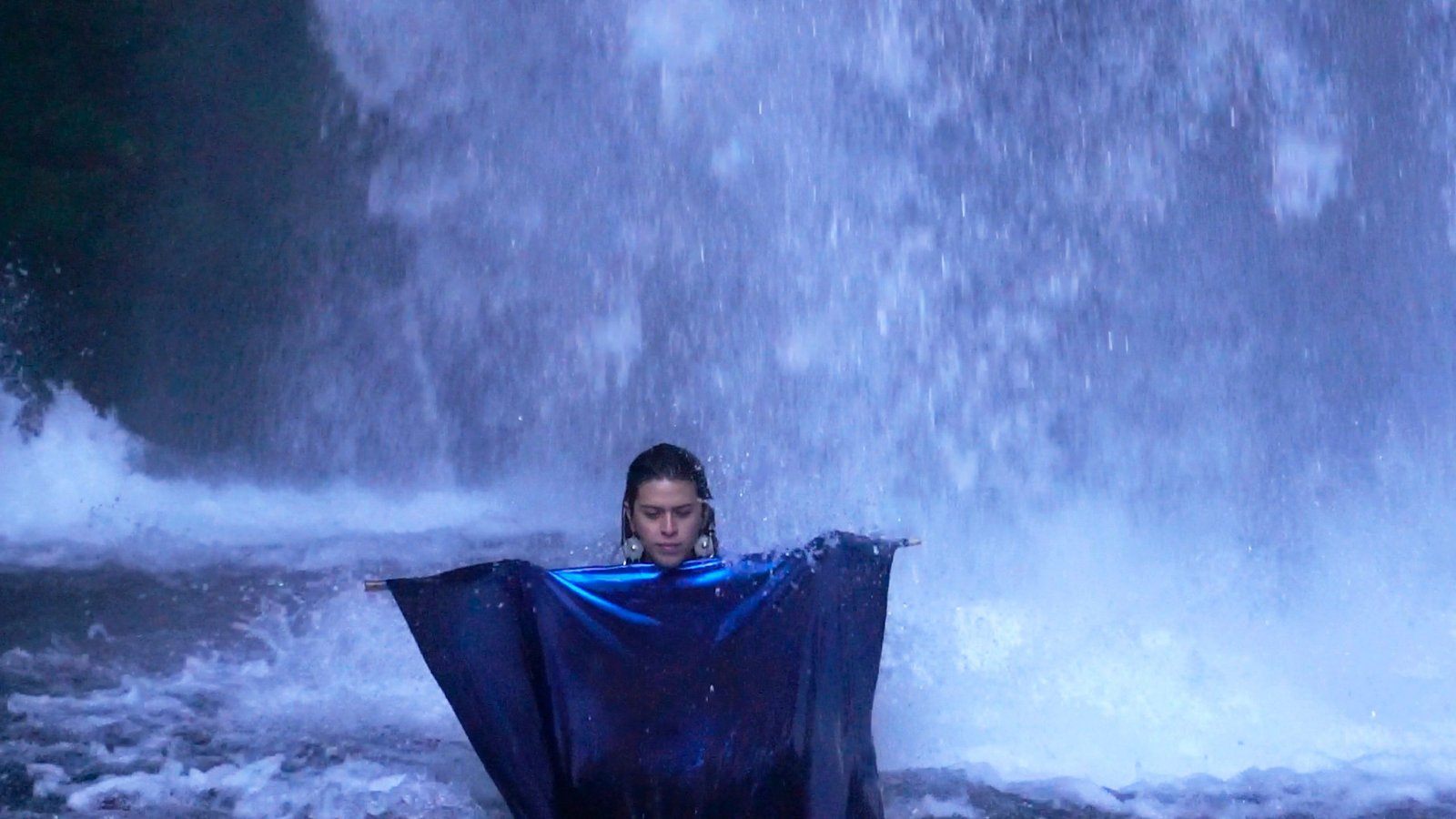
Water runs close behind plants as subject matter (and sometimes overlaps). Seba Calfuqueo’s work Tray Tray Ko (2022) is about the importance of waterfalls to the Mapuche cosmology. Tarek Atoui has made audio environments about the sound of global ports in Waters’ Witness. Carolina Caycedo’s entire roving research project, Be Dammed, is based around working with river communities on the politics of water.
Sound art is a major source of energy. Atoui, Raven Chacon, and Lawrence Abu Hamden all are experimental audio makers who move into installation and performance. (The Sonic Acts Biennale in Amsterdam appears as an interesting node for a lot of this work.)
Film installation remains the top biennale medium (second only to “evolving research-based exhibition project,” which may or may not be a “medium”).
Apichatpong Weerasethakul in collaboration with Rueangrith Suntisuk and Pornpan Arayaveerasid, A Conversation with the Sun (Afterimage): 2025, installation view, Museum of Contemporary Art Australia, Sydney, 2025, image courtesy and © Apichatpong Weerasethakul, Rueangrith Suntisuk and Pornpan Arayaveerasid. Photo: Zan Wimberley.
Apichatpong Weerasethakul, famed as a narrative filmmaker as well (albeit an arty one), is a trendsetter, with his atmospheric video pieces. Ismailova also began her career on the festival film circuit, before making video installations that dig into folklore and the political memory and landscape of Central Asia.
Torkwase Dyson stands out as relatively unique among all these artists in that she is known specifically for a visual signature and materially specific kind of art: large black abstract sculptures. The work owes its massive success, however, to how Dyson positions it as relating to her method of “Black Compositional Thought,” deriving form from ideas of how Black people have been confined or forced to navigate space. In this way her sculpture connects with the work of a polymathic artist like Dennis, who has the largest number of biennial appearances by my count, and speaks of making work guided by “Black consciousness of space.”
Political Geography
Artists from and making work about Africa and the Middle East have been far and away the most widely seen on the global biennial scene in recent years, even if many of these figures are based in the United States or Europe. Meanwhile, the most visible artists from the U.S. and Europe make work about the Black or Indigenous experience.
Ali Eyal, And Look Where I Went (2025). Courtesy of the artist and François Ghebaly, Los Angeles, New York.
You could overstate the case, but this constellation’s command of the most high-visibility and high-prestige global exhibitions tracks the loss of moral credibility and cultural hegemony for the “developed” world writ large, even as its political and military hegemony remains firm. The result is a general style of reflective and retrospective aesthetic Third Worldism.
Few issues have cratered Western credibility in recent years as much as the failure to stop Israel’s war in Gaza after October 7. A striking number of the top artists are Palestinian or Lebanese and known for work directly critical of Israel. I don’t think it’s off base to say that their presence at the top of the exhibition circuit is a measure of how sharply world cultural opinion has turned on Israel, even before the joint U.S.-Israel war on Iran (even Israel’s own research, evidently, admits that much of the world now views it as a “genocidal, apartheid state”).
Lawrence Abu Hamdan, Air Conditioning (2022). Photo by Ben Davis.
Still, while horrifying news images may be the immediate backdrop, it’s worth saying that Abbas & Abou-Rahme (in Until We Became Fire and Fire Us) and Manna (in Foragers) have made art about the longer historical arc and less spectacular aspects of Palestinian dispossession, as have Abu Hamdan (in Air Conditioning) and Hadjithomas & Joreige (in Khiam) for Lebanon.
What’s Changed?
Looking at these artists together as reflective of a moment, how new is what they represent?
Most of the themes I teased out—the dominance of research-based practice, the concern with colonial memory, the “politics of plants”—have preoccupied curators for a decade or more. Four years ago, when I did a similar tally looking back at the most-shown biennial artists, many of the same themes dominated, as well as several of the same names, some of whom also appear in the upcoming Venice Biennale, such as Attia, Nguyen, and Rezaire.
What may be characteristic of the period is less a big change from the past, and more that the theme of post-colonial historical reckoning has dominated the art biennial imagination to such an extent. Before, there were other, minor thematic currents you could see in the mix, particularly the “speculative science” and “critical tech” paths, in works by the likes of James Bridle, Alicja Kwade, Marguerite Humeau, and Ian Cheng.
Interestingly, the artist who most carries on this thread in the list above also happens to be the most-shown one in recent times: Nolan Oswald Dennis. The South African artist explores African cosmologies but also collaborates with scientists, and has done a project, for instance, that makes hacked A.I.-enabled printers unspool a made-up conversation between historical Black liberation thinkers. Maybe this style is a reflex of the near past, since the political impulse that runs through the art circuit today seems more likely to turn on tech as a symbol of alienation. Or maybe it’s a preview of a synthesis we’ll see more of in the near future. That’s something to keep tracking.
