


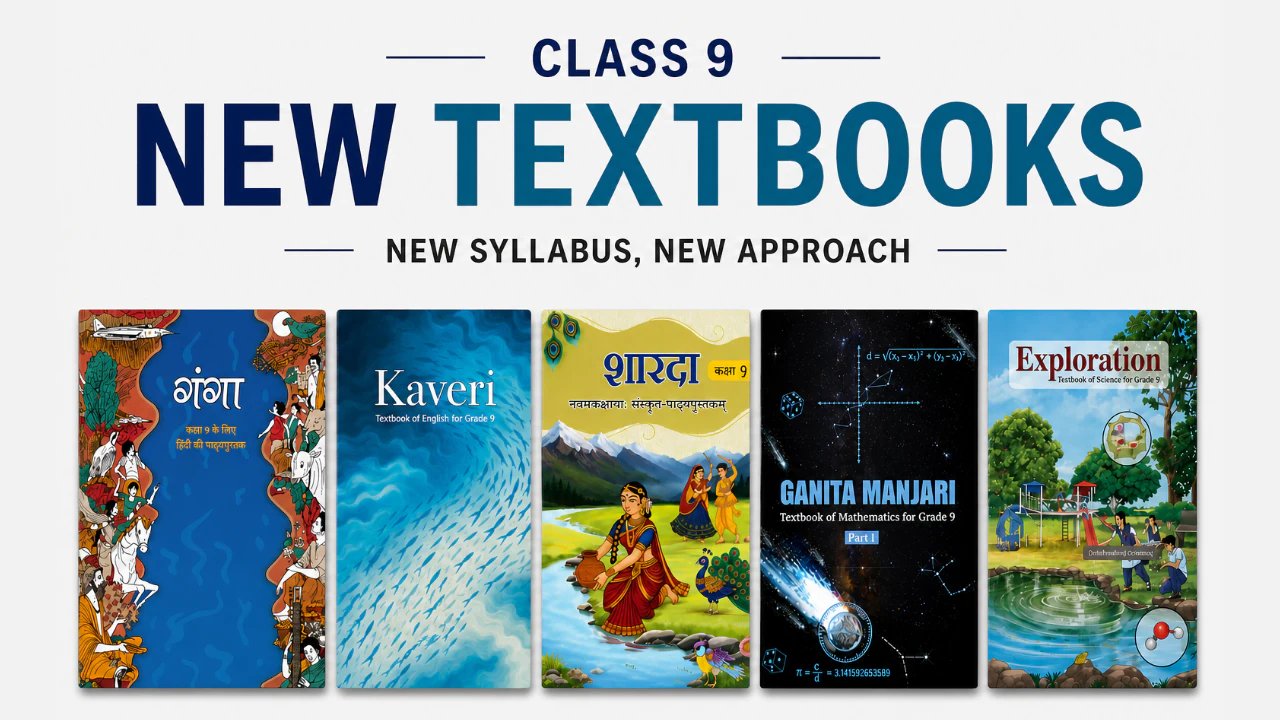
The NCERT has officially released the NCERT Class 9 new books for the academic session 2026-27. The updated textbooks are as per the latest CBSE syllabus and follow the framework of NEP 2020 and NCF 2023.
CBSE has directed all affiliated schools to adopt the revised textbooks from the current session itself, signalling a decisive shift in how secondary-level subjects will be taught and assessed across the country.
What’s New in NCERT Class 9 Books 2026-27
The NCERT Class 9 new textbook for 2026-27 comes with subtle yet important improvements designed to enhance learning outcomes.
- Content aligned with competency-based education
- Improved illustrations and real-life examples
- More practice questions and in-text activities
- Better language clarity for easier understanding
- Stronger alignment with NEP 2020 learning goals
These updates ensure that students focus more on understanding concepts rather than rote learning.
NCERT Class 9 Books Subject-wise List: 2026-27
NCERT has released the Class 9 books for the 2026-27 session covering all core subjects. The subject-wise details below give a clear overview of the topics and concepts included in each book as per the latest CBSE and NEP 2020 framework.
English – Kaveri
The new English textbook, named Kaveri after one of India’s sacred rivers, replaces the long-running two-book combination of Beehive and Moments with a single integrated reader. The selection draws from Padma Shri and Sahitya Akademi awardees alongside international writers, weaving prose and poetry around shared themes.
Key features of the book:
- Thematic units that bring prose and poetry together around common ideas
- Dedicated focus on vocabulary in context, speaking and listening, and writing tasks
- A sharper emphasis on literary devices, persuasive writing, and creative expression
For a closer look at the new English curriculum, head to the Class 9 English NCERT Textbook page.
Hindi – Ganga
The Hindi textbook Ganga (गंगा) replaces the earlier four-book arrangement of Kshitij, Kritika, Sparsh, and Sanchayan, consolidating the curriculum into a single volume. The new book leans towards activity-driven, discussion-based learning over memorisation, and is paired with a simplified syllabus and a broader approach to assessment.
What stands out:
- A balanced mix of classic and contemporary voices in Hindi literature
- A new Bhasha Sangam section encouraging connections with other Indian languages
- Greater emphasis on communication, critical thinking, and creative expression
- A 360-degree assessment system covering formative, self, and peer evaluation
To explore the full structure of the revamped Hindi syllabus, visit the Class 9 Hindi NCERT Textbook page.
Sanskrit – Sharda
The Sanskrit textbook has been renamed Sharda (शारदा), replacing Shemushi. The new book attempts to bridge classical learning with contemporary themes such as artificial intelligence and financial literacy – reflecting a view that Sanskrit’s grammatical structure offers a logical foundation for computational thinking.
Key updates in the syllabus:
- Translation has been dropped from the writing section and replaced with dialogue and story completion exercises
- Refinements introduced in grammar, including more clearly defined verb and indeclinable categories
- Grammar and literature together continue to carry the bulk of the theory paper’s weightage
A detailed breakdown of the revised Sanskrit course can be found on the Class 9 Sanskrit NCERT Textbook page.
Mathematics – Ganita Manjari Part 1
The Mathematics textbook has been thoroughly redesigned and renamed Ganita Manjari Part 1. Several topics traditionally taught in higher classes have now been moved down to the Class 9 level, broadening the scope of what students engage with at this stage.
Highlights of the new approach:
- A conceptual, activity-based method that asks students to reason and explain rather than simply compute
- A two-tier assessment system – a mandatory Proficiency Level and an optional Advanced Level for students pursuing higher mathematics
- Chapter titles framed as questions rather than topic labels, encouraging inquiry
- Stronger focus on computational thinking, visualisation, and mathematical proofs
Students looking to dive deeper can refer to the Class 9 Maths NCERT Textbook page.
Science – Exploration
The Class 9 Science textbook, titled Exploration: Textbook of Science for Grade 9, is an entirely new volume that brings together Physics, Chemistry, and Biology – and, for the first time at this level, Earth Science. The book steps away from discipline-wise organisation in favour of interdisciplinary, competency-based themes.
Key shifts in the new edition:
- A fresh focus on how science actually works – covering models, predictions, scientific reasoning, and the link between science, mathematics, and society
- Reorganisation and renaming of certain topics to better reflect real-world application
- Greater weight given to experiments, observation, and inquiry-based learning
The complete subject-wise overview is available on the Class 9 Science NCERT Textbook page.
Social Science
The new NCERT Class 9 Social Science textbook has not been released yet and is expected to be made available soon. Like the other revised books, it will be aligned with NEP 2020 and NCF-SE 2023, with a stronger focus on inquiry, real-world context, and competency-based learning.
This section will be updated as soon as the new Social Science textbook is released. For the latest information, keep an eye on the Class 9 Social Science NCERT Textbook page.
Why Are These NCERT Books Important for Students?
NCERT books remain the most important study resource for Class 9 students, especially those studying under the Central Board of Secondary Education curriculum. They are designed to build strong conceptual foundations and ensure clarity in every subject, making them essential for academic success.
Most examination questions are directly or indirectly based on NCERT content, which makes these books highly reliable for preparation. In addition, they help students prepare for higher classes and competitive exams while staying aligned with the latest CBSE exam patterns and guidelines.
Conclusion
The release of Kaveri, Ganga, Sharda, Ganita Manjari Part 1, and Exploration signals a clear intent: less memorisation, more understanding; fewer rehearsed answers, more reasoning.
For parents, teachers, and students, the 2026-27 session is less a routine academic year and more the beginning of a different way of learning.
