


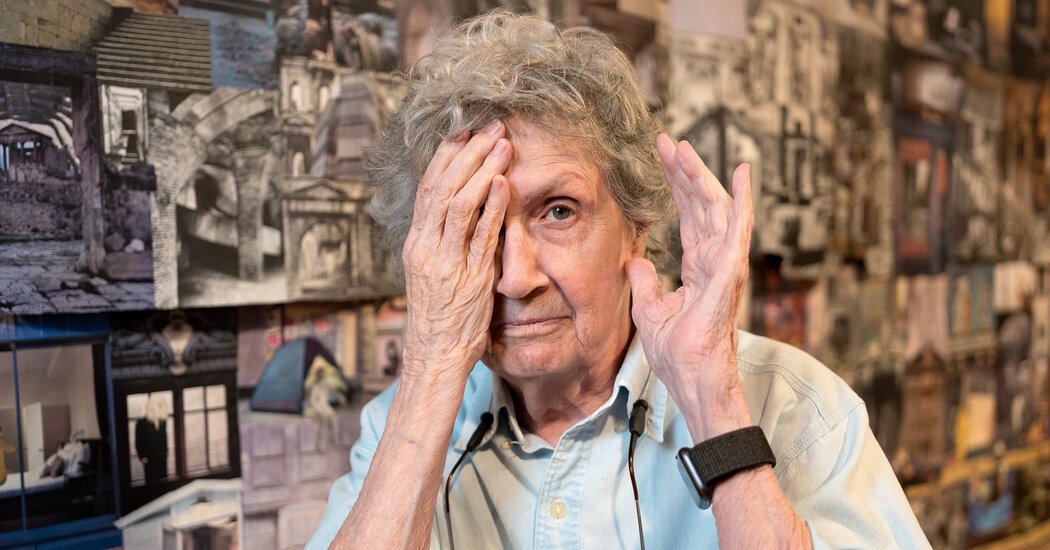
Aldwyth, an iconoclastic and reclusive South Carolina artist who made intricate, witty and startlingly lovely collages and assemblages from found objects and printed material, challenging and reimagining history — art history, in particular — and her own place in it, died on April 10 near Hilton Head Island. She was 90.
Her death, at a hospice facility, was announced by her son, Calhoun Thomas III.
Since 1980, Aldwyth had lived in a sort of treehouse — an 800-square-foot octagonal home with one room, set on stilts and tucked into the marshy pine forest of Deer Island, a secluded enclave of Hilton Head with dozens of such dwellings. There, she made her obsessive, expansive and idiosyncratic artwork.
Her Joseph Cornell-like containers and contraptions were crafted from cigar boxes or found materials, like the debris she picked up in Charleston after Hurricane Hugo devastated the city in 1989.
They were kitted out with handles, straps, wheels and drawers into which she tucked various objects, pictures and words typed on strips of paper or cut out of printed material. Unlike Cornell’s boxes, however, hers were meant to be picked up and hauled around, their contents plucked out and pored over. They looked battered and lived-in.
Her collages were epic in scale, some as large as seven feet square, composed of thousands of images sliced from books, exhibition catalogs and magazines, and glued to Okawara paper, a hardy, fibrous Japanese material that Mark Sloan, a curator and champion of her work, likened to an animal hide.
Mr. Sloan met Aldwyth in 1999, when he was the director of the Halsey Institute of Contemporary Art in Charleston. A colleague at the South Carolina Arts Commission called to tell him that someone had submitted an application for the commission’s coveted fellowship that, while “improper,” might be of interest.
Instead of providing a printed résumé and photos of artworks, the applicant — who had the curious name Aldwyth — had sent a small box on casters. It opened to reveal what looked like specimen trays covered in glass, each one containing a scrap of paper inscribed with a phrase like “NEA grant,” “Manhattan dealer” or “Art in America review.”
A fat “X” was inked on the glass over each compartment except for one, which was marked with a check and contained the word “work.”
The piece, titled “re-su-mé/re-sume,” represented Aldwyth’s résumé as she saw it, noting the accolades, awards and exhibitions that she had not received. The single word “work” — as both a noun and a verb — described how she viewed her biography and accomplishments.
This beguiling piece disqualified Aldwyth for the fellowship, but it intrigued Mr. Sloan, who asked to meet the artist for a studio visit.
When he walked into her home, which resembled some combination of a cabinet of curiosities, an antiquarian bookshop and a museum archive, he recalled being bowled over. It was densely layered, or “encrusted,” in Mr. Sloan’s words, with the materials for Aldwyth’s work and with her works in progress — collages, mostly, which covered the floor.
Everywhere he looked there were shelves filled with art catalogs, textbooks, artists’ monographs and art magazines, as well as postcards and photographs of work and individuals that Aldwyth found inspiring.
Her practice involved painstakingly slicing up this material and filing the cutouts by theme — animals, people, landscapes — in hundreds of zip-lock bags and flat file drawers.
She had a thing about eyeballs and filled Tupperware containers with images of them. She had multiples of textbooks, including at least 10 copies of H.W. Janson’s “History of Art,” the enduring encyclopedia, every one of which was so thoroughly sliced up that the pages resembled redacted F.B.I. files.
Janson was a rich mine for her. She used it for a piece she called “Document,” in which she reordered the book’s index, glued the entries on a vast sheet of paper and augmented them with the handwritten names of those she felt had been left out — mostly women and people of color. (The piece had a pencil attached to it, so viewers could add their own entries.)
A monumental collage she called “Casablanca” was another form of art history: the world according to Aldwyth. It was composed of a mosaic of images of artists’ eyeballs, hundreds of them, spanning centuries — from Vermeer to Vuillard, Louise Bourgeois, Jean-Michel Basquiat and Lynda Benglis — that she arranged in a circle along with tiny cutouts of their work. Even Henry Darger, the mystical outsider artist, was represented.
It was a piece that stared you down, eyeball to eyeball. Hence the title, which referred to the movie of the same name and its oft-quoted line, “Here’s looking at you, kid.”
Aldwyth was outside the art world, but she was not an outsider artist, a term that describes those who are self-taught. She had studied at a few institutions, including the University of South Carolina, where she earned a Bachelor of Fine Arts degree, and she had been working doggedly since the 1970s, when she left an unhappy marriage to a domineering husband who had forbidden her to make art while she raised their three sons.
She lived and worked with strict economies, starting with her name. After her divorce, she dropped her husband’s surname, Thomas, and went by Mary Aldwyth, her first and middle names. In 1989, she dropped Mary, after a male critic described an assemblage she had made — a mirrored box that contained a bottle of cadmium red paint — as being a commentary on menstrual blood.
It was not — the piece was an elegy to Aldwyth’s favorite color — and the gendered assumption annoyed her.
Money was tight, and while her sons were still living at home she worked as, among other things, an electric meter reader, a house-cleaner and organizer, operations manager for a local magazine, a bookkeeper and a legal secretary. When her sons left for college and she moved into her treehouse, she found more efficient ways to earn money, by working in the middle of the night. She would hang art for Louanne LaRoche, who owned the Red Piano Art Gallery in Hilton Head, where Aldwyth showed her work; she also photographed and inventoried the collections there.
Aldwyth was not misanthropic, exactly, but she was happier working alone, and she developed a strict routine that allowed her to do so. She went to bed at sunset, rose at 2 a.m., worked for Ms. LaRoche until sunrise and then headed home to make her art.
“She did what she needed to do to take care of herself,” Ms. LaRoche said in an interview. “And she wasn’t going to be accountable to anybody but herself.”
She was indifferent to meals, which not only cost money but took time away from art making. She didn’t have a kitchen — just a microwave, a refrigerator and a coffee pot. Nor did she have a bed. She slept on a thin foam mattress that she laid on a table each evening and rolled up during the day. Hers was a life pared down to the bare essentials.
In 2009, when Aldwyth was 73, Mr. Sloan organized a solo show for her at the Halsey Institute, the museum of the College of Charleston. It included a grant for Aldwyth to be an artist-in-residence there for a week. She was offered the use of the college president’s house, a grand historic property, and a room with a four-poster bed.
She declined. She preferred to sleep in the gallery. She had brought her bedroll and supplies, having measured out enough wine, coffee and crackers to see her through the days. Mr. Sloan’s colleagues called her “the art monk.”
At the show’s opening, Aldwyth talked a bit about her work. Then an audience member asked, “What was the biggest obstacle you faced as an artist?”
“Oh, honey,” Aldwyth replied. “I divorced him in the ’70s.”
Mary Aldwyth Dickman was born on Nov. 21, 1935, in Pomona, Calif., the youngest of two daughters of Paul Dickman, a Navy chaplain, and Muriel (Jones) Dickman, a schoolteacher.
The family moved often for Captain Dickman’s work. Aldwyth grew up in various places, including San Diego; Nyack, N.Y.; Beaufort, S.C.; and Arlington, Va., where she finished high school.
When she was 18, she secretly married Calhoun Thomas Jr., whom she had met in Beaufort; she thought she was pregnant, but it was a false alarm.
The couple moved around a bit, too; Mr. Thomas joined the Marines before entering law school. They eventually settled in Hilton Head. Aldwyth dipped in and out of college before her children were born, finally earning her B.F.A. in 1966.
In addition to her son, who goes by Reb, Aldwyth is survived by two granddaughters and three great-grandchildren. Two other sons, William and Joseph, predeceased her.
In 2023, when she was 88, Mr. Sloan organized a retrospective of her work at the Gregg Museum of Art & Design at North Carolina State University in Raleigh. There, a student reporter asked her what she hoped people would take away from the show.
“I hope they don’t take anything away,” she said. “I worked very hard to put it together.”
