


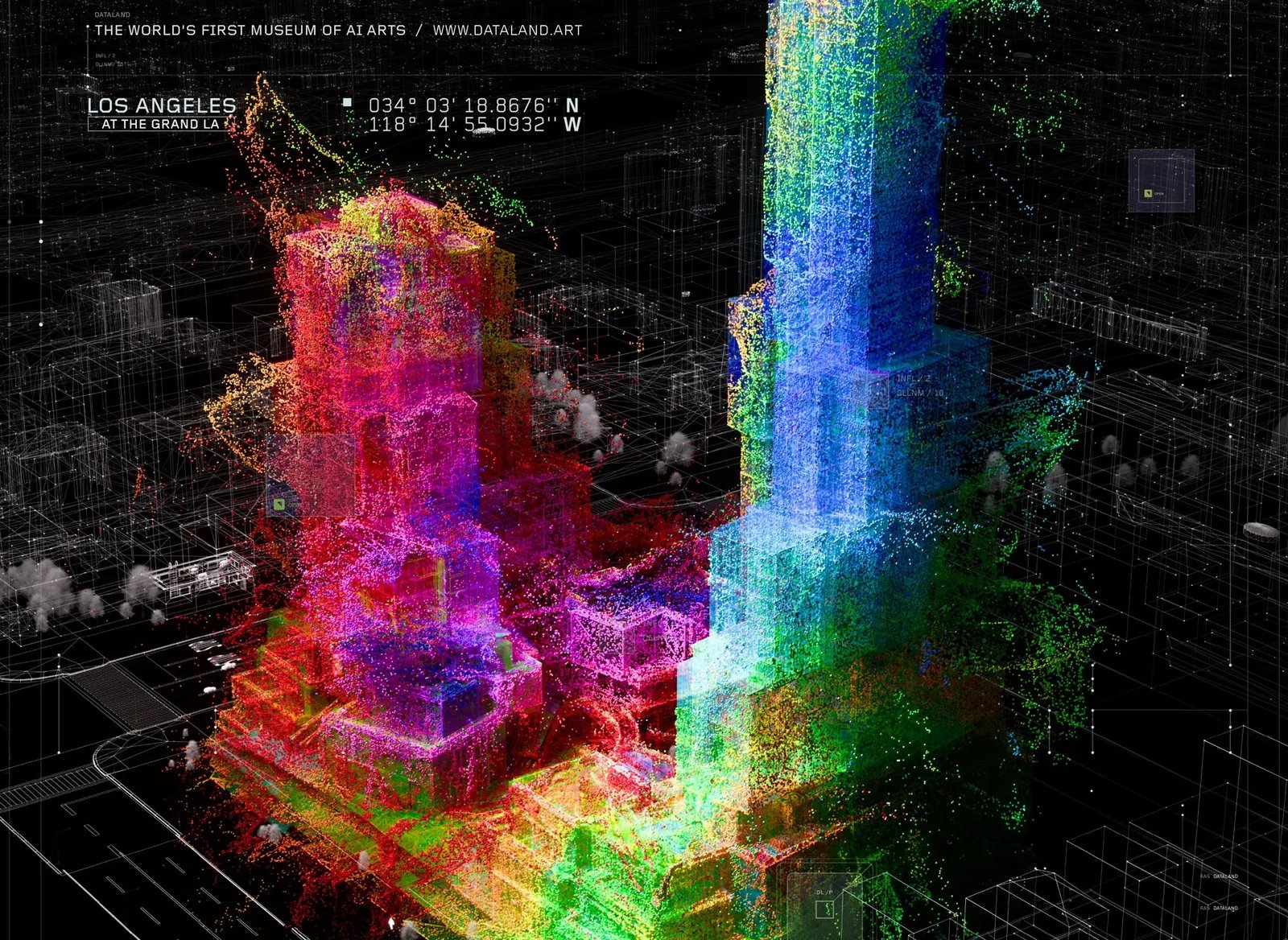
Dataland’s immersive exhibitions, generated with artificial intelligence, will debut to the public on June 20, with an inaugural show about rainforests trained on millions of images of nature
Michele Debczak
|
April 24, 2026 4:28 p.m.
A digital rendering of new museum Dataland
Dataland
The four-block strip that houses such Los Angeles institutions as the Walt Disney Concert Hall, the Broad and the Museum of Contemporary Art will get a different type of cultural attraction this summer. Dataland, billed as the world’s first museum dedicated to A.I.-generated art, is set to open on June 20.
The brainchild of digital artists Refik Anadol and Efsun Erkiliç, Dataland will anchor the Grand LA complex, designed by architect Frank Gehry, in downtown Los Angeles. The privately funded museum covers 35,000 square feet, 10,000 of which are reserved for the technology required to support the exhibitions. Rather than traditional halls displaying individual artworks, Dataland’s five galleries and 30-foot ceiling are designed for total immersion.
“It’s very exciting to say that A.I. art is not image only,” Anadol tells Jessica Gelt for the Los Angeles Times. “It’s a very multisensory, multimedium experience—meaning sound, image, video, text, smell, taste and touch. They are all together in conversation.”
The museum’s inaugural exhibition, called “Machine Dreams: Rainforest,” was inspired by a trip to the Amazon. Anadol’s studio created an open-access A.I. model called the Large Nature Model, fed it millions of images of nature, and then prompted the machine to “learn and play with the intelligent behaviors of the natural world,” Richard Whiddington writes for Artnet. The result, as Anadol puts it per the Times, is a “a living museum” where visitors can walk among “digital sculptures.” In addition to a kaleidoscope of imagery, museum guests will be immersed in soundscapes, woven from audio that includes oral histories of the Yawanawá people of Brazil and the last recorded call of the extinct Kaua‘i ‘ō‘ō bird of Hawaii, Léa Zeitoun reports for Designboom.
Dataland / Launch Teaser / June 20
The use of A.I. in creative fields has been a lightning rod for controversy in recent years. Because generative models like Midjourney and DALL-E rely on massive datasets of pre-existing images—many sourced without human artists’ permission—the legal ownership of any art they produce is a source of debate. Earlier this year, the U.S. Supreme Court turned away a case on whether A.I.-generated art can be copyrighted under the law. Artists using artificial intelligence tools have taken advantage of the legal gray area in the meantime, selling their work in competition with art made in more traditional ways.
The humans behind Dataland are well aware of concerns about potential copyright violations, and they’ve taken steps to get ahead of it. Anadol tells Sharyn Alfonsi and Michael Baltierra of CBS News the images he uses are sourced “ethically,” from institutions including the Smithsonian, London’s Natural History Museum and the Cornell Lab of Ornithology.
Did you know? The costs of A.I.
Generating one image with A.I. consumes up to 1,000 times more energy than performing a simple web search, MIT researcher Noman Bashir explained to Alyssa Andrews of CBS News.
A.I.’s environmental sustainability problem is another hot-button issue that Anadol and Erkiliç say they consider, in part by hosting the Large Nature Model on cloud servers in Oregon that run on 87 percent carbon-free, renewable energy.
“This is such an important technology, and represents such an important transformation of humanity,” Anadol tells the Times. “And we found it so meaningful and purposeful to be sure that there is a place to talk about it, to create with it.”
Even with the museum’s efforts to consider ethics, Dataland still faces an uphill battle with certain art connoisseurs. Some critics have a philosophical opposition to A.I.-generated art. “Whether you are creating a novel or a painting or a film, you are engaged in an act of communication between you and your audience,” author Ted Chiang wrote for the New Yorker. “That is something that an auto-complete algorithm can never do.”
Recent data, however, shows that the general public may be more receptive to the shift. According to a Stanford University Graduate School of Business working paper from 2025, the consumers of one online art marketplace showed a preference for A.I.-generated images when they were shown alongside human-made art.
Time will tell how museumgoers feel about Dataland when it debuts.
