


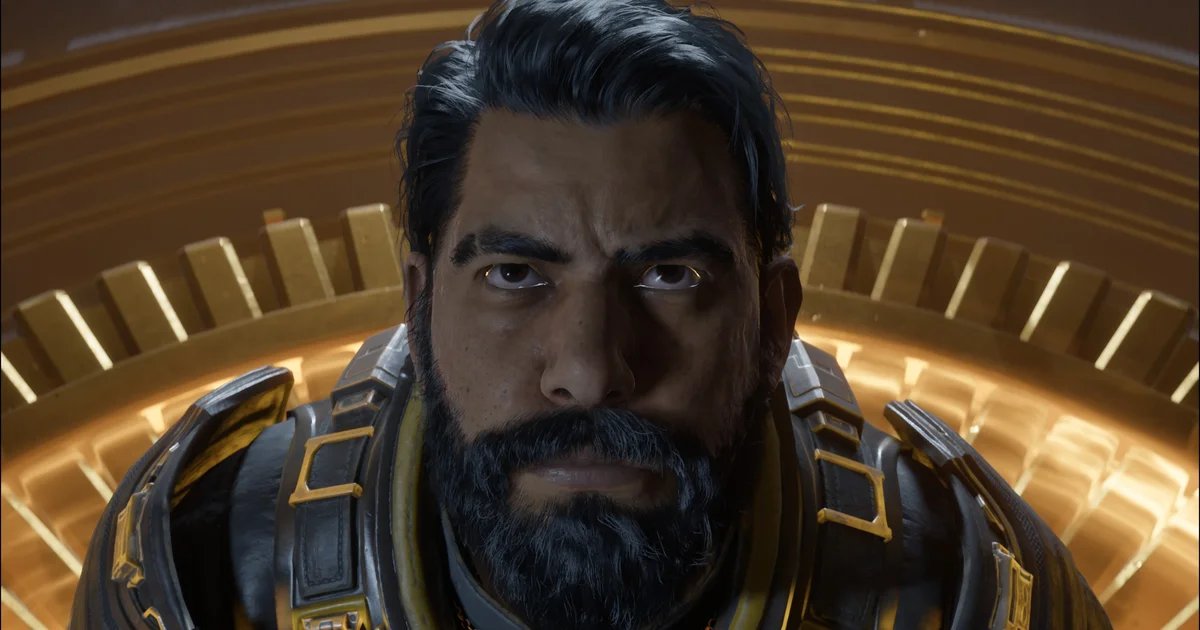
Saros’ narrative often feels at odds with the kind of experience it wants to be, but there’s no denying this is another top-tier action game from Housemarque.
You know an action game has the magic when you come out of a sequence thinking “How the hell did I survive that?” Your hands shaking with adrenaline, the controller slick with sweat. Sekiro had it. Doom Eternal had it, and Returnal had it too, with Housemarque’s timeloop sci-fi thriller offering some of the most thrilling action of this generation.
Saros review
- Developer: Housemarque
- Publisher: Sony Interactive Entertainment
- Platform: Played on PS5
- Availability: Out 30th April on PS5
Saros is no different. Moment-to-moment, Housemarque’s latest represents a clear step forward over Returnal. Numerous mechanical twists, combined with some truly ferocious enemy designs, produces a game of awe-inspiring spectacle and electrifying combat.
But there is a downside. Saros’ action moves so fast that the rest of the game struggles to keep up at times. Not only is its story left choking in the dust kicked up by its freight train of a protagonist, but there are also moments when its overarching structure buckles under the sheer weight of its momentum.
If you mainly care about dodging ridiculous numbers of projectiles at equally ridiculous speeds, Saros is one of the best to ever do it. At its core, Saros is a procedurally generated arena shooter where you battle clusters of enemies who seemingly subsist on a diet of lethally toxic bubble-bath. Most attack by firing, conjuring, or literally vomiting formations of spheres into the air which you must dodge, block, and occasionally parry your way through to survive.
Manage cookie settings
Here’s a Saros launch trailer to show it in action.Watch on YouTube
Saros layers a couple of extra systems onto the template laid down by Returnal. The first is a bubble shield that protects main character Arjun Devraj from most attacks. Initially this seems like an odd addition to such a lithe, acrobatic shooter. But its true function isn’t really defensive. By absorbing the energy of certain projectiles, the shield charges your special abilities. This essentially lets you throw attacks back at enemies – always the most satisfying way to eliminate your foes.
The other crucial mechanic is Eclipses. As you progress through a biome, whether it’s a blood-red marshland or a sprawling subterranean facility, you’ll eventually come across a strange, plant-like structure of grasping hands. Interacting with this transforms the region into a more dangerous form. Blood red swamps become searing acid pools. Ancient alien machinery springs to infernal life. Enemies become more hostile too, their regular blue attacks replaced by yellow orbs that douse you in Corruption. This reduces your max health, and can only be cleared by firing your special attack.
You should definitely be afraid. | Image credit: Sony Interactive Entertainment / Eurogamer
Both additions work well. The shield enables you to be more aggressive in combat, transforming enemy attacks from something to be feared into something to be relished. Judicious use of the shield lets you clear an arena with astonishing speed, blowing away groups of enemies with a powerful rocket or a PS5-as-heck swarm of charged particles.
Eclipses, meanwhile, elevate this push-and-pull combat into a highwire act, as trying to fill your special attack becomes a much riskier manoeuvre. You’re always required to enter Eclipse mode at some point during a run, but you can often choose to do entire runs beneath Saros’ eerily obscured sun. And arguably the best trick Saros pulls is how it makes you want to pursue the harder path, for reasons that I’ll explain in due course.
Each biome you rattle through culminates in a boss fight, which like FromSoft has become something of a signature for Housemarque. Saros ups the ante both in number and in spectacle, though it does take until the halfway mark for the fireworks to truly begin. The first couple of bosses are visually impressive but also quite static, and they’re followed by a couple of souped-up versions of enemies you encounter in regular combat. These are fun enough to fight, but they nonetheless represent Saros at its lowest ebb.
The reason for this becomes clear enough, though, because the boss fights in Saros’ second half are absolutely off the chain. Each could easily serve as the game’s final boss, and indeed, I thought I’d completed the game about three times before I actually saw the credits, such is the scale and spectacle of these titanic showdowns.
Image 1: Saros dot jpeg. Image 2: It’s not just orbs you’ll need to dodge. There are also blobs, arrows, shockwaves and *hackspit* lasers. Image 3: Blue orbs can be absorbed, yellow orbs cause corruption, and red orbs must be avoided or parried.
But it’s the improvements to regular combat that are arguably more significant here. Saros is reasonably intense from early on, but the way it mixes and matches and elaborates on enemy types is hugely impressive. There’s one particular enemy called the Devastator, basically an evil satellite that fires massive sheets of orbs at you from above. Your first encounter with it is memorable enough, as the entire screen suddenly fills with blue projectiles. But there’s another, enhanced version of it that crops up later in the game. When that bastard turns up, it feels like the apocalypse is happening, and it isn’t the only late game foe that brings the endtimes to the party.
Not everything about Saros’ combat is perfect. While I mostly like Saros’ arsenal, there are a couple of weapons, particularly shotguns and weapon variants without autohit, that just feel like a waste of time. There’s also one enemy – the laser turret – that I absolutely despise. Laser attacks hit you instantly, and it’s easy to miss the turret’s warmup in the chaos of a fight. Finally, while Saros is generally very good at riding that line between challenging and entertaining, it does occasionally throw a scenario at you that ganks you outright, which can be frustrating.
Nonetheless, if everything else about Saros was on a par with its action, it would be a stone cold five-star game. Sadly, that isn’t quite the case. Where Saros makes clear advancements over Returnal in its combat, the storytelling represents something of a retreat.
To be clear, I don’t think Saros has a bad story, so much as the wrong story for the kind of game it is. Returnal did an excellent job of building a compelling tale around the limitations imposed upon it by its structure and mechanics. It understood the player’s attention was mostly going to be on dodging stupid amounts of ordnance, so it centred its story almost entirely around a single character – your protagonist Selene – while seeding the narrative with clear, instantly gripping mysteries. Why is this planet littered with the protagonist’s own corpses? Who is this astronaut guy? Why is my house here? Why do I keep coming back?
Saros starts off as a much more traditional sci-fi affair, a tale of colonial ambitions, hypercapitalist corporations, and dickhead AIs. There are multiple characters alongside Arjun, and as the story progresses, more and more names are added to the script. Some are encountered in person, while others appear through the game’s many audio logs.
Rahul Kohli’s a fun choice for Arjun, but he feels a little wasted in the role. As a character, Arjun is mostly kept at arm’s length, making him a less compelling protagonist than Returnal’s Selene. | Image credit: Sony Interactive Entertainment / Eurogamer
It’s the kind of story that would work great in a game like System Shock, skulking around the corridors of some space-station listening to the fate of its crew. Here, however, there’s so much else going on at any one time that it’s just impossible to keep up with all the different plot threads and timelines of events. It doesn’t help that the various personalities are not especially distinctive or interesting, but even if they were, it would be hard to keep up. I was constantly wondering “Who is this guy?” before getting instantly distracted by another 10,000 glowing balls headed in my direction.
Meanwhile, the character you spend the most time with – Arjun – has the least presence in the narrative for large chunks of it. There are story reasons for this, but the effect is that you never get to properly know him in the way you do Returnal’s Selene. As such, the game’s central mystery, which delves into Arjun’s past relationships, doesn’t have the stakes that it should.
It’s a shame because there is interesting stuff happening here, from temporal shenanigans to the exploration of some weighty themes you don’t see often in games like this. It also successfully constructs an atmosphere of cosmic dread without resorting to cheap scares or grisly body horror, which is worthy of commendation. I’m not convinced by its obsessive referencing of The King in Yellow, though, as it tends to overwhelm some of Saros’ more original story beats. Did you know that Saros is inspired by The King in Yellow? Believe me, you will by the time you’ve finished it. Every other audio log is someone going “Wrharalargh! I’m going insane because of The King in Yellow! Aroooooooooo!”
Narrative is where Saros exhibits its biggest flaws, but it isn’t the only area that has issues. Saros adapts a more modern roguelite structure than Returnal. You don’t start from scratch every time in Saros (you can, but that isn’t how Housmarque intends you to play) instead teleporting to the beginning of each zone. On top of this, you can spend currency earned in each run to upgrade Arjun’s stats.
Brown shooters are back, baby! | Image credit: Sony Interactive Entertainment / Eurogamer
All of this works well enough, although you shouldn’t come to Saros expecting much in the way of buildcrafting. The skill tree is more of a skill trunk, and your progress through it is gated by those keystone boss fights. Where Saros is more interesting, and also more problematic, is in the upgrades you acquire during each run.
As you progress through an area, you’ll pick up various items to help you in your run. More powerful weapons, resources required to upgrade your skills, temporary stat improvements. The most significant of these, though, are artifacts, items that simultaneously boost your base stats while also giving you a passive ability, such as health regeneration on kills, or a power bar refill when you use a melee attack.
Artifacts become particularly interesting in Eclipse mode, where they grow more powerful, but also come with a negative modifier such as enabling fall damage, increasing the recoil of your weapon, or for the real masochists out there, increasing your dash cooldown so you have to wait longer between dodges.
This is how you end up drawn into doing full Eclipse runs even though they’re more dangerous, as they give you a better chance of hitting the boss with an absolutely monstrous build. It’s also one area where the systems and the story elegantly mesh together: “How could anyone be so stupid as to lose their mind to The King in Yellow?” I say as I deliberately blot out the sun on my seventeenth power trip of the evening.
Eclipses up the ante across the board, from the challenge of enemies you fight, to the rewards you claim during a run. | Image credit: Sony Interactive Entertainment / Eurogamer
As I delved further into the game, however, the number of artifacts I’d pick up in a run slowed from a torrent to a trickle. At the outset, I’d be picking up so many I couldn’t fit them into the available slots. But for most of its middle section, in some runs I’d be lucky to pick up even a couple, despite the fact that I had unlocked more slots for artifacts than I had when I started.
Saros accessibility options
No dedicated accessibility options, but the following options are available within other submenus: Perfect reload by fire button: on/off. Unlimited protection: modifiers on/off. Fall protection: on/off. Subtitles: on/off. High pitch ringing reduction: on/off. Look axis helper: percentage slider. Aim Axis helper: percentage slider. Colour options for projectiles, melee strikes, beams and energy patterns: red, orange, yellow, green, turquoise, indigo, violet, pink, white.
It’s possible that Saros expects you to start your run from farther back in the game at this point, though that isn’t what the checkpoint-based structure implies. More likely, I think, is that this is a balancing issue. The monolithic structures where you receive artifacts are also where you get new weapons and other items, and the choice you’re offered is randomised. As you unlock more types of weapons to wield, these seem to come up more frequently than artifacts.
This isn’t as much of a problem as it could be, because you’re not solely reliant on artifacts for progression. Indeed, I should say that while Saros is a challenging game, and I threw more than one tantrum while playing it, I never once felt like the challenge was insurmountable. But the drought of artifacts can be an issue if, say, the run to the boss is shorter than usual, or the level proc-gen gets stingy with optional areas to explore (where most upgrades are found). It’s also just less fun, partly denying you the escalating highwire act Saros’ Eclipses are supposed to be.
Saros sees Housemarque take two steps forward and one step back. But while I have issues with the story and some of the balancing, ultimately it’s an action game with truly phenomenal action, and I get a little buzz of excitement every time I think about playing it. And looking out beyond just Saros, to where it sits amongst its contemporaries, you realise linear single-player action games haven’t been this good in a long time. It’s a trend that should be cherished and celebrated.
A copy of Saros was provided for this review by Sony Interactive Entertainment.
