


The shortlist for the Turner prize 2026 brings together four artists whose practices are firmly rooted in sculpture and installation. Their work, in diverse ways, tests how material form can carry political, ecological and symbolic meaning.
This year’s Turner prize jury (chaired by Alex Farquharson, director of Tate Britain) is composed of Sarah Allen (South London Gallery), Joe Hill (Yorkshire Sculpture Park), Sook-Kyung Lee (The Whitworth) and Alona Pardo (Arts Council Collection). They praised the shortlisted artists for their material intelligence and their capacity to link sculptural language to wider systems of power, memory and belief. Here is a round up of this year’s shortlisted artists.
Simeon Barclay: performance, place and British ruin
Simeon Barclay performs The Ruin at The Hepworth Wakefield.
Peter Rupschl/he Artist Workplace
Simeon Barclay is nominated for The Ruin, shown at the Institute of Contemporary Arts (ICA), London in January 2025 and later at the Hepworth Wakefield in Yorkshire. His work combines performance, sculptural installation, spoken word and live brass music. This combination nods obliquely to the industrial and musical traditions of his Yorkshire upbringing.
Barclay’s practice frequently returns to British national identity as something shaped by labour, landscape and decay. In The Ruin, industrial materials become resonant rather than merely symbolic: scaffolding, sound and breath are choreographed to produce an atmosphere that feels both ceremonial and unstable. The presence of brass instruments (historically tied to civic pride and working-class culture) introduces a solemnity that is repeatedly undermined by fragmentation and collapse.
Barclay’s work stages Britishness as something assembled and disassembled in real time. Spoken language slips between declaration and hesitation, while the sculptural setting refuses to settle into monumentality. It is a practice less concerned with nostalgia than with the ways national identity is continually rehearsed, strained and repaired.
Marguerite Humeau: sculpting belief systems
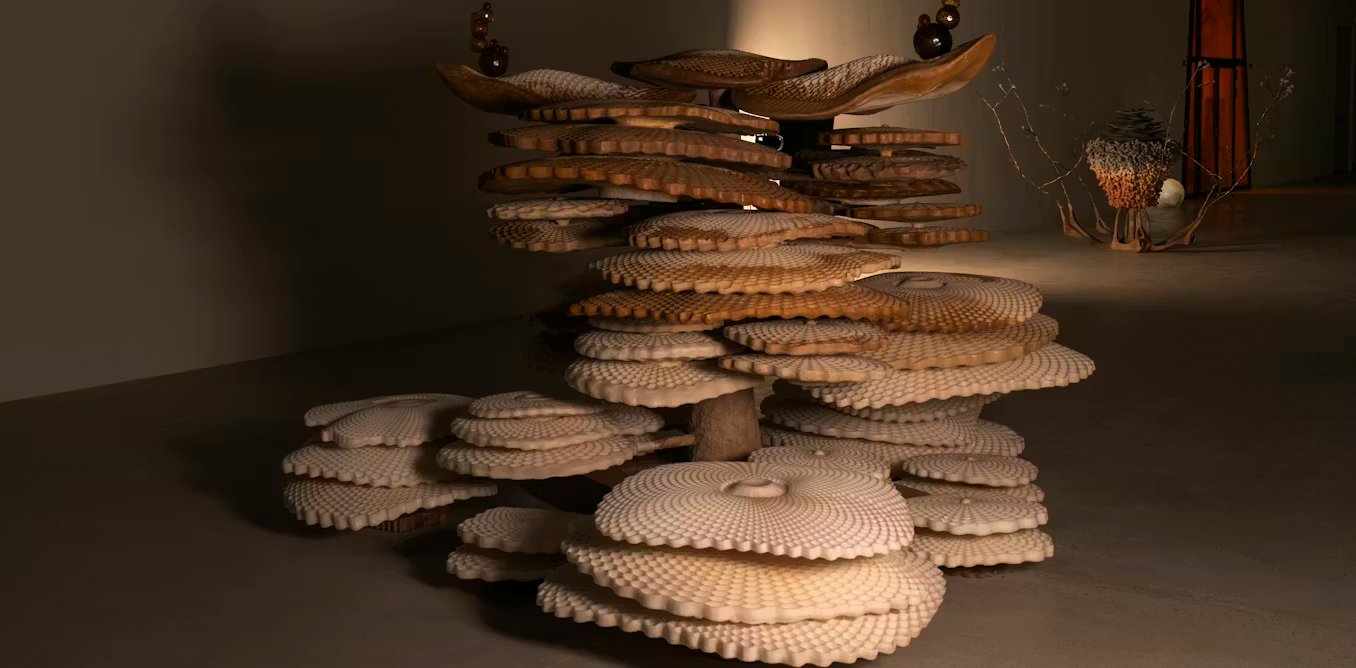
Marguerite Humeau is nominated for Orisons (2023), originally produced for the Black Cube Nomadic Art Museum, and for her subsequent exhibition Torches at ARKEN Museum in Denmark. Her contribution to the shortlist brings an overtly speculative dimension into dialogue with sculpture.
Humeau’s work often begins with research into non-human intelligence and biological communication systems. In Orisons, a large-scale sculptural elephant emerges as a central figure. However, it is not as an image of wildlife, but a stand-in for matriarchal knowledge and collective memory. Elsewhere in her practice, attention shifts dramatically in scale, from insects and wasps to ecosystems that exceed human comprehension.
The jury highlighted Humeau’s “cinematic” approach, and this is apt. Her installations are immersive, carefully lit and choreographed, producing a sense of narrative without storyline. Yet the work resists being pinned down. Instead, sculpture becomes a speculative tool for imagining belief systems that sit outside rationality: an attempt to materialise what cannot be directly known, only inferred.
Kira Freije: softness, armour and the human figure
Kira Freije is nominated for Unspeak the Chorus, her exhibition at the Hepworth Wakefield in Yorkshire. Her sculptures take the form of life-size hybrid beings – part animal, part human, part automaton – constructed from fabric, metal and aluminium casts taken from her body and the faces of people close to her.
Freije’s work consistently plays hardness against softness. Industrial materials such as aluminium are used not for rigidity, but for their capacity to receive impressions through casting. The results are surfaces that appear armoured yet vulnerable. Faces emerge as partial traces, embedded within bodies that refuse stable identity categories.
These figures don’t dominate space so much as inhabit it uneasily. Suspended between animation and stillness, they suggest forms of collectivity that are fragile, negotiated and embodied. The jury noted her transformation of everyday and industrial materials, but it is the emotional economy of the work – its careful calibration of exposure and defence – that gives it weight.
Tanoa Sasraku: sculpture and petro-politics
Tanoa Sasraku completes the shortlist with Morale Patch, exhibited at the ICA in 2025. Her work looks at oil as a system of power, examining how petro-politics shapes corporate identity, military culture and national symbolism.
In Morale Patch, Sasraku disrupts minimalist sculptural grids by inserting objects laden with meaning: paperweights awarded to mark milestones in oil extraction, flags mounted on crates that evoke pallets or coffins, and repeated references to military terminology. The title points to the symbolic language used to maintain cohesion within structures of extraction and violence.
Sasraku juxtaposes American and Scottish flags, drawing attention to unexpected national entanglements within global energy systems. Sculpture here operates as a critical inventory, cataloguing how abstract economic forces find expression in objects designed to reassure, reward or commemorate.
Sculpture and the institutions that shape it
This year’s prize arrives at a moment when sculpture, funding structures and art education are becoming unusually entangled. For the first time, the prize will be hosted within a university setting, Middlesbrough Institute of Modern Art (known as MIMA, part of Teesside University). The Turner prize is run by Tate, an Arts Council England (ACE) National Portfolio Organisation (NPO) – as is MIMA. This means that ACE funds a national prize presented in an ACE-funded space, which also functions as a teaching and research environment.
In recent years, there have been clear connections between funding and nomination with some shortlisted artists holding NPO status. This is a pattern that my research has identified as part of the wider instrumentalisation of British art funding.
Then there are the concerns raised by the Independent Review of Arts Council England’s critical assessment of ACE’s increasing institutionalisation and its sidelining of artistic quality.
Together, these issues raise questions about how closely programming, funding frameworks and art education may begin to mirror one another. Universities, some of which are NPOs or host NPO-adjacent arts centres (as we do at the University of Lincoln), risk reproducing rather than challenging dominant artistic norms.
Yet this year’s shortlist complicates that concern. It’s notably strong on artistic grounds, driven less by identity-led rationales than by a renewed commitment to sculpture as a way of thinking about power, ecology and belief.
Marguerite Humeau stands out as a possible winner. Her work exemplifies a post-postmodern sensibility shaped by new materialist thought: sculpture no longer represents the world so much as participates in it, modelling forms of non-human intelligence and agency through matter itself.
Humeau’s ability to combine speculative research with rigorous fabrication gives her work both intellectual ambition and genuine aesthetic appeal. These are qualities that suggest the Turner Prize, for all its institutional entanglements, still has the capacity to reward artistic excellence.
An exhibition of the shortlisted work will open at Middlesbrough Institute of Modern Art (MIMA) on September 26 2026.
