


Others before him surely strained technique and taste, like the Impressionists and their loose, exuberant brushwork daring to subvert historical realism. But it was Duchamp who sent shockwaves well beyond the art world’s hermetic realm, the first who made everyone say: What the hell is this?
Marcel Duchamp, L to R: “Paradise (Adam and Eve), 1910-1911; “The Chess Game,” 1910; “Portrait of Dr. Dumouchel,” 1910, at The Museum of Modern Art’s “Marcel Duchamp,” through August 22.Jonathan Dorado © The Museum of Modern Art, New York
It feels like we’ve been been saying it ever since. Duchamp is coded deep in the cultural DNA of the 20th and 21st century, from Surrealism, to Pop, to Conceptual Art, all the way through popular culture. Any reference to inscrutable head-scratching contemporary art in any movie or TV show is mostly his fault. Any attempt at satire? His too. Artists, meanwhile, will never get over him. Andy Warhol’s famous framing of corporate logos, which he then presented as art? Duchamp did it first. Repurposing scavenged everyday objects? Check — with his “readymades,” he invented the form. When Maurizio Cattelan famously duct taped a banana to the wall at the Art Basel fair in 2019 and demanded $100,000 for it, the widespread public outrage felt well-practiced. It was at least part cheeky homage to art’s original renegade clown prince, because it couldn’t not be.
“Marcel Duchamp,” the show, is very much homage to the playful absurdities Duchamp, the artist, levered into the world of serious art. The first major Duchamp show in the U.S. in more than 50 years, it’s a little teacherly; reverential and completist, with its 300-plus pieces, it can feel heavy with duty. It offers a slow, not always compelling march through what feels like every moment of Duchamp’s evolution. He was compulsive, prolific, catalytic, so it takes a while.
Marcel Duchamp, L: “Portrait (Dulcinea),” 1911; R: “Sonata,” 1911. Installed at “Marcel Duchamp,” Museum of Modern Art, until August 22.Murray Whyte/Globe Staff
I loved the establishing shot, a first gallery of Duchamp’s early paintings as he scrambled to keep pace with an advancing turn-of-the-century Parisian avant garde: “Portrait of Dr. Dumouchel,” 1910, with its thick-featured subject embedded in the color-rich gloomy haze looking a lot like a Marc Chagall; “The Bush,” 1910-11, a painting of two nude women with distinct, dare I say, Matisse-ean overtones. In the same room, I learned for the first time that Duchamp made ends meet on moving to Paris as a satirical cartoonist for newspapers and magazines. Ah. And so it begins.
Onward, though not briskly. The show takes great pains to establish Duchamp’s bonafides as a painter and draughtsman. He didn’t just sign urinals and put them in galleries, it seems desperate to say. It’s an important distinction, though I don’t know how many dozen preparatory sketches we need to make that distinction, when a handful of his frankly breathtaking paintings will do.
Marcel Duchamp. Nude Descending a Staircase (No. 2), 1912. Oil on canvas, 57 ⅞ x 35 ⅛ inches (147 x 89.2 cm).Philadelphia Art Museum: The Louise and Walter Arensberg Collection
Case in point: Not a year after his heavy-set figure paintings, Duchamp had shifted in a bracing new direction, trading the heavy materiality of paint itself for bigger ideas about time and movement.
“Portrait (Dulcinea),” 1911, shows up in the next space as a revolution: A mercurial image in soft, warm tones of a woman in various overlapping poses, and in various stages of undress. (The painting, slightly creepily, captures Duchamp’s fantasy vision of a beautiful stranger he saw in passing.) In the gallery, the loose, arhythmic plunk of piano filters through the space, metronome-like, keeping unsteady time. It’s a strategic accompaniment for the ephemerality Duchamp meant to impose on the static realm of picture-making itself.
Marcel Duchamp, “The King and Queen Surrounded by Swift Nudes,” 1912, at the Museum of Modern Art’s “Marcel Duchamp” until Aug. 22.Murray Whyte/Globe Staff
He wasn’t alone on the journey. The New York Armory Show of 1913 was a departure point for American art. A showcase for radical innovations like Cubism, it was the first time a rising European avant garde marshalled by the likes of Pablo Picasso, Georges Braque, and Henri Matisse touched ground stateside. But it was Duchamp that stole the show. His “Nude Descending a Staircase (No 2),” 1912, was a sensation, and a tease to the showmanship that would later define his career.
The title was bait, which the press predictably took. A glass case with more than a dozen mocking editorial cartoons is testament to Duchamp’s gift for attention-getting. But the painting itself remains an irreconcilable visual compulsion, and a monument to an artist unbothered by norms. The painting unfolds, as though in motion, like no other I know. Cascading forms lead the eye from the upper left of the frame to the bottom right. Nothing is distinct — good luck finding a nude, or a staircase — though nor is it abstract. Your eye never gains a firm toehold, but it never stops trying.
Marcel Duchamp, “Pharmacy,” 1914. Installed at the Museum of Modern Art’s “Marcel Duchamp” until August 22.Murray Whyte/Globe Staff
An array of paintings from the same time line the nearby walls, all of them virtuosic experiments in trying to deny painting’s fixed state. Duchamp could have stopped here, producing variations on a theme until the end, and been a Picasso-esque figure of towering influence. Instead, he threw it all away.
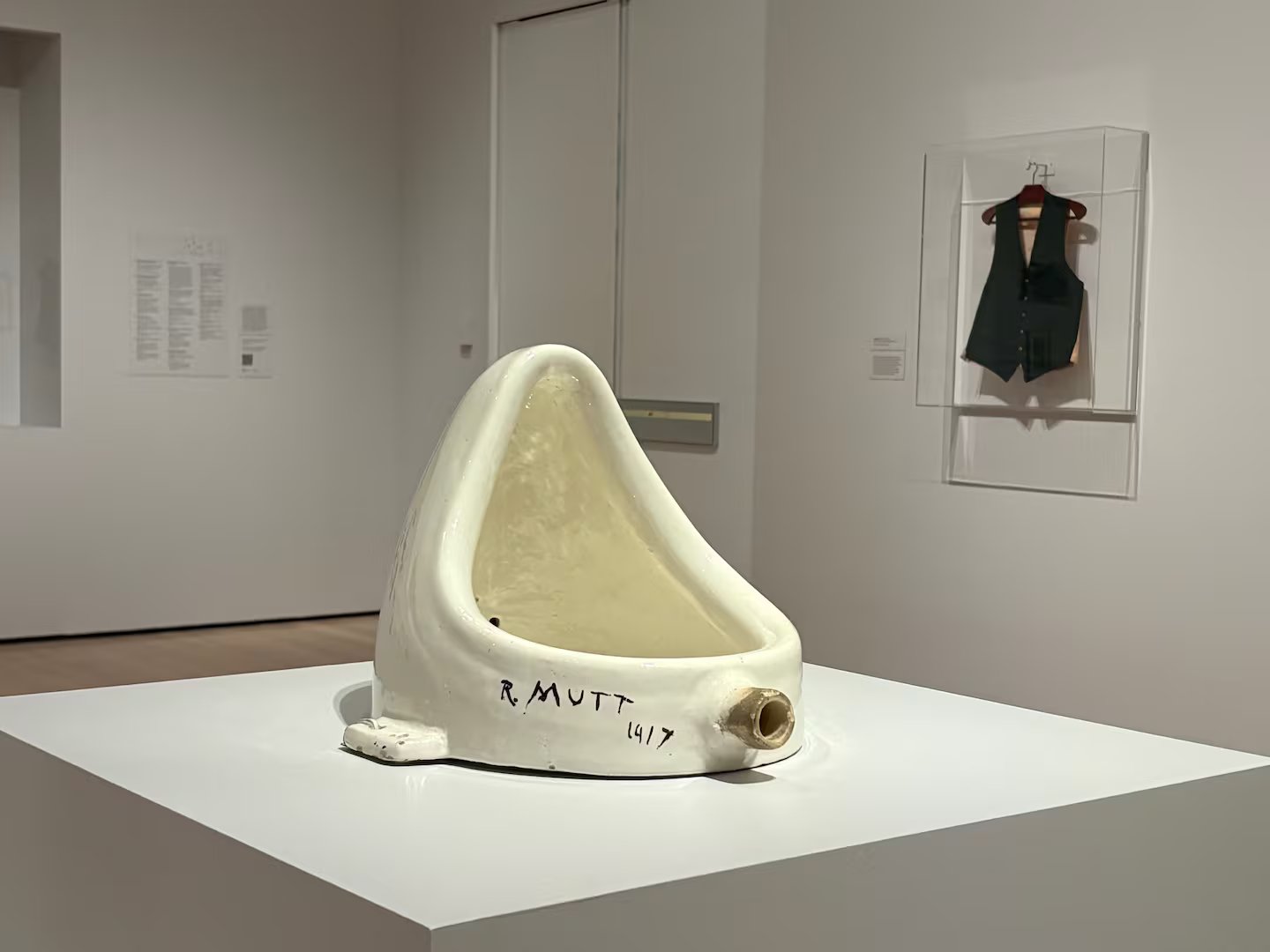
The next gallery here is simultaneously a catalog of early career suicide and a monument to restive genius. It’s filled with his “readymades,” of which “Fountain” is his most famous. It’s also the most fun you can have in an art museum. I’d never heard so many people laugh out loud. Duchamp’s inexhaustible artistic derring-do is still fresh, more than a century on.
Marcel Duchamp, “50cc of Paris Air,” 1919, at the Museum of Modern Art’s “Marcel Duchamp” until Aug. 22.Murray Whyte/Globe Staff
A sampler of favorites: “Pharmacy,” 1914, his very first readymade, a cheap reproduction of an unremarkable landscape painting to which Duchamp reframed and claimed as his own by adding two dots, one red, one green (Appropriation art, a craze rooted in Pop that blossomed in the 1980s, finds it roots here); “50cc of Paris Air,” 1919 a sealed glass pharmaceutical vial remarkable only for its contents (Conceptual art, exhibit A); “Appolinaire, Enameled,” 1916-17, a paint ad on a tin plate customized by Duchamp (Pop Art took note). One piece, “Why Not Sneeze, Rose Sélavy?” from 1921, teases at another departure; a miniature birdcage filled with cubes of white marble, it invokes the artist’s female alter-ego, a proto-performance artist before the term was uttered.
What follows — wooden stools and bottle racks, bicycle wheels and snow shovels (that last one titled “In Advance of the Broken Arm,” 1945), endless ephemera like posters, pamphlets, postcards — are endless variations on a theme, testament to a lively, restless intellect, and genuine fun. One powerful passage reminded me that there was profundity to his absurdist project, too. An array of “Box in a Valise” project, low lit under glass. In his 50s, Duchamp remade all his major works in miniature to be fit and carried in a briefcase — an enduring, portable mini-museum, if no other would have him.
A gallery of “readymades” at the Museum of Modern Art’s “Marcel Duchamp,” until Aug. 22.Murray Whyte/Globe Staff
The decades since have proven otherwise, but most importantly, it all reminded me, in a serious time, that art need not be funereal to be provocative, and challenging norms can be inviting, not confrontational. Duchamp’s key innovation might be that: A trope we might call the irreverent profane. Duchamp maintained high-minded purpose with an open-door policy. He challenged, and then unraveled the sometimes-impenetrable realm of art with puzzlement, surprise, and joy. He embraced curiosity and play at the same time as big ideas about the creative urge. But his big idea is the one that sticks: It’s not the thing itself, but the ideas it whips up, that makes art live. There may be no more lively artist, then, now, or ever.
MARCEL DUCHAMP
Through August 22. Museum of Modern Art, 11 West 53rd St., New York, NY. 212-708-9400,www.moma.org
Murray Whyte can be reached at murray.whyte@globe.com. Follow him @TheMurrayWhyte.
