


Menu
Art
Chinese Literati Painting
900s-Early 1900s
One of the longest-running movements in art history, it combined poetry and painting into a single image. “The very idea of a movement that acknowledged the equivalence of poetry, drawing and calligraphy” is “unique,” says Chika Okeke-Agulu, 59, a professor of art history at Princeton University. The Chinese literati painters’ fusion of text and image inspired artistic movements around the world, from the Japanese Bunjinga painting of the 18th century to the Nsukka School in Nigeria in the 1960s.
mid-900s
“Dongtian Mountain Hall” by Dong Yuan
1690
“Reading Under an Autumnal Tree” by Cheng Sui
Italian Renaissance
1400s-1600s
Western culture’s obsession with the painter as a singular genius comes straight from the Renaissance. While earlier eras prized stained-glass makers and sculptors, the Renaissance saw “the rise of the painter — they [became] famous people,” says the art historian Martin Kemp, 84. In addition to traditional patrons, like the aristocracy and the clergy, a class of newly wealthy merchants and bankers in Italy commissioned artists like Masaccio, Andrea Mantegna and Piero della Francesca to create ambitious paintings that harked back to the aesthetics of ancient Greece and Rome while embracing then-novel techniques and materials like oil paint, canvas and linear perspective.
circa 1427
“The Tribute Money” by Masaccio
1472-74
“The Brera Madonna” by Piero della Francesca
1520-23
“Bacchus and Ariadne” by Titian
Mughal Miniature Painting
Mid-1500s-Mid-1800s
Many artistic movements are defined by their heroic scale. But Mughal painters were distinguished by their “power to make it all so tiny and yet so conceptually, magnificently grand,” says Anne Higonnet, 67, a professor of art history at Barnard College and Columbia University. In the mid-1500s, the Mughals arrived in what is now India from Central Asia. The fusion of Persian Islamic and Hindu traditions created a new and profoundly cosmopolitan form of art. Painted with fine brushes made from squirrel hair, miniature paintings the size of paperbacks combined elegant Persian line work with Indian artists’ vibrant menagerie of animals. Their subjects ranged from the emperor and his court to hunting scenes to stories from Persian and Indian literature.
1590-95
“Krishna Holds Up Mount Govardhan to Shelter the Villagers of Braj,” folio from a Harivamsa (The Legend of Hari [Krishna])
1627-28
“Shah Jahan on a Terrace, Holding a Pendant Set With His Portrait,” by Chitarman, folio from the Shah Jahan Album
17th-Century Dutch Painting
1600s
The Frick Collection in New York’s chief curator, Aimee Ng, 44, describes 17th-century Dutch painting as more of a “bubble” than a movement. But despite its narrow geographic scope, it was deeply influential: Artists, including Johannes Vermeer and Rembrandt van Rijn, created sumptuous portraits and domestic scenes that appeared to glow from within by building up thin, transparent layers of oil paint. Their work was funded by a rising merchant class in Amsterdam and Delft. For the first time, Ng notes, “it [wasn’t] just nobility who could get their portraits painted.”
1624
“The Laughing Cavalier” by Frans Hals
1659
“Self-Portrait” by Rembrandt van Rijn
circa 1665
“Girl With a Pearl Earring” by Johannes Vermeer
French Impressionism
1860s-1880s
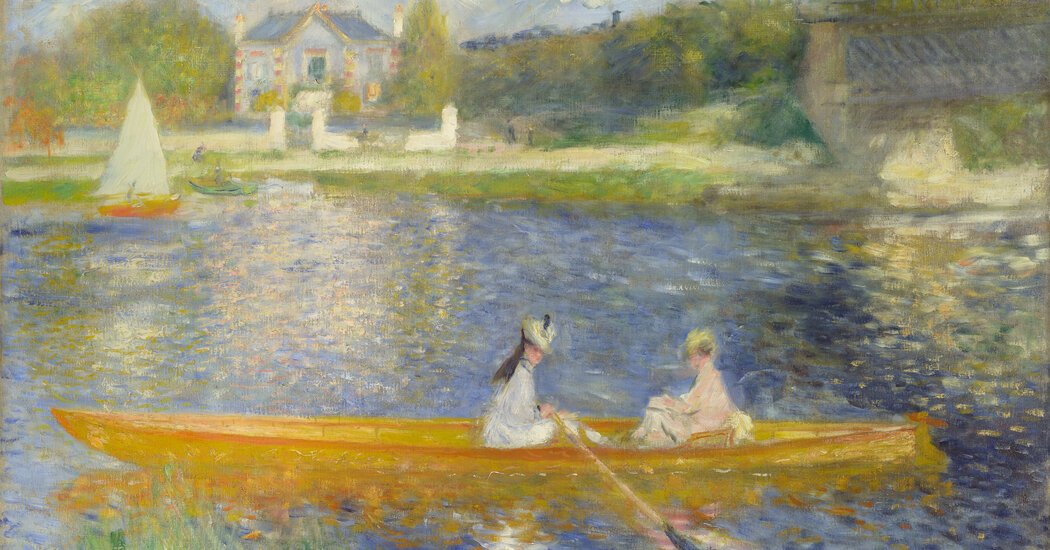
Led by eight original members, including Edgar Degas, Pierre-Auguste Renoir and Berthe Morisot, the Impressionists were rejected by France’s academic institutions for painting “subjects that were of interest to the modern middle class” — domestic scenes, children, streetscapes — says Higonnet. Their brightly colored, sun-dappled style also ruffled feathers. “They were no longer abiding by academic rules about proportion, blending brushstrokes, making volume,” says the art educator and curator Sarah Urist Green, 46.
1872
“The Cradle” by Berthe Morisot
1873-76
“The Ballet Class” by Edgar Degas
1875
“The Skiff” by Pierre-Auguste Renoir
Cubism
1907-1920
The impact of Cubism is inversely proportional to its duration. In unheated Parisian ateliers, Pablo Picasso and Georges Braque developed a style that, in a significant break from tradition, had nothing to do with faithfully representing nature. Instead, they reimagined the world as discrete geometric units and planes. “One might wonder why this revolution in painting lasted for such a short period of time,” says Laura Hoptman, 64, the director of the Drawing Center in New York. “It’s because artists found more direct ways to express dimensionality and movement — through film, for example.”
1910
“The Table (Still Life With Fan)” by Georges Braque
1914
“The Village” by Fernand Léger
1921
“Three Musicians” by Pablo Picasso
Suprematism
1913-34
Some movements are more influential in retrospect — like Suprematism, so named by the Russian artist Kazimir Malevich. Its defining painting is his “Black Square” (1915), which is exactly what the title suggests: a black square on a white background. The artist hung the canvas in the upper corner of a gallery like a Russian icon. The implication was that pure color, form and thought could connect us to something greater; art was no longer about craft, execution or imitation. “It was a bold statement,” Kemp says. “It didn’t stick.” In 1934, Stalin mandated that artists paint in a realistic style that celebrated Soviet life. Nevertheless, the impact of Suprematism, and of the broader Russian avant-garde, was internationally known, as artists in Europe, the United States, Japan, Brazil and elsewhere sought in the 1960s to redefine what a painting could be.
1915
“Black Square” by Kazimir Malevich
1923
“Proun Room” by El Lissitzky
Abstract Expressionism
Early 1940s-Early 1960s
After World War II, a group of artists primarily based in New York made painting more psychologically intense by introducing chance into their craft. Mark Rothko rendered haunting, feathery voids on billboard-size surfaces; Jackson Pollock splashed skeins of paint across canvases laid on the floor. Abstract Expressionism “goes beyond Cubism in saying all that matters is the picture as an entity, an object in itself,” Kemp says. The movement’s gravitational pull was strong enough to relocate the mainstream art world’s energy from Paris to New York.
1950
“One: Number 31, 1950” by Jackson Pollock
1957
“The Seasons” by Lee Krasner
1958
“No. 16 (Red, Brown and Black)” by Mark Rothko
Pop Art
Mid-1950s-Early 1970s
When images are endlessly reproduced on TV and in magazines, how should art respond? Pop Art offered an answer. The British artist Richard Hamilton devised the first definition of the movement in 1957: “Popular (designed for a mass audience), Transient (short-term solution), Expendable (easily forgotten), Low-cost, Mass-produced, Young (aimed at youth), Witty, Sexy, Gimmicky, Glamorous, Big Business.” Although Pop is most famously associated with the United States — chiefly Andy Warhol — artists from Latin America, Asia, Europe and the Middle East also explored the impact of consumer culture in their art.
1956
“Just What Is It That Makes Today’s Homes So Different, So Appealing?” by Richard Hamilton
1964
“Campbell’s Soup Can” by Andy Warhol
Gutai
1954-72
Can art inspire an entire country to challenge authority? That was the aim of Gutai, a radical movement that emerged in Japan after World War II. By using unconventional methods like painting with their feet or ripping through paper, Gutai artists sought to teach “a population that had become so passive that they had followed their leaders into an unjust war to think critically,” says the curator Ming Tiampo, 52, who co-organized the Guggenheim’s 2013 show on Gutai.
1954
“Holes” by Shozo Shimamoto
1958
“Untitled” by Kazuo Shiraga
These interviews have been edited and condensed.
More in Art
American Land Art
Essential Museum Works
Is It Surreal?
Masks
Innovations in Painting
Postwar Art
Conceptual Art Explained
Essential Pottery
Intangible Art
What Is Performance Art?
Notorious Controversies
See the rest of the issue
