


Martha Cooper was a staff photographer for the New York Post in the late 1970s, curious about the big, spray-painted letters increasingly covering the city’s buildings, parks and subway cars.
Cooper had grown up in her father’s camera shop in Baltimore and spent much of her time looking at the world through the other side of a lens. Where others saw vandalism that needed to be scrubbed away, she saw energy and beauty. She befriended a young graffiti writer named Edwin Serrano, known as He3, who brought her into the underground, thus launching a remarkable career documenting street art that’s spanned six decades — and is still going.
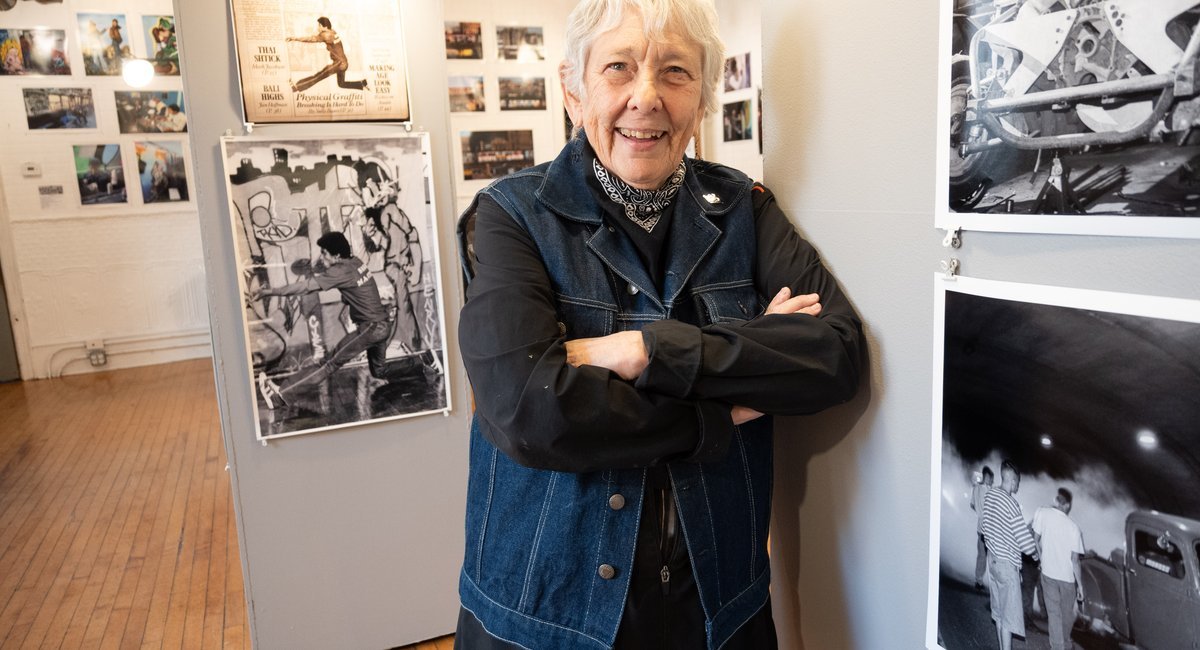
Cooper’s first-ever U.S. retrospective is now on display at the Bronx Documentary Center, until mid-June.
“She’s one of the first photographers to photograph graffiti extensively, has the first known photos of kids breakdancing. She was at the center of a lot of changes in urban culture and was photographing it voraciously,” Bronx Documentary Center Founder Michael Kamber said.
Cooper’s 1984 photo book with Henry Chalfant, “Subway Art,” is widely regarded as the graffiti “bible” and has sold more than a half-million copies. It’s also affectionately known as potentially the “most stolen” art book of all time.
Kamber said he approached Cooper about a retrospective because he saw a certain resonance in staging it in the Bronx, the location of so much of Cooper’s work.
“People thought of the Bronx in that time, or the Lower East Side, as a place to be avoided,” he said. “But this was a place where she was going and seeing people being creative.”
The retrospective, called “Martha Cooper: Streetwise,” also includes Cooper’s photographs of street racing, break dancing, hip-hop, tattoos and illegally built casitas.
In an interview, Cooper said the unifying theme of her work is “art in everyday life.” At 83 years old, she is just as energetic as ever, bouncing around the exhibit on a recent night in a custom jean jacket printed with her name in big block letters. A lightly edited transcript of the conversation follows below.
180th Street Subway platform; Bronx, 1982.
Martha Cooper
Gothamist: Let’s go back to the beginning. How did shooting street art become your specialty?
Martha Cooper: I was working for the New York Post and I was driving around the city every day and I started to do a personal project about kids playing creatively on the Lower East Side. And one of the boys showed me his sketchbook with drawings and explained to me that he was practicing to put his name on a wall.
That was the first time I understood what graffiti was. Before then, I didn’t realize that kids were writing their nicknames. So he said, “I can introduce you to a king.” The king was DONDI. And DONDI was so amazing that I became obsessed with graffiti.
How did you build trust? This kind of art was not legal, it was very much underground, you were older than them. How did you gain entry into their world in such an intimate way?
It was gradual, but one thing was that I always gave back photographs. Photography has always been a part of graffiti writing because the photographs are the proof of what you’ve painted.
I mean, the kids were shooting with, like, cardboard cameras, disposable cameras. I could take better pictures. Because I had better camera equipment. And so basically they trusted me because I did come back and I did give them pictures.
Myles Loftin
Where some people see graffiti as an eyesore that needs to be cleaned up, it seems like you always had a reverence for it.
You know, I was amazed at this art world that these kids had developed, that their parents were kind of unaware of, and how it was dismissed as vandalism, when in fact it was a very carefully planned activity with their own set of aesthetics. About whether paint was dripping or not dripping, or who was a “toy,” and who had can control. That kind of thing.
I just thought it was fascinating, that it was an amazing world.
Did you have the sense early on this would become such a focus of your life’s work?
No, I thought it was gonna disappear and that I would have the record of it. I had a sense that it was historic preservation. And in fact, part of that is true because I have the early record. But the other part is that graffiti’s become a worldwide phenomenon.
How has New York City changed in the decades you’ve been capturing it?
Well it’s cleaned up, but it’s not as interesting to me. For example, I don’t think I could go out and see all this on the Lower East Side of Manhattan. You’re not gonna find that now.
There’s still trains being painted, but I haven’t managed to take pictures of any of them because they get pulled out of service immediately. But I see pictures on my Instagram. They’re out there, but they’re not as common.
TATS Cru with their World Trade Center Mural seen from 207th Street #1 subway line; 2002.
Martha Cooper
There’s a famous picture you took of two police officers standing in a train that’s been totally covered in graffiti.
One of the cops I actually met recently. One is dead. But there was a guy writing a book and he wanted to use that picture because he happened to interview that cop. He lives in Queens and he invited me and the cop over.
There’s a funny video on YouTube of me meeting this cop. And he tells me that the kids, after the book “Subway Art” came out, the kids used to bring it to them in Washington Heights and ask them to sign it. He said we were like rock stars.
Myles Loftin
How have the graffiti styles and forms changed over your time documenting it?
Everything’s changed. The tools have changed, the techniques have changed. At first there were very limited colors. For example, the spray cans, now there’s like infinite numbers of colors and companies producing paint specifically for spray-canned art.
And there’s a much wider appreciation and there’s some incredible artists out there.
Do you feel you’ve had a hand in that more widespread appreciation?
Yeah, I do! And I have no regrets.
“Martha Cooper: Streetwise” is on view from April 9 to June 14 at the Bronx Documentary Center Annex. Admission is free and hours are available online.
