


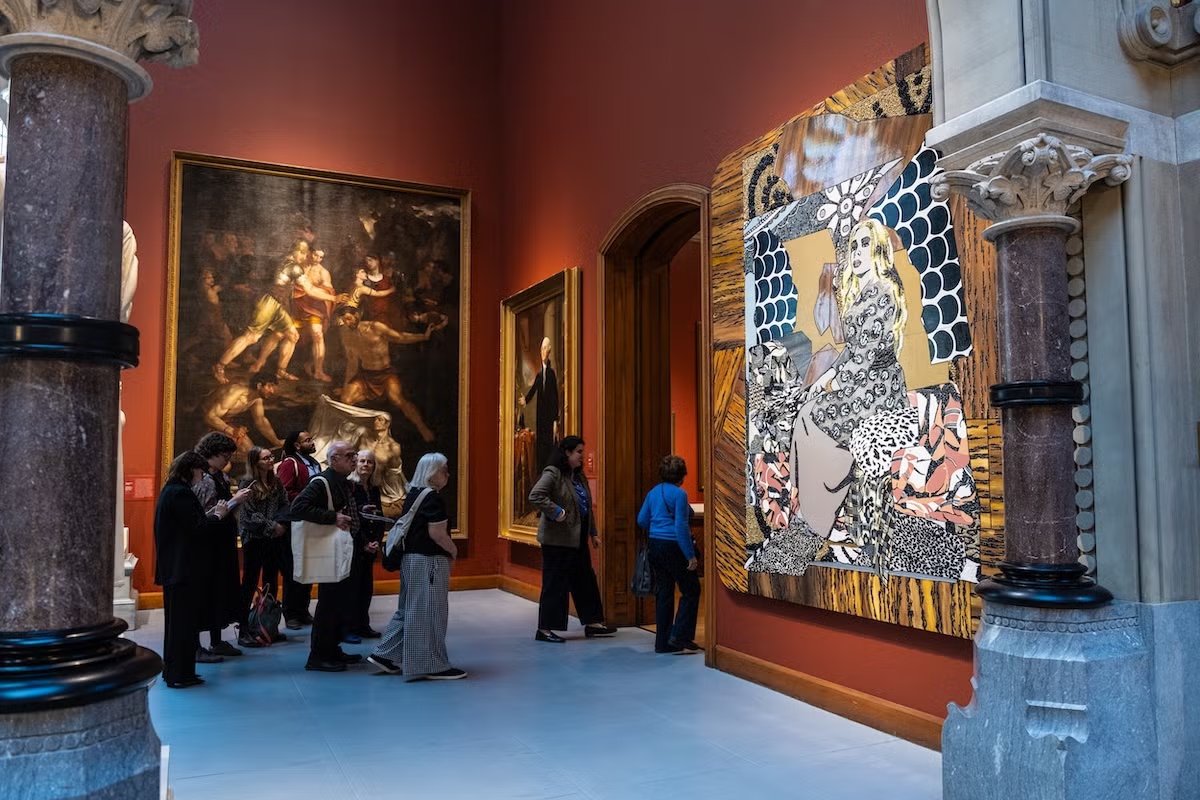
The scope of “A Nation of Artists” spans from 1779, when artist Charles Wilson Peale depicted Gen. George Washington’s victory at Princeton, to 19th century Hudson River School’s impossibly grand American landscapes, to 20th century modernist art of the Southwestern deserts, to a whimsical painting made just a few months ago by Philadelphia artist Kati Gegenheimer depicting her dog Mars romping in the Belmont Plateau in the style of Winslow Homer’s painting “Fox Hunt.”
The impetus for the museums to combine forces came from John Middleton, the controlling owner of the Philadelphia Phillies. With his wife, Leigh, they have one of the finest private collections of American art.
The Middletons loaned many works to the PMA and PAFA to augment their respective collections.
The Middleton collection is particularly strong in Hudson River School paintings, for example, in which neither the PMA nor PAFA is particularly deep. The borrowed paintings give the PMA the opportunity to show how America imbued its landscape with a quasi-spiritual quality and the belief in a “manifest destiny” to occupy and conquer the west.
At PAFA, those sublime views of romanticized wilderness are treated as gateways to examine America’s enduring imagery of the West, including Marsden Hartley’s paintings of New Mexico deserts and an Andy Warhol screenprint of a Buffalo nickel.
“We don’t pretend to have the whole national story, because every museum is unique,” said Kathleen Foster, senior curator of American art at the PMA. “We’re very strong on a local, regional story. We’ve tried as much as we can to open it up to tell a more national story, to include Indigenous voices, to include artists from the South and from the West. But the truth is, there is no museum that is encyclopedic.”
