


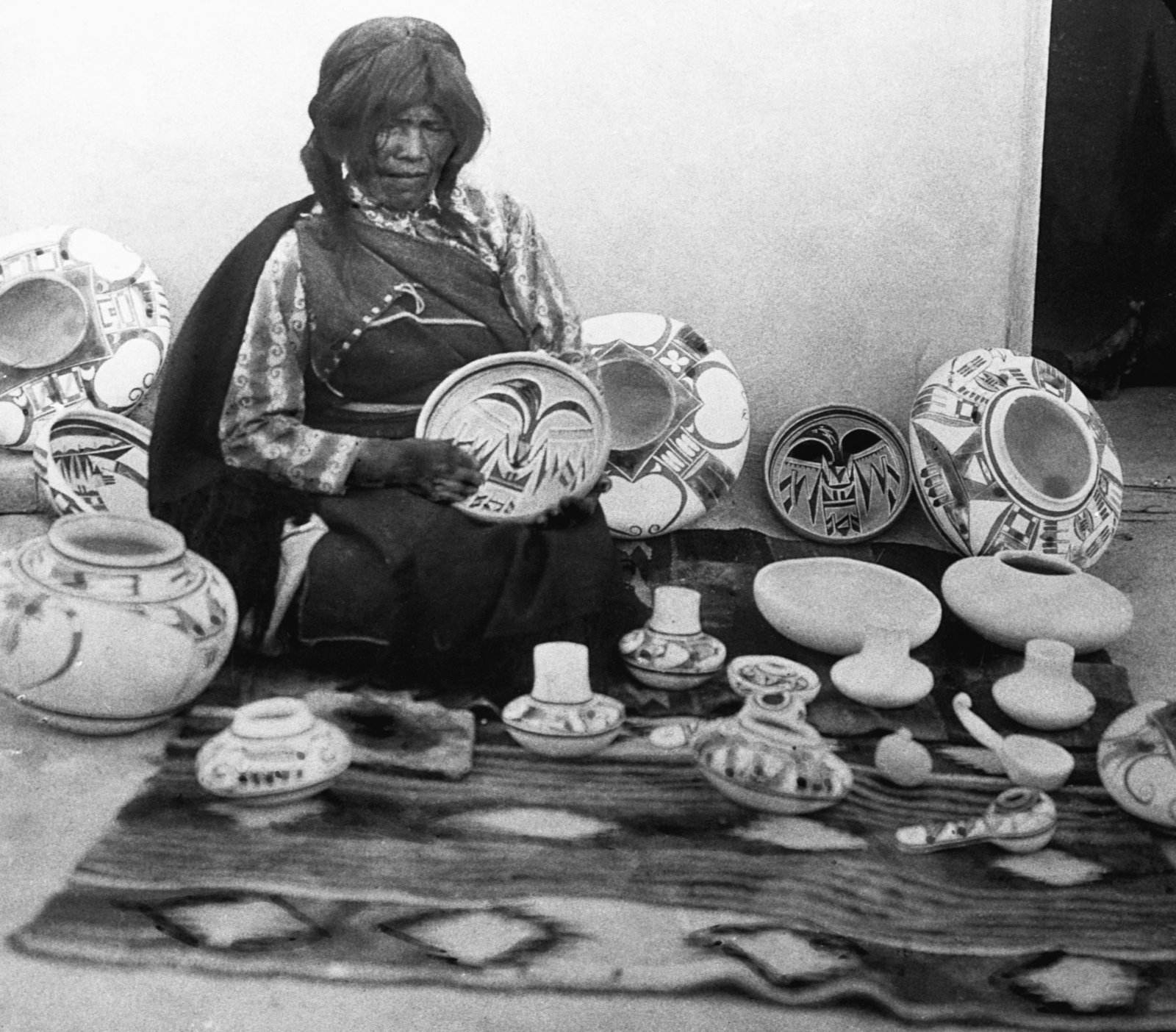
She is called the grande dame of Hopi pottery. In the late 1800s, the artist Nampeyo was one of the major forces behind the Sikyátki Revival, a resurgence in the techniques and designs of centuries-old Hopi polychrome pottery.
“Nampeyo is one of the most important figures in the history of modern ceramics,” said Wendy Nālani E. Ikemoto, vice president and chief curator of the New York Historical, which recently acquired a Nampeyo vessel through a gift. “By adapting this [ancestral] knowledge to new expressions, she transformed Pueblo pottery into a globally recognized modern art form.”
Born in 1859 in the village of Hano, a Tewa village on First Mesa, in modern-day Arizona, Nampeyo (1859–1942) is believed to have learned the art of pottery making from her paternal grandmother. By the 1870s, Nampeyo was selling her works at trading posts throughout the region. When photographer William Henry Jackson visited the Hopi mesa in 1875, he photographed the then 15-year-old Nampeyo.
William Henry Jackson, Nampeyo and her brother Tom Polacca on the rooftop of the Corn clan dwelling at the Hano village (1875). Collection of the Colorado Historical Society.
Over the decades, Nampeyo became the face of Pueblo pottery, a near celebrity figure who created works before audiences at the Grand Canyon and held exhibitions at fairs in Chicago. She even appeared on postcards.
Today, her pieces—which blend both ancient motifs and personal innovations—continue to be prized among collectors of Pueblo pottery. In 2010, one of Nampeyo’s polychrome jars achieved a new record for Nampeyo when it sold at Bonham’s San Francisco for $350,000, according to the Artnet Price Database.
Beyond specialist circles, however, Nampeyo’s name has remained largely unknown—though this may now slowly be changing. In 2019, “Hearts of Our People: Native Women Artists,” a traveling exhibition that originated at the Minneapolis Institute of Art, prominently featured her works. More recently, the De Young Museum in San Francisco presented “Nampeyo and the Sikyátki Revival.” This exhibition—co-organized by Bobby Silas, a contemporary Hopi potter, and Hillary C. Olcott, associate curator of the arts of Africa, Oceania, and the Americas—brought together works by Nampeyo and her Hopi contemporaries, along with earlier precedents and works by Nampeyo’s daughters.
Nampeyo of Hano, Untitled (late 19th or early 20th century). The New York Historical, Promised gift of Agnes Hsu-Tang and Oscar Tang, The Hsu-Tang Collection
“Nampeyo has influenced a lot of potters today,” said Silas, who is a first-generation potter, during a phone conversation. “Her designs, her pots, and how she made them have inspired many people, including me.”
Meanwhile, the record-setting pot that sold at Bonham’s back in 2010 is now on view at the Metropolitan Museum of Art, a gift to the collection from the Valerie-Charles Diker Fund in 2017.
Nampeyo’s legacy is a complex one, shaped by ancestry, archaeology, and the shifting trade systems of the still-expanding United States as it entered the 20th century. Here’s what you need to know about her.
What Is the Sikyátki Revival?
Nampeyo was born the daughter of a Tewa mother and a Hopi father. The Tewa are a group of Native American Pueblo who migrated from northern New Mexico to Arizona in the 1690s after the Spanish Reconquest. The Tewa lived alongside the Hopi while also having their own language and customs.
Nampeyo’s early ceramics were Zuni-influenced works, known as Polacca Ware, which incorporated a white slip that served as a smooth base for painted designs. These works often have a craquelure surface. Hopi ceramics of the 19th century were often deeply rooted in Zuni tradition, as Hopi ceramic craft had declined by that time, but interaction with Zunis and their ceramic methods fostered renewed attention to the medium.
In 1895, Nampeyo’s work would take a new direction. That year, excavation began on Sikyátki, a prehistoric Hopi village in Arizona, under the leadership of archaeologist and anthropologist Jesse Walter Fewkes of the Smithsonian Institute. Nampeyo’s husband, Lesso, was employed on the site, and there Nampeyo saw firsthand shards of Hopi pots and fragments dating back to the 15th century. These forms became inspirations for Nampeyo.
Nampeyo, Canteen. Photo: Jannelle Weakly. Courtesy Arizona State Museum, the University of Arizona.
During these years, she shifted from making tall, narrow vases to low, wide jars similar to what she saw at the dig, and adapted certain design motifs.
“She was able to hand-build these really difficult forms. She expertly executed the often very complex designs,” said Diane Dittemore, an associate curator of ethnology at the Arizona State Museum. Prized among her works are vessels made with a wide “flying saucer” shape along with her representations of eagle tails. Her inventive works sparked a style known as Sikyátki Revival, which imagined centuries-old motifs and embraced forgotten ceramic techniques.
Among the highlights of the Arizona State Museum collection is a work from the prominent Gila Pueblo collection with a sticker reading “Made by Nampeyo.” “It has a very striking eagle tail design, one of her hallmark motifs, very finely painted. It was repaired in a Native fashion with drilled holes and a leather thong, which makes it especially interesting,” Dittemore explained.
Nampeyo, Square-Rim Jar. Photo: Jannelle Weakly. Courtesy Arizona State Museum, the University of Arizona.
Glenn Adamson, historian and craft scholar, wrote about Nampeyo in his book 2021 Craft: An American History, and is drawn to the tension between the innovative and the ancestral in her work. “Her example suggests that whenever we encounter something ’traditional’ we should enquire further,” Adamson wrote in an email. “Usually, what we’ll find is something much more complex, conscious, and compelling than a story of static preservation.”
Silas, who first learned about Hopi ceramics as a teenager, is among a generation of artists who are building from Nampeyo’s legacy. Seeking his own visual language, he looked to the past. “I ended up doing what Nampeyo did: going back and looking at old pottery designs, researching them, and incorporating them into my own style,” he explained. “I visited ruins often. There’s pottery everywhere, and you see all these beautiful designs. I would take photos, save them, and create a design book based on those.”
New information about these traditions continues to come to light. “Prehistoric Hopi pottery used coal firing, and that fascinated me. I devoted myself to reviving that method so Hopi people could learn about it—because many believe sheep manure is traditional, when it’s actually a European influence,” Silas said.
A ceramic work by Bobby Silas. The bird-and-feather motif is particularly symbolic for the artist, representing ancestors’ spirits. Courtesy of the artist.
Commercialization and the Rise of the Railroads
Nampeyo’s artistic success was born of the rapidly changing 19th-century American nation. The dawn of the railway system, the birth of new East Coast museums, and the cash economy spurred by the California Goldrush all bolstered her career.
Nampeyo was already selling her works through British-born trader Thomas Keam by the late 1870s or early 1880s. Keam helped establish the commercial market for Hopi pottery, setting up a trading post in what is today Keams Canyon, Arizona, and became a major supplier of Indigenous pottery to American museums.
“Sometimes museums were buying directly from traders, asking traders to assemble collections and ship them east on the railroad,” said scholar Kelley Hays-Gilpin, curator of anthropology at the Museum of Northern Arizona. “The Harvard Peabody Museum bought a large collection from Keams in the late 1800s.”
Nampeyo decorating pottery (ca. 1900).
Nampeyo did not know how to write and, in keeping with Hopi traditions, she did not sign her name to her works. “You didn’t want to stick out,” Hays-Gilpin explained, “In Hopi pottery, families work together.” This began to change. “As museums started collecting, they wanted information about who made the work, and the idea of the individual artist became important.”
The expansion of the railroad into the American West fueled another new market for her pottery, too: tourism. The Fred Harvey Company, established in 1876, transformed American hospitality in the West, setting up the first chain restaurants and expanding into hotels and tourist attractions. In 1904, the company opened Hopi House, a structure designed to resemble a traditional Hopi pueblo, which presented Native American art at the Grand Canyon. “The company sponsored Nampeyo and her family to come and demonstrate seasonally,” Hays-Gilpin explained.
These two market forces—traders working for museums and the tourism industry, catering to individuals made her the first Indigenous potter widely recognized by name, though she was far from the only potter creating works for these audiences. “There were other potters supplying traders, supplying the museums, supplying the tourists, but she was the one demonstrating at Grand Canyon,” Hays-Gilpin noted.
Nampeyo also taught her daughters to make ceramics, expanding her enterprise. “The family became full-time craft specialists,” she added. “Their output was huge, but also really high quality, known for her freehand linework and the imagination expressed in her designs and their variations.”
Ceramics offered a valuable route into the cash economy, which was replacing traditions of trade. “People were making pottery on First Mesa for utilitarian use and for exchange at weddings and gifting,” said Hays-Gilpin. “Some people, including Nampeyo, saw an opportunity to make pottery for an outside audience.”
View of a “Queen of Hearts” that features a portrait of “Nampeyo, Famous Hopi Pottery Maker” from a deck of playing cards, 1911. It was published, as part of the “Indians of the Southwest” card deck, by the Kansas City, Missouri-based Fred Harvey Company. Photo by Transcendental Graphics/Getty Images.
Nampeyo’s likeness and name soon became a marketing tool. In the early 1900s, she appeared on Fred Harvey Company postcards and even on a stack of playing cards.
“Fred Harvey Company created little stickers—some just said ‘Hopi Mesas,’ others said ‘Made by Nampeyo, Hopi.’” explained Hays-Gilpin, “At that point her name was well known, and used as a ticket of authenticity, a marketing effort.”
But Nampeyo’s success was more than just a personal triumph. “Nampeyo revived pottery making among Hopi and Hopi-Tewa potters at a time when culture change threatened its survival,” said Dittemore. “She was able to build a foundation that generations of potters, in her family and her broader community, have benefited from, culturally as well as economically. Nampeyo’s role within her community was not limited to that of an artist, either. “Nampeyo’s world was so much more than the pottery she produced, including her many roles as an elder within her family, clan, and community,” Dittemore said.
Intergenerational Legacy
When Nampeyo taught her daughters—Annie Healing, Nellie Douma, and Fannie Nampeyo—to make pottery, she was participating in a long tradition.
“Pottery making among Pueblo people has been and continues to be a family enterprise. Collaborations between generations were very common,” said Dittemore.
While Nampeyo certainly collaborated with her daughters, there is some scholarly debate over whether her husband, Lesso, worked with her as well. “Since pottery is traditionally a woman’s art, it may be that Lesso declined to be publicly known to be a potter as well, or he may not have sought the limelight for other reasons,” said Dittemore.
Adding to the layered nature of her practice, Nampeyo began losing her eyesight in the 1920s, caused by trachoma, which worsened to near blindness later in her life.
Tewa Hopi potter Nampeyo building a kiln. Creator: Edward Sheriff Curtis. Photo by Heritage Art/Heritage Images via Getty Images.
“As her eyesight became compromised, she was unable to do the fine painting,” said Dittemore. “While she continued to form vessels, even into the 1940s, just before her passing, her daughters and then other maybe clan relatives and brothers ended up painting the designs.” One work in the Arizona State Museum collection, records indicate, was even gifted by Nampeyo to Dr. Joshua Miller in exchange for eye treatments.
These intricacies make attribution of her works complicated. Scholars are forced to rely on a variety of attributes. “Works are often attributed with varying degrees of certainty based on limited information,” explained Dittemore.
Even in these gray spaces, Nampeyo’s legacy remains enormous. Glenn Adamson sees the recent resurgent interest in her work as part of a larger reevaluation of craft, and “an instinct to counteract the dehumanizing and even anti-human aspects of contemporary technology, from the frictionless glide of social media to the frightening specter of AI.”
Dittemore, meanwhile, sees this new interest in Nampeyo’s work within a larger interest in overlooked women artists—but hopes people will take the time to dive more deeply into the history of the region. “Artists such as Nampeyo serve as gateways to a whole broad field of Indigenous creativity that for too long was shunted into ‘curiosities’ categories rather than being taken as the fine works that they can represent,” she said. She hopes the new appreciation of Nampeyo may change that.
