


by Jon Gorga
As this year’s MoCCA Festival was drawing to a close on Sunday, those attending were treated to a remarkable window into the inner workings of one of the only segments of the publishing world that has been growing instead of shrinking over the past decade: kid’s comics.
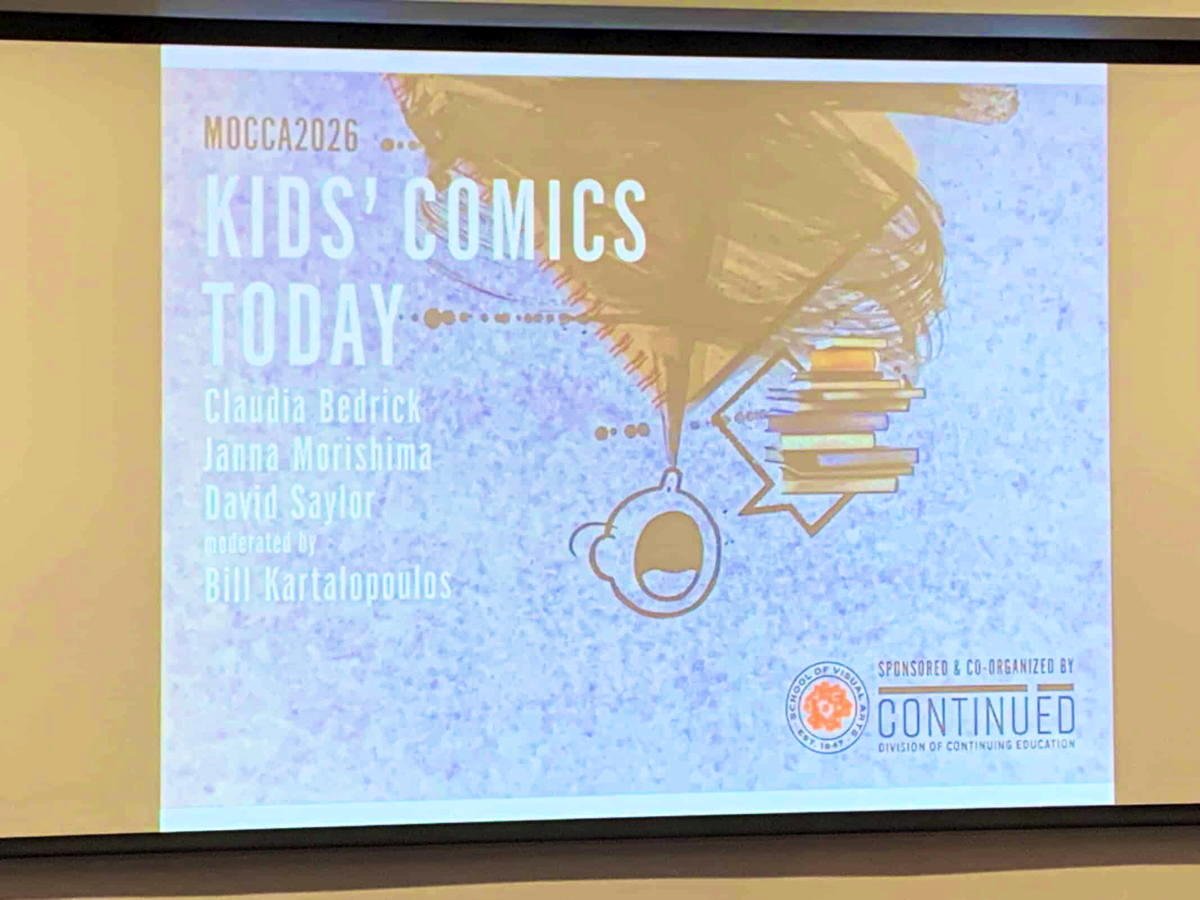
This window came in the form of the “Professional Development: Kids’ Comics Today” panel with publisher, editor, and art director of Enchanted Lion Books Claudia Bedrick, Janna Morishima of Kids’ Comics Unite!, and David Saylor– the Creative Director and Senior Vice-President for Graphix at Scholastic. School of Visual Arts professor and MoCCA’s own Programming Director Bill Kartalopoulos moderated.
Saylor is the founder of the Graphix imprint at Scholastic, the little house responsible for massive sellers like Smile and Dog Man. Saylor and Morishima recalled the genesis of the imprint. When she was his assistant at Scholastic, long before she launched the online creators community Kids’ Comics Unite!, they realized a huge vacuum existed for reprinted comic-books and graphic novels just for children at high quality. The first book under Graphix was a reprint collection of Jeff Smith’s comic-book Bone in late January 2005. As Saylor said, it “broke the mold” and “opened the floodgates” for bookbound novel-length comics aimed at kids.
Saylor said, “I loved comics as a kid. Why did I stop reading them? And I realized it was that there wasn’t anything for me at a certain point.” “Comic makers like DC and Marvel kind of abandoned kids.” So Graphix was born, the industry moved with them, and now graphic novels make up a full 25 percent of book sales to tweens. Kartalopoulos summed it up well by projecting a photo of a typical bookstore’s kids’ shelves and saying, it’s “a very robust category of publishing today.”
Live sketches by Ellen Stedfeld.
Kartalopoulos started some debate by sharing that he was a judge at the Bologna Children’s Book Fair in 2023 and a judge from another country noticed that the kids’ comics submitted from America all looked very similar, as if stylistically in a “narrow box.”
All four then openly analyzed the merits of mainstream taste and the perceptions that come with it. Saylor passionately said, “I get to work with these amazing writers and artists” as he and Morishima both stressed that there’s space for nuanced, layered work in popular material. Even among the titles aimed at children from a large publisher like Scholastic.
Bedrick added that the massive traditional publisher “Chronicle did make us an offer”– at one time looking to purchase Enchanted Lion Books. “That’s not the fate or future I want for Enchanted Lion,” implying it would almost certainly have made it much harder to publish category-defying titles like those in their Unruly imprint. These are actually fully an out-of-their-category experiment for Enchanted Lion, as they are specifically referred to as “adult-centered.” This is the kind of risk publishers must weigh when they consider work that steps out of the mainstream.
They all agreed that it is a shame the American book publishing world is one of the few among wealthy countries to have nearly zero government subsidies for the arts, making it an industry with inherent risk. Bedrick made this difference concrete for the audience when she revealed that there’s a guaranteed sale of thousands and thousands of copies when a Norwegian publisher publishes the work of a Norwegian creator but Enchanted Lion has no such guarantee in the USA when publishing the very same book in translation here.
During the question and answer period, an audience member asked what advice they could offer a young queer aspiring comics writer when, as the entire panel agreed, there’s too much censorship (primarily aimed at narratives including non-white or non-straight characters) in libraries and schools in America currently.
Morishima pointed out that all creators must hope for ever more diversity both in the types of graphic novels being made and for more freedom in the kinds of stories they feel confident telling. She said, “one of my dreams is that more American publishing people travel!” and reminded the audience that a large part of why Japanese and European comics can appeal to so many people is that they didn’t experience the crushing self-censorship American comic-books did after the 1954 Senate Subcommittee on Juvenile Delinquency.
Saylor expressed that hearing so many stories about teachers and librarians undergoing hardships as severe as losing their jobs when found to be sharing certain graphic novels is “heart-breaking.” He recommends standing strong. “I would ignore it,” he said. “Follow your passion and don’t listen to it.”
Like this:
Loading…
