


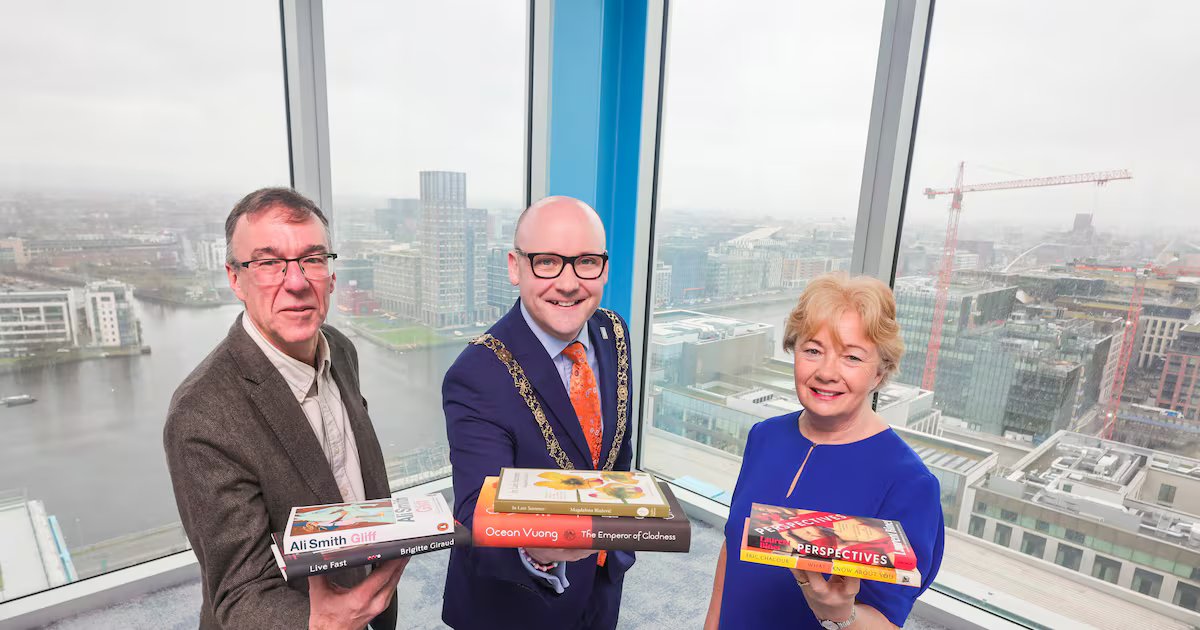
Novels translated from French make up half the six-strong shortlist for this year’s Dublin Literary Award, sponsored by Dublin City Council, which is worth €100,000 to the winner.
The shortlist also features In Late Summer, the debut novel by Croatian Magdalena Blažević, translated by Anđelka Raguž, as well as Gliff by award-winning Scottish author Ali Smith and The Emperor of Gladness by Vietnamese-American writer Ocean Vuong.
“The 2026 shortlist for the Dublin Literary Award stands as a celebration of the finest qualities of literature at its most international, most ambitious, and most humane,” the Lord Mayor of Dublin, Councillor Ray McAdam, the prize’s patron, said. “That four of the shortlisted works are translations is especially significant, for it speaks to the award’s enduring belief that great writing belongs not to one nation or one language, but to the world.
“Representing Bosnia, Canada, France, the United Kingdom, and the United States, these extraordinary books confront universal themes of grief, war, dystopian fear, unexpected friendship, and historical intrigue with brilliance, depth, and emotional power. In Dublin, a Unesco City of Literature, we are proud to champion an award that continues to recognise writing of the highest distinction and global significance.”
The Dublin Literary Award is the world’s most valuable annual prize for a single work of fiction published in English, worth €100,000 to the winner or, if the book has been translated, the author receives €75,000 and the translator receives €25,000. Unique among literary prizes, nominations are submitted by librarians and readers from a network of libraries around the world.
As well as non-voting chairman Prof Chris Morash of Trinity College Dublin, the judges are award-winning novelist and film director Xiaolu Guo; Daniel Mulhall, a former Irish diplomat and author; translator Clara Ministral; poet Dike Chukwumerije; and author Disha Bose.
Live Fast by Brigitte Giraud, an autobiographical novel about the death of her husband in a motorcycle crash, won the Prix Goncourt and was translated by Cory Stockwell. The judges said: “For anyone who has ever experienced grief as a sense of ordinary decisions that have been over-taxed with consequence, this will be a novel with powerful resonance.”
Perspective(s) by Laurent Binet, translated by Sam Taylor, is “filled with fun and irony. Binet affirms that the saviour of human life is faith in art and creation”. Binet was awarded the 2010 Prix Goncourt du Premier Roman for his first novel, HHhH, about the assassination of Nazi leader Reinhard Heydrich in 1942.
What I Know About You “is Éric Chacour’s debut novel, which shows him to be a master storyteller with an impressive emotional feel”.
[ Gliff by Ali Smith: Part allegory, part dystopian fiction, altogether thrillingOpens in new window ]
Gliff by Ali Smith, twice a Costa Novel of the Year award-winner, is “a dystopian novel which will seem unsettlingly contemporary to any reader”.
In Late Summer, “related with incredible restraint in a deeply authentic voice, also offers a timeless, universal tale of country life, childhood innocence and the way that everything can be ripped apart in the blink of an eye”.
The Emperor of Gladness is “a delicate web of plots and subplots woven together masterfully by Ocean Vuong”.
[ Did nobody actually read this book before it went to print?: The Emperor of Gladness by Ocean VuongOpens in new window ]
The winner will be announced by the Lord Mayor on May 21st during Dublin City Council’s International Literature Festival Dublin, which runs from May 15th to 24th in Merrion Square Park.
Last year’s winner was The Adversary by Canadian Michael Crummey. The most recent Irish winners were Frank Wynne in 2022 for his translation of The Art of Losing by France’s Alice Zeniter and Anna Burns for Milkman in 2020.
Judges’ citations on the shortlisted titles
Gliff by Ali Smith
Ali Smith’s Gliff is a book about two homeless children who befriend a horse. This seemingly modest plot, however, is the basis for a dystopian novel which will seem unsettlingly contemporary to any reader. As we follow two young siblings trying to survive a bewildering new world, there is a hum of destruction in the background. The data collection, surveillance, societal labelling and otherness are all too familiar to present-day. Like with the names of the protagonists, Briar and Rose, Smith is linguistically playful in this book, often humorous. This adds not only to the sense of foreboding but also to the shift and loss of language in this landscape set in our near future. It is a speculative novel, but accessible to all reading tastes. It nudges the reader to reflect on the future of education, environmental destruction, family and human survival.
In Late Summer by Magdalena Blažević, translated from the Croatian by Anđelka Raguž
Magdalena Blažević’s debut In Late Summer, which might almost be described as a poetry collection in novel form, is a powerful anti-war piece inspired by real-life events and a poignant exploration of the shattering effects of war upon its innocent victims. Set in Bosnia and Herzegovina in the early 1990s, it is a heart-wrenching story in which our 14-year-old narrator Ivana, her family and the entire rural community where they live have their existence upended by the arrival of the conflict and the terrible violence it entails. Related with incredible restraint in a deeply authentic voice, the book also offers a timeless, universal tale of country life, childhood innocence and the way that everything can be ripped apart in the blink of an eye. Thanks to the meticulously crafted translation from Croatian by Anđelka Raguž, the text’s internal rhythms, silences and recurring echoes guarantee a rich, sensual reading experience which affords moments of heightened tension alongside scenes of tranquil beauty that stay with the reader long after finishing this memorable book.
Live Fast by Brigitte Giraud, translated from the French by Cory Stockwell
Brigitte Giraud’s Live Fast is a novel that hinges on the two words that break through the surface of any act of mourning: “If only …” From the outset, we are introduced to the central premise of this highly autobiographical novel: the woman who is narrating the story is telling us how her partner was killed in a motorcycle accident. “If only it had rained.” “If only I had a cell phone.” The random wrong turns spiral outwards in Giraud’s narrative, bringing us back to the protagonists’ childhoods, their love, and their lives together up to the moment of the accident in all of their ordinary, day-to-day detail, each suddenly laden with an almost overwhelming significance. For anyone who has ever experienced grief as a sense of ordinary decisions that have been over-taxed with consequence, this will be a novel with powerful resonance. Cory Stockwell’s translation from French is true to Giraud’s tight, succinct prose in a work of literature in which no gesture is wasted or superfluous.
Perspective(s) by Laurent Binet, translated from the French by Sam Taylor
Laurent Binet’s craftily entitled Perspective(s) is a multi-angled novel that tells a gripping story about art and power in 16th century Florence from a number of different points of view. Its genre is not easy to pin down: at once an epistolary detective novel, an art historian’s sketch book, a counterfactual history of the Renaissance social scene, it is above all a breathlessly engaging murder mystery and a sportive romp through the sometimes lurid intrigues of Florentine society under the reign of Cosimo de’ Medici.
The visual splendour of the narrative mirrors the credo of the time. As Binet writes: ‘Because to see is to think. The viewer must deserve his painting.’ Binet’s prose confidently invites and sustains such scrutiny. Superbly sequenced letters among figures such as Giorgio Vasari, Cosimo de’ Medici, Michelangelo, and Benvenuto Cellini afford us an intimate glimpse into the higher and lower depths of the politics, religion, art and everyday life in the waning years of what we call the Renaissance. Filled with fun and irony, Binet affirms that the saviour of human life is faith in art and creation.
Translator Sam Taylor’s ear is astonishingly well attuned to Binet’s tone; anglophone readers owe much to him for enabling a full experience of this charmingly witty yet also wistful and profound story about what it means to see.
The Emperor of Gladness by Ocean Vuong
A young man perched on a bridge, determined to jump. An old woman’s casual glance through the window of a house trapped in isolation. Ocean Vuong’s The Emperor of Gladness is a story of human intersections, and the extraordinary beauty it hides. Fragile characters, in introspective prose, light a surreal lamp in the reader’s imagination, softly rendering eternal truths about the redemptive power of love, even when held in the hands of the deeply flawed. Hai and Grazina, Vietnamese and Lithuanian, one a recovering addict, the other burdened with dementia and the stubborn memories of a war the teenager cannot know, form the narrative heart of a tale set in East Gladness, Connecticut. It is a tale that shines in spite – or, maybe, because – of the bleakness of its setting. A delicate web of plots and subplots woven together masterfully by Ocean Vuong.
What I Know About You by Éric Chacour, translated from the French by Pablo Strauss
What I Know About You by Éric Chacour is a gem of a novel, set within the Levantine Christian community in Cairo and in multicultural Montreal. The book’s shaping idea is that ‘none of us is ever wholly what society expects us to be’. It explores themes of family, identity, conformity and sexuality through the story of Tarek, a doctor from a prominent family, and his singular relationship with Ali. Their intense affair, which is sensitively explored, crosses boundaries of class, community and religion, and shatters sexual taboos. It upends Tarek’s comfortable existence. The story uses different angles through which to reveal itself – You, Me and Us, fusing the experience of Tarek and his son, Rafik.
This is Chacour’s debut novel, which shows him to be a master storyteller with an impressive emotional feel. The novel’s characters, with their unfamiliar backgrounds, are easy to identify with while the prose, in a translation from French by Pablo Strauss, is consistently exceptional. This engaging saga stretching from the 1960s to the early 2000s unfolds with grace and power. It packs a lot into its 220 highly readable pages.
