


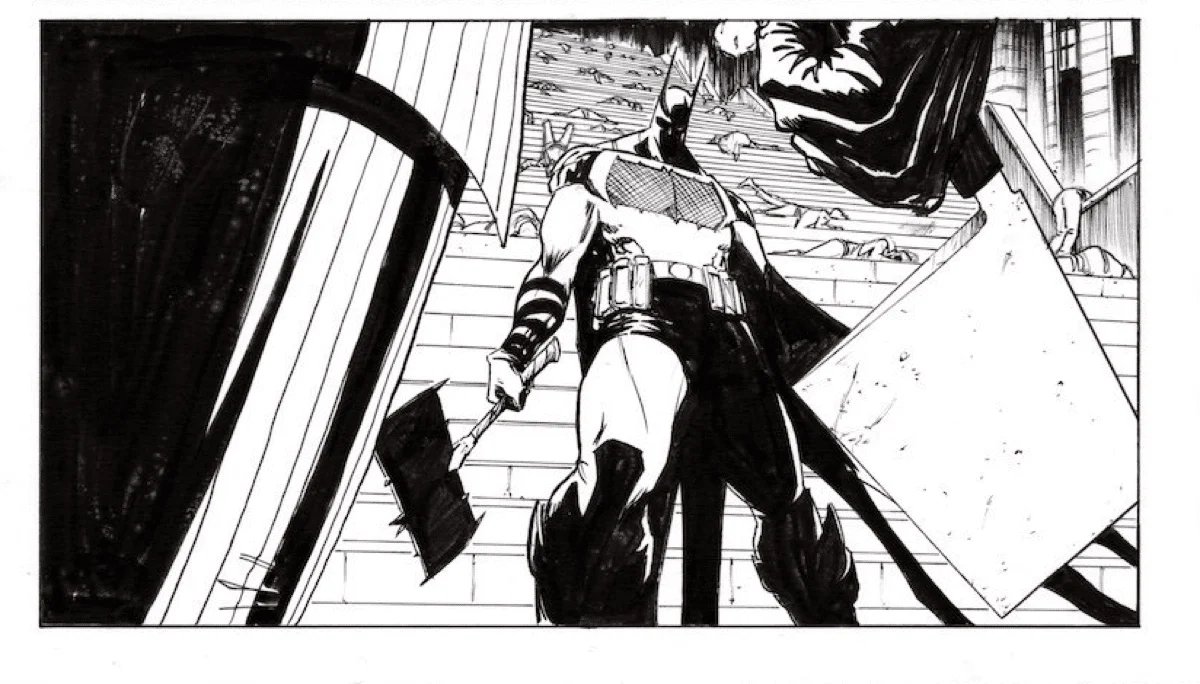
It’s official! Comics artists are hot again!
The news came in a Hollywood Reporter article by Borys Kit entitled With an Assist from ‘Absolute Batman’ and DC, the Comic Artist Superstar Rises Again
The piece profiles Nick Dragotta and Daniel Warren Johnson, certainly two excellent cartoonists worthy of the “superstar” title.
Along the way, Kit drops a few sales tidbits:
Certainly these numbers are something to write home about.
Kit also gives a brief overview of the rise and fall of the Superstar Artist:
For most of the 21st century, comics, despite being a visual field, has been a writer-dominated medium. Even though some artists gained a degree of popularity, it has been authors such as Brian Michael Bendis, Robert Kirkman, Scott Snyder, James Tynion IV and Brian K. Vaughan that have been the stars in the field, rising off a platform built by a previous generation of wordsmiths, names such as Alan Moore and Grant Morrison.
Dragotta, Johnson and a handful of others that include names such as Hayden Sherman, Jorge Jimenez and Peach Momoko, have become among the biggest artist names in the comics industry since the early 1990s, when a group of artists led by Jims Lee, Todd McFarlane and Rob Liefeld quit Marvel Comics and created Image Comics. It was comics’ Beatlemania when those artists made store appearance in places such as L.A.’s Golden Apple. In response, Marvel and DC clamped down on the power of artists and raised the voice of the scribes.
It’s true that back in the day (very back) you picked up comics based on the artist. To give a very brief overview of the matter, as great as he was, Jack Kirby was considered a bit of a journeyman in the 60s, but the arrival of stylish pencil pushers like Neal Adams and Jim Steranko changed all that. The rise of fandom that venerated past creators like the EC Comics gang and Will Eisner made artists the stars of the show, as Bronze age luminaries like Miller, Simonson, Byrne, Pérez, Mike Golden and Art Adams became the hottest commodities.
But the Image founders didn’t just flip the script – they tore it into tine little piece and threw them up in the airing while maniacally laughing. Lee, Liefeld, McFarlane and Silvestri were well along the track of becoming stars in the Neal Adams mold when they decided to go their own way, to tremendous success. Wizard’s Top Ten list fueled the fire and raised the profile of more artists, like Michael Turner and J. Scott Campbell.
And while I wasn’t in the room for the conversation, it is said that during all of this, DC and Marvel decided that they could never let artists take over the game again. And the Age of the Writer began.
Funnily enough, art continued to be an important part of what made comics successful – Bryan Hitch, John Cassaday, Frank Quitely – but the “house style” took over during the Crisis Era. Think back to all those promo pieces for the endless events of the 00s and 10s. Well drawn but generic, with no artistic style standing out. Marvel’s shrinking rates and changing art teams willy nilly certainly haven’t helped.
But while comics sales had been idling in the garage, a fresh fuel has been introduced. Superstar artists! And it’s about time. According to Jim Lee in THR, we’re “getting back to a balance where both artists and writers are driving sales, driving fans,” and the return of superstar artists “is good for the business, it is good for the artform.”
It is also good for the artists, according to THR, Dragotta and Johnson are making not only good page rates, but getting paid to sign things and making a mint from original art sales.
Two days into his marathon signing with Johnson, I ask Dragotta what the biggest change in his life in the wake of the book’s success. He chuckles, and replies candidly: “Money.”
And good for him!
Lee is right. This is a good thing. Comics are a visual medium, and inventive and engaging art is what makes comics great. And creators SHOULD be getting paid what their worth – I’ve run countless grim breakdowns of how little money there is in comics, so the idea of publishing success actually benefiting the creators is stupendous!
Another story came out last week that gives this even more perspective: according to Popverse, at his MegaCon panel, Greg Capullo, another artistic superstar who toiled before the term was fashionable, is thinking about retiring.
One of the chief reasons is his age. While he may not look 64 when you or I run into him at a convention (and get that fistbump), Capullo says that seeing others die even younger, and seeing all the time he could be spending with his wife now, with the luxury of a well-paid career in comics, makes it easier for him to turn down interior comics jobs.
“You look at the clock. I don’t want to bring it all down here, but I’m going to be 64 this month. Jesus Christ, right?” Capullo says. “I’ve seen a lot of people die earlier. I really love my wife, and I’ve spent so much time just sitting at that table working. I want to spend a lot more time with my wife. She’s great.”
A 64 year old man looking back at a successful career and wanting to spend more time with his family – normal stuff, but not in comics! At least not recently. Last year I wrote something about the longevity of comics characters and noted that an American One Piece was unlikely because of the economics involved:
It’s hard to imagine an American cartoonist achieving anything like [One Piece]. The main reason is simple: it just doesn’t pay enough. Comic strip cartoonists were able to continue telling their tales because newspaper strips were wildly popular in their day and wildly profitable. Jim Davis is worth some $800 million today due to the heyday of Garfield and its continued licensing and merchandising. Popular comics strip artists were millionaires or multi millionaires in their day, and sitting down to draw four panels a day is pretty good work to have a crack at that much money. Japan’s most popular mangaka are also well compensated: Oda makes an estimated $23 million a year from his creation. This kind of money allows them to hire assistants and form studios to make turning out such a high volume of work possible. (I won’t get into the sweatshop aspects of this system:it isn’t great, but it’s how the sausage is made.)
There’s just no comparable payout for American comic book creators. I’m not sure what the longest running current comic books are, but Stan Sakai’s Usagi Yojimbo and Erik Larsen’s Savage Dragon spring to mind, and while I doubt either of them are financially struggling, you’re unlikely to see them on the lists of highest paid entertainers any time soon.
A few people making a good living doesn’t change the generally abysmal page rates in the comic industry, but it’s something. Artists getting their flowers – and their paydays – 35 years after Image is a step in the right direction. I’m a little surprised it took 35 years, but that’s comics for ya.
Like this:
Loading…
