


Imagine walking through a high-end shopping mall in Chennai, cocooned from the heat and noise outside, except for the rhythmic shuffling of footsteps on polished marble. You are probably there for a mundane errand—a pair of shoes, a quick bite—but then an interesting photograph hanging on a wall stops you in your tracks and takes you inside the Sundarbans. A mall is usually not a place you expect to encounter a form of art, but now you can—all thanks to the Chennai Photo Biennale’s (CPB) International Photography Open Call. With the open call, the CPB, a nonprofit, is dragging art out of the exclusionary silence of the gallery and into the messy intersections of daily life. It is not merely exhibiting images; it is leading a movement to democratise the visual landscape. And so, you can spot the exhibition at VR Chennai mall near the busiest Thirumangalam-Koyambedu junction, the MRC Nagar park and the Avtar Foundation for the Arts.
The open call made its debut during the CPB’s 2024 edition. It has now become its calendar event. This year saw 9,400 entries from 37 countries, filtered through an eight-member international jury that initially worked anonymously, responding only to the power of the image.
“Photography and its presentation as art in accessible forms has always been at the heart of the Chennai Photo Biennale Foundation,” said Varun Gupta, founding director of the foundation. “Exhibitions across public spaces such as parks, beaches, libraries, heritage sites, train stations, malls and galleries invite wider audiences to encounter photographic art, while fostering awareness of sociocultural, environmental and regional stories through creative expression.”
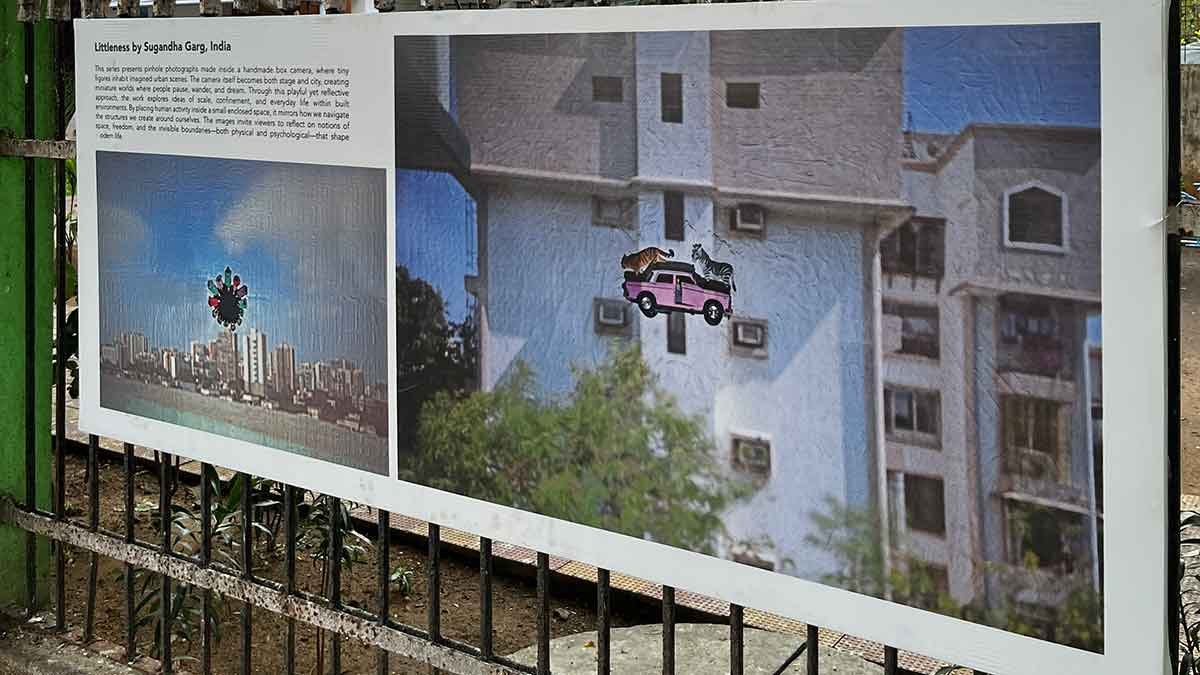
Among the varied works, in theme and form, a debutant like Sugandha Garg presents an intricate miniature world through her handmade box cameras, while an experienced Yash Sharma explores surveillance and anonymity through portraits where faces are obscured or manipulated. “I wanted people to see it. I wanted to see if the work could stand on its own,” said Garg.
Curating such an exhibition can be done only after making a detailed study of the work and the space where it will be showcased. In the mall, where attention is fleeting, the organisers placed a few arresting images that provide an immediate aesthetic jolt. In the quieter reflective environments like the MRC Nagar park and the Avtar Foundation, they placed complex, long-form narratives that require time to sink in. “We made sure we provided something very easy to follow and understand—visually stunning work,” said Ranga Prasad, CPB’s director of exhibitions. “At the end of the day, the public needs to understand the work.”
Gupta and Prasad argue that in a world of synthesised perfection, the value of photography lies in its capacity to witness and grieve. For instance, the work of Swastik Pal, 35, who has spent 17 years behind the lens, stings your imagination. His decade-long project—In the Shadow of the Tiger—documents the disappearing livelihoods of the Sundarbans. “An AI can generate a tiger, but it cannot document the sweat, the mythology of the forest goddess Bonobibi or the visceral reality of a community living on the edge of extinction,” explained Pal.
